
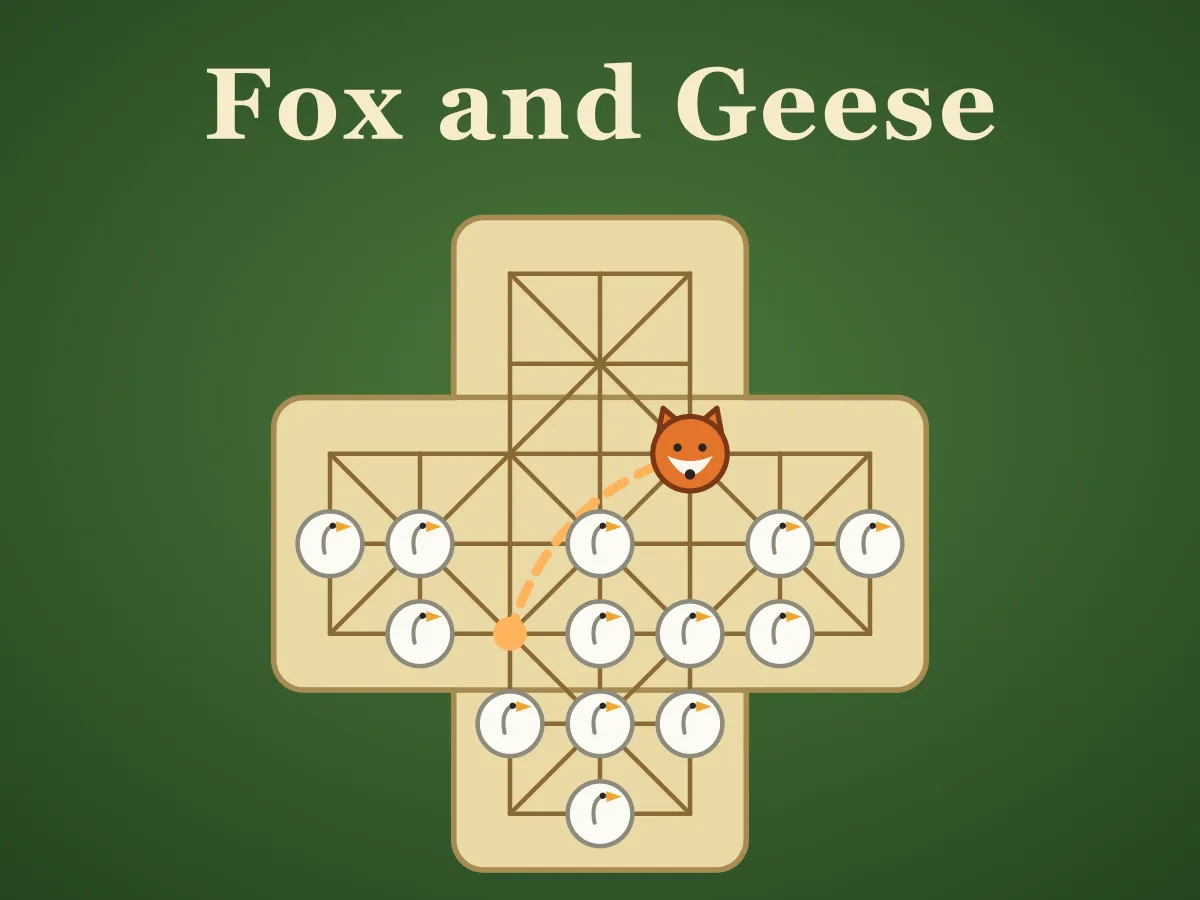




Fox and Geese is a traditional hunt game for two on the 33-point cross-shaped board. One side has a single fox that can jump and capture; the other has a flock of 13 or 17 geese that can only step forward or sideways, and must close in until the fox cannot move. Play either side against the computer, each with its own ladder of eight levels, on boards with and without diagonal lines. Free in your browser, no download, and it works on phones.
How to play Fox and Geese
- Choose a side at the top: Play the geese or Play the fox. The computer takes the other side, and each side has its own ladder of eight levels. The geese always move first.
- The geese move one at a time, one point along a line, forward (up the board) or sideways — never back. Tap a goose, then one of the green dots. Geese never jump and never capture.
- The fox moves one point along any line, or jumps a goose standing next to it when the point straight beyond is empty, taking that goose off the board. After a jump it may jump again from where it lands; tap the next landing, or tap the fox (or Stop here) to end the turn. Jumping is never forced.
- The geese win as soon as the fox has no move. The fox wins by catching the number of geese the level shows (5 of 13, or 7 of 17), when the geese have no move left, or when the geese use up their moves — the counter shows how many they have left — without trapping it.
- Win with a good margin for two or three stars — moves to spare for the geese, geese caught for the fox; the targets are shown beside the board — and each win opens the next level. Using Undo or a Hint counts the win as one star.
Tips
- As the geese, move as a wall. A goose with an empty point behind it on a line the fox can reach is a goose the fox can jump; one with another goose or the edge behind it is safe.
- As the geese, close the middle row first and push forward together. The fox is trapped most easily in the top arm or a corner, so herd it upwards rather than chasing it.
- As the fox, stay in open ground near the middle and wait. Every goose move uses up the flock’s time, and a goose that steps forward alone usually opens a jump.
- As the fox, look for double jumps: two geese with gaps behind them in a line or a corner turn can both go in one turn.
- Diagonal lines help the fox far more than the geese: it gets eight directions to escape and to jump, so on those boards the flock needs more moves or more geese.
FAQ
Is Fox and Geese free to play?
Yes. Fox and Geese is completely free to play online with no download, no account and no in-game purchases.
Does Fox and Geese work on mobile?
Yes. Tap a goose and then a green dot to move it, or, as the fox, tap a green dot to step or jump. The board fills the screen held upright or sideways, and it also plays with a mouse or the keyboard (arrow keys and Enter).
What are the rules of Fox and Geese?
One fox against a flock of geese on a cross-shaped board of 33 points. Both move one point along a line per turn. The fox can also jump a goose next to it onto the empty point beyond, capturing it, and can chain several jumps in one turn. The geese cannot jump or move backwards; they win by surrounding the fox so it cannot move. The fox wins if it catches enough geese that the rest cannot trap it.
Why do the geese have a limited number of moves?
Traditional rules set no limit, so a flock that never closes in could shuffle sideways for ever. Here the geese get a fixed number of moves per level — 50 to 120, shown on the counter — and the fox wins if it is still free when they run out. It keeps games to a few minutes and means the geese must keep making progress.
Does the fox have to jump?
No. Jumping is never compulsory in this version, and after a jump the fox may stop instead of jumping again. Some versions make jumping compulsory; this one does not.
Which side is easier, the fox or the geese?
It depends on the board. We played the computer’s strongest fox against its strongest geese 30 times on each: on the plain board with 13 geese the geese trapped the fox in all 30 games, and on the diagonal board with 17 geese they won 23. On the diagonal board with 13 geese the fox got away in 21 of 30, even when the flock had 120 moves. So each ladder starts on a board that favours your side and ends on one that favours the computer’s.
How strong is the computer?
As the fox it has five strengths — Kit, Rusty, Scamp, Sly and Reynard — and as the geese four: Goslings, Farm Geese, Greylags and Wild Geese. They differ in how many moves ahead they look, from one to six, and in how loosely they pick between moves that look about as good. Each level was measured over 100 games with two stand-ins for you, a casual player looking two or three moves ahead and a strong one looking four. Playing the geese, the strong stand-in won 99 on the first level and 14 on Fox Hill, the casual one 97 and 2; playing the fox, the strong one won 100 and 13, the casual one 94 and 1. Taken together, they never won more on a level than on the one before it.
How are the stars worked out?
Playing the geese, by the moves you still had to spare when the fox was trapped; playing the fox, by the geese you caught. Each level’s targets come from the strong stand-in’s wins there: two stars at its middle winning margin and three at the margin of its 80th-percentile win — and as the fox, at least one goose for two stars and two for three. Any win earns one star, and a win with Undo or a Hint is one star.