
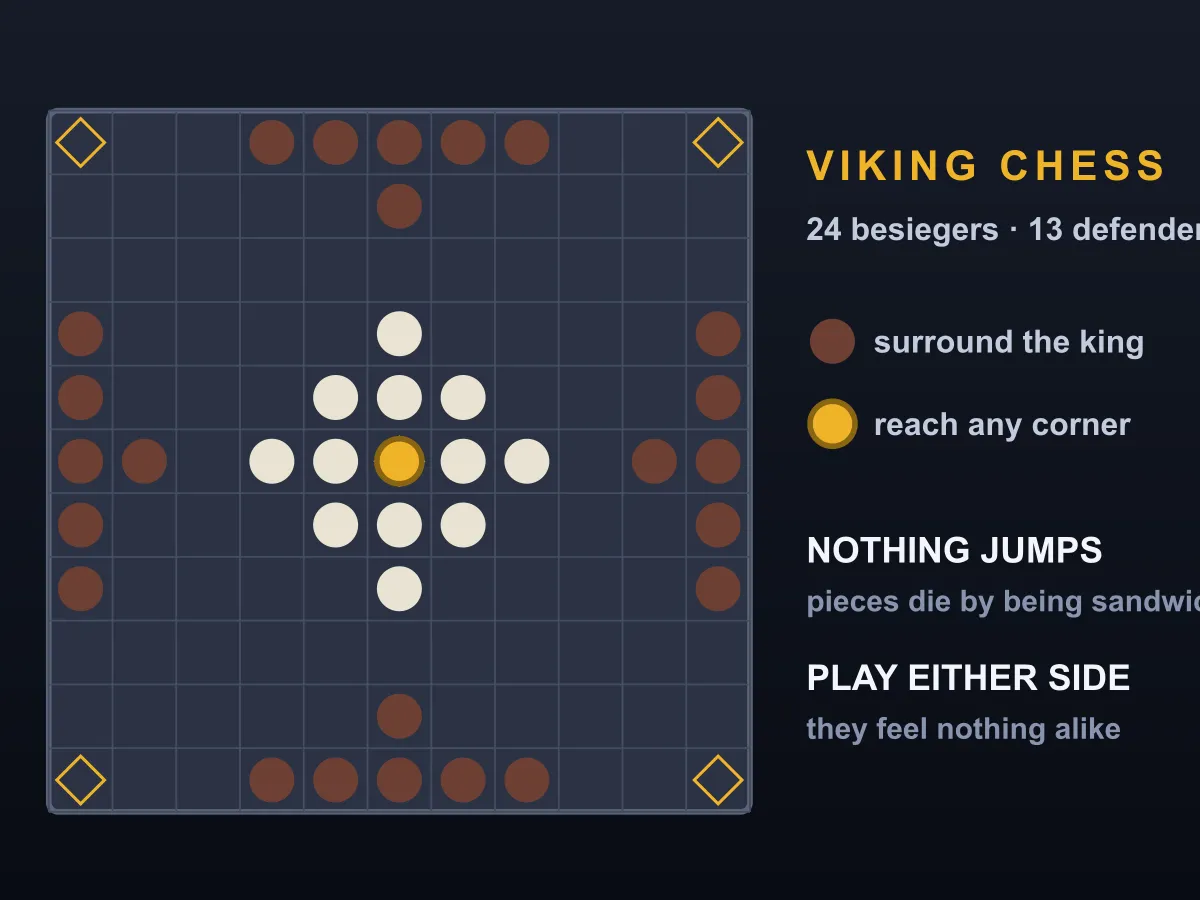




Hnefatafl is a free online version of the Norse "king's table", the board game northern Europe played for eight hundred years before chess arrived. It is the only genuinely lopsided game on this site: twenty-four besiegers ring an eleven-by-eleven board, thirteen defenders sit in a cross at the middle with the king on the throne, and the two sides are not trying to do the same thing at all. The besiegers must surround the king on all four sides. The defenders must walk him off the edge of the world — any corner will do. Everything moves like a rook and nothing jumps. Pieces are not taken by landing on them: a piece dies when an enemy closes a sandwich around it, which means you can walk safely between two enemies and only die if one of them shuts the trap on its own turn. The throne and the four corners belong to the king alone, and all five of them help with captures. This is the Copenhagen shape: corner escape, an armed king, and a king taken by four besiegers — or three and the throne, when he is standing beside it. You can play either side, and they feel nothing alike.
How to play Hnefatafl
- Press Play. Twenty-four dark besiegers ring the board; thirteen pale defenders sit in a cross in the middle with the gold king on the throne.
- Everything moves like a rook — any distance along a rank or a file — and nothing jumps over anything.
- Tap one of your pieces and every square it can reach is dotted. Tap a dot to move there.
- Pieces are taken by sandwiching. Move so that an enemy is between your piece and another of yours, and it comes off the board.
- The sandwich has to be closed by the piece that moves. Walking into a gap between two enemies is perfectly safe — they have to shut the trap on their own turn.
- The four corners and the throne are marked. No ordinary piece may stand on them, and all five count as an enemy for the purposes of a sandwich — a corner alone can take a piece.
- The throne only helps with captures while it is empty, which means it stops helping the moment the king sits back down on it.
- The king cannot be sandwiched. He is taken only by being surrounded on all four sides — or on three, if the fourth is the empty throne.
- Against the edge of the board the king cannot be surrounded at all, which is exactly why the defenders run for the rim.
- The defenders win the instant the king reaches any corner. The besiegers win by taking him, or by leaving the other side with no legal move.
- Use the two chips at the top to swap sides and to change how far the computer looks ahead. Swapping sides starts a new game.
Tips
- As the defenders, open a file before you run. A king three squares from a corner with a besieger in the way is no closer than one in the middle.
- As the besiegers, guard the corners, not the king. Standing between him and the rim wins games; chasing him round the middle does not.
- Count the open corners — the line at the top does it for you. Two open corners is usually already lost for the besiegers, because one move can only block one of them.
- The corners take pieces for free. Pushing an enemy up against one and closing from the other side costs you nothing at all.
- Getting the king off the throne early is good for the defenders twice over: he starts moving, and the throne stops being a piece the besiegers can use.
- Defenders are worth more than besiegers, since there are half as many. Trading one for one is a loss for the king side even though it looks even.
- As the besiegers, build a wall rather than a net. Four pieces on a rank cannot be walked through, and the king cannot jump.
- Watch for a piece that walks between two of yours. It is safe until one of them moves — and moving the wrong one of the two is how a beginner loses material for nothing.
FAQ
Is Hnefatafl free to play?
Yes. It runs free in your browser with no download, no install and no account. Your record is saved on your own device.
What is Hnefatafl?
A Norse board game, sometimes called Viking chess or tafl, played across northern Europe for centuries before chess replaced it. It is asymmetric: one side has twice the pieces, the other has the only piece that matters.
How do you capture?
By sandwiching. Move so an enemy piece is caught between your moving piece and another of yours, or between your piece and a corner or the empty throne, and it is removed.
Can I move between two enemy pieces?
Yes, and you are safe there. The sandwich only works when the *moving* piece closes it, so walking into the gap costs nothing until one of the two moves away and back.
How is the king taken?
By being surrounded on all four sides, or on three sides with the empty throne as the fourth. He cannot be sandwiched like an ordinary piece, and he cannot be surrounded at all while he is on the edge of the board.
Which side is harder?
They are different rather than one being harder. The besiegers have twice the pieces and a much harder goal; the defenders are outnumbered and only have to reach one of four corners. Playing both is the point.
Which rules are these?
Copenhagen-shaped: eleven by eleven, corner escape, an armed king who takes part in captures, and a king taken by four besiegers or three plus the throne. The shieldwall and exit-fort rules of full Copenhagen are not included.
What if neither side can win?
A long stretch with no capture at all is called a draw, and a side with no legal move loses. Both are rare — the board is wide and almost everything can move a long way.