







Home / Board / Mansion Mystery
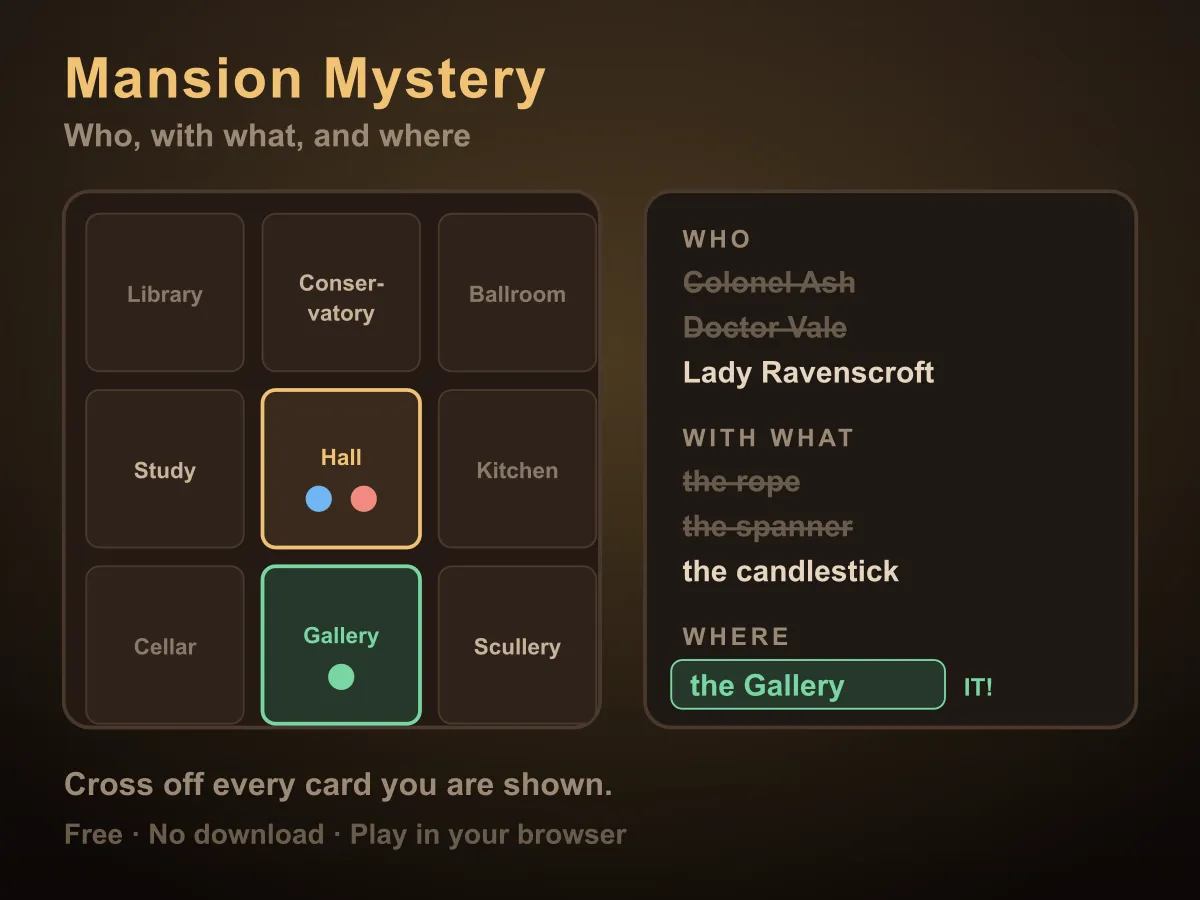
Mansion Mystery is a free online murder mystery deduction game for one player against two computer guests. One suspect, one weapon and one room are set aside face down before anybody sees a card; the other eighteen are dealt six each between the three of you. On your turn you step into a room next door and say who you think did it, with what, in the room you are standing in. The other two are asked in seat order, and the first who holds any of those three cards must show you one. That card is not the answer — it is proof of where the answer is not, and the notebook down the side of the screen crosses it off for you the moment you see it. What makes the game is the suggestion nobody can refute. If neither guest can show you anything, then every card you named that is not in your own hand is in the envelope, and the notebook marks the whole category solved. The two computer guests play by exactly the same rules and the same deductions, and they accuse the moment they are sure, so there is a real race on. Accusing is once only: get it right and the case is yours, get it wrong and the answer is revealed and the evening is over. A computer guest who accuses wrongly is out of the running but stays at the table, still showing cards. The house is a three by three grid with passages joining opposite corners, so nobody is ever stranded in the wrong wing. The mansion, the six guests and the six weapons were all written for this game.
How to play Mansion Mystery
- Press Play. One suspect, one weapon and one room go into the envelope, and the other eighteen cards are dealt six each to you and the two computer guests.
- Your own six cards are listed along the top and already crossed off in the notebook. Nothing in your hand can be the answer.
- On your turn, tap a room next door to walk into it. The four corner rooms also have passages to the opposite corner, which count as next door.
- Then tap one guest and one weapon in the notebook. The room is whichever one you are standing in, so where you walk decides what you get to ask about.
- Press Say it. The two other guests are asked in seat order, and the first who is holding any of the three cards shows you one.
- A card shown to you is crossed off automatically. It proves that card is in somebody's hand, which means it is not in the envelope.
- If neither guest can show you anything, every card you named that is not in your own hand is in the envelope. The notebook marks it green and settles that whole category.
- You also see when the two computer guests deal with each other: the log says whether somebody refuted, but never which card. That is still a clue.
- When the notebook is down to one guest, one weapon and one room, press Accuse, pick all three and confirm.
- An accusation is made once. Right, and the case is yours. Wrong, and the case is over for you and the answer is revealed — a computer guest who accuses wrongly is out but stays at the table showing cards.
Tips
- Name cards you are holding on purpose — the notebook lets you pick them. Putting one of your own weapons into a suggestion means any refutation has to be about the guest or the room, so one question tells you as much as two.
- Walk towards the rooms you have not ruled out. Every suggestion names the room you stand in, so walking badly wastes the question entirely.
- The suggestion nobody can refute is worth ten ordinary ones. It settles a whole category at once, so the moment two of your three candidates look thin, test them together.
- Watch the log when the two computer guests question each other. A suggestion nobody could refute tells you they have just learned something, and that the race is nearly over.
- Count what is left rather than what you have seen. Eighteen cards are in hands; every one you cross off brings the three in the envelope closer to being the only ones left.
- Do not accuse on two out of three. There is no partial credit, and a wrong accusation is the end of your evening rather than a hint.
- Corner passages are quick ways across the house. The Library and the Scullery are next door to each other, and so are the Ballroom and the Cellar.
- If a guest keeps showing you cards, they are holding a lot of one category. Keep asking them about the other two.
FAQ
Is Mansion Mystery free to play?
Yes. It runs free in your browser with no download, no install and no account.
How do I win?
Work out which suspect, which weapon and which room are in the envelope, then accuse. You get all three right or you are out, so the whole game is about being sure before you speak.
What does it mean when nobody can refute my suggestion?
It means neither guest holds any of the three cards you named. Every one of them that is not in your own hand is therefore in the envelope, and the notebook settles that category for you straight away. It is the strongest clue in the game.
Do I have to keep my own notes?
No. The notebook down the side tracks all twenty-one cards: your own hand, every card shown to you, and any card it can prove is in the envelope. You only have to decide what to ask next.
Why can I only move to some rooms?
A guest steps one room at a time through the three by three house. The four corners also have a passage to the opposite corner, so you are never more than a couple of moves from anywhere.
What happens if I accuse and get it wrong?
The case is over for you. In the full parlour rules a wrong accuser keeps showing cards to everyone else, and that is what happens to a computer guest here — but for you the game ends, so the answer is revealed.
How good are the computer guests?
They deduce exactly as you do: they cross off their own cards and everything shown to them, they read an unrefuted suggestion of their own as the answer, and they accuse as soon as one candidate is left in each category. Measured over two hundred cases, a case is decided in about eighteen turns.
Is this the board game I am thinking of?
It is the same kind of deduction, but it is not that game. The house, its nine rooms, the six guests and the six weapons were all written for this one, and none of the names are borrowed.