
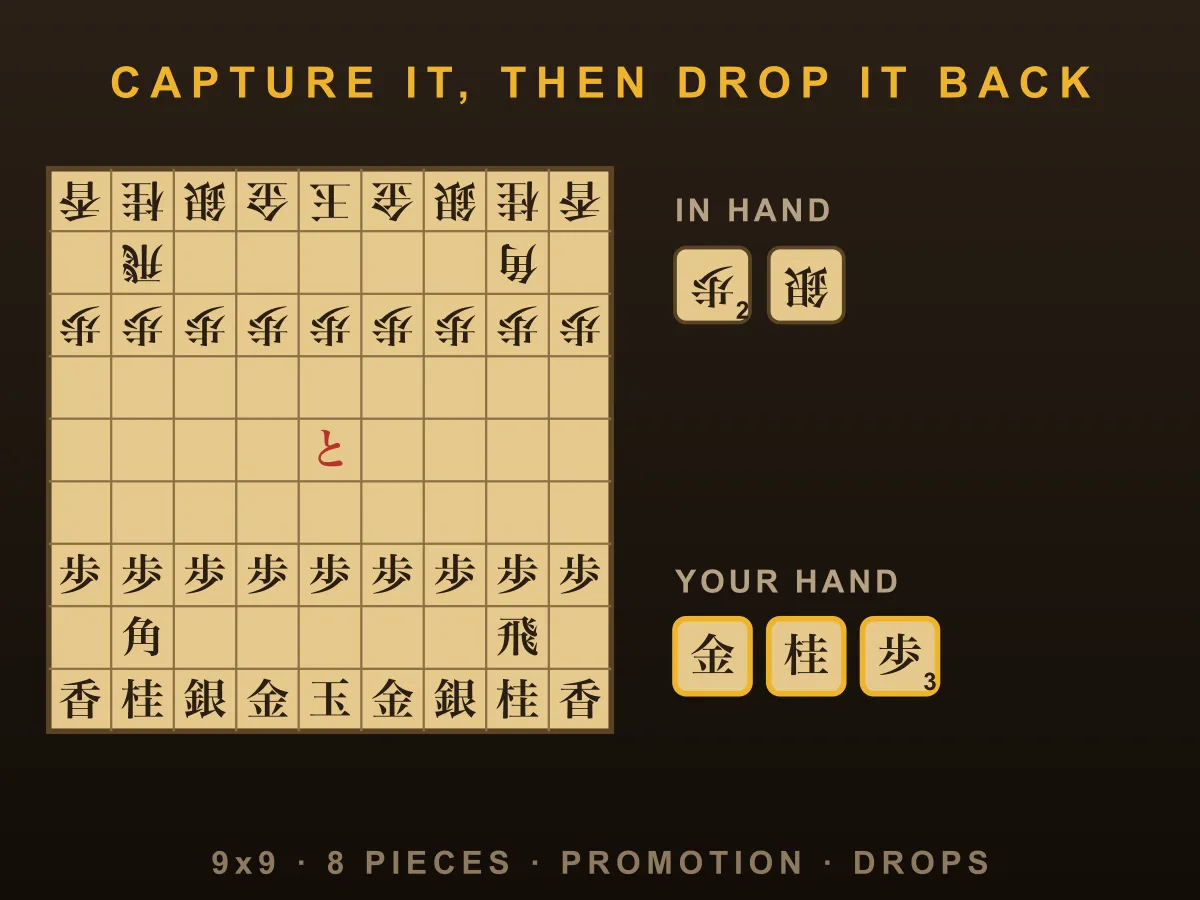



Shogi is a free online version of Japanese chess, played against the computer on a nine-by-nine board with twenty pieces a side. The rule that makes it a different game from Western chess is the drop: a piece you capture joins your hand and can be put back on the board, as your own, as a whole move. Nothing ever leaves the game, so positions get busier rather than emptier as pieces trade, draws are almost unheard of, and a material lead is much harder to convert. Eight kinds of piece — king, rook, bishop, gold and silver generals, knight, lance and pawn — and all but the king and the gold can promote when they move into, out of or within the far three ranks. A promoted rook and bishop keep their slides and gain the king's steps; every promoted minor piece simply moves like a gold. Three rules keep drops honest and all three are enforced here: never two of your unpromoted pawns in one file, nothing dropped where it could never move again, and no pawn dropped to give immediate checkmate — any other piece may. Three computer settings, from a one-move look to a three-move search.
How to play Shogi
- Press Play. You are Black and move first, from the bottom of the board upwards.
- Tap one of your pieces. Every square it can legally move to is marked — a dot on an empty square, a red ring on a piece you would capture.
- Pawns move one square forward. Lances slide any distance forward. Knights jump two forward and one across, and only forward — they cannot move back.
- Silver generals move one square diagonally or straight forward; gold generals move one square any way except diagonally backwards. The king moves one square in any direction.
- Rooks slide along ranks and files, bishops along diagonals, exactly as in chess.
- Capture a piece and it joins your hand. On a later turn you can drop it onto any empty square as your own piece, facing your way — that is a whole move.
- Three restrictions on drops: never two of your unpromoted pawns in one file, nothing dropped where it could never move again, and no pawn dropped to give immediate checkmate. Only moves that obey all three are offered.
- Moving into, out of or within the far three ranks lets most pieces promote, and the game asks you whether to. Declining is sometimes right: an unpromoted silver reaches squares a promoted one cannot.
- A promoted rook or bishop keeps its slide and adds the king's single steps. A promoted silver, knight, lance or pawn simply moves like a gold general.
- A piece that would have no move left must promote — a pawn or lance reaching the last rank, a knight reaching either of the last two.
- Win by checkmating the computer's king. Three settings change how far ahead it looks.
Tips
- Build a castle before you attack. Shogi kings are safest tucked into a corner behind three generals, and the game is long enough for it to be worth the moves.
- A piece in hand is worth more than the same piece on the board, because it can appear anywhere. Trading into a fistful of generals is rarely a bad deal.
- Do not promote your silver automatically. A promoted silver moves like a gold and loses its two backward diagonals, which is exactly how a silver gets out of trouble.
- Pawn drops do most of the work. A pawn dropped in front of an advancing rook costs nothing and stops it dead.
- Watch the nifu rule when you trade pawns. Ending up with two pawns in hand and only one file free is a real constraint on how you attack.
- Knights and lances cannot come back. Pushing one is a commitment, and once it is past the enemy pawns it is usually food.
- Attack with the pieces you have in hand, not the ones on the board. A rook and two generals in hand is a mating attack against almost any castle.
- Count the drops your opponent has when you calculate. A square that is defended twice is not safe if they can drop a gold onto it.
FAQ
Is Shogi free to play?
Yes. It runs free in your browser with no download, no install and no account. Your game record against the computer is saved on your own device.
What is a drop?
A piece you capture becomes yours. On any later turn you can place it on an empty square, facing your way, instead of moving something — and that is your whole move. Nothing ever leaves a game of shogi.
Which pieces can promote?
All of them except the king and the gold general. Promotion is offered when a move starts in, ends in or passes into the far three ranks, and is forced when the piece would otherwise have no move left.
Why can I not drop a pawn there?
One of three rules. You already have an unpromoted pawn in that file; or the square is one the pawn could never move out of; or the drop would be immediate checkmate, which a pawn alone is not allowed to deliver. Any other piece may mate by being dropped.
Should I always promote?
No. A promoted silver moves like a gold, which loses the two backward diagonals a silver uses to retreat. Rooks, bishops, pawns and lances almost always want it; silvers and knights sometimes do not.
How is this different from chess?
Drops, mainly. Material never leaves the board, so there is no simplifying into a quiet endgame, draws are very rare, and an attack can start from a piece that was captured twenty moves earlier.
How strong is the computer?
Three settings: gentle looks one move ahead, steady two, sharp three with a narrowed search. It is a club-level opponent rather than a strong one — shogi's move list runs past 170 in a middlegame, and searching all of it in a browser tab is not an option.
Does it work on a phone?
Yes. The board scales to the screen with a hand above and below it, and every move is two taps — the piece, then the highlighted square.