



Home / Board / Polyomino Cover
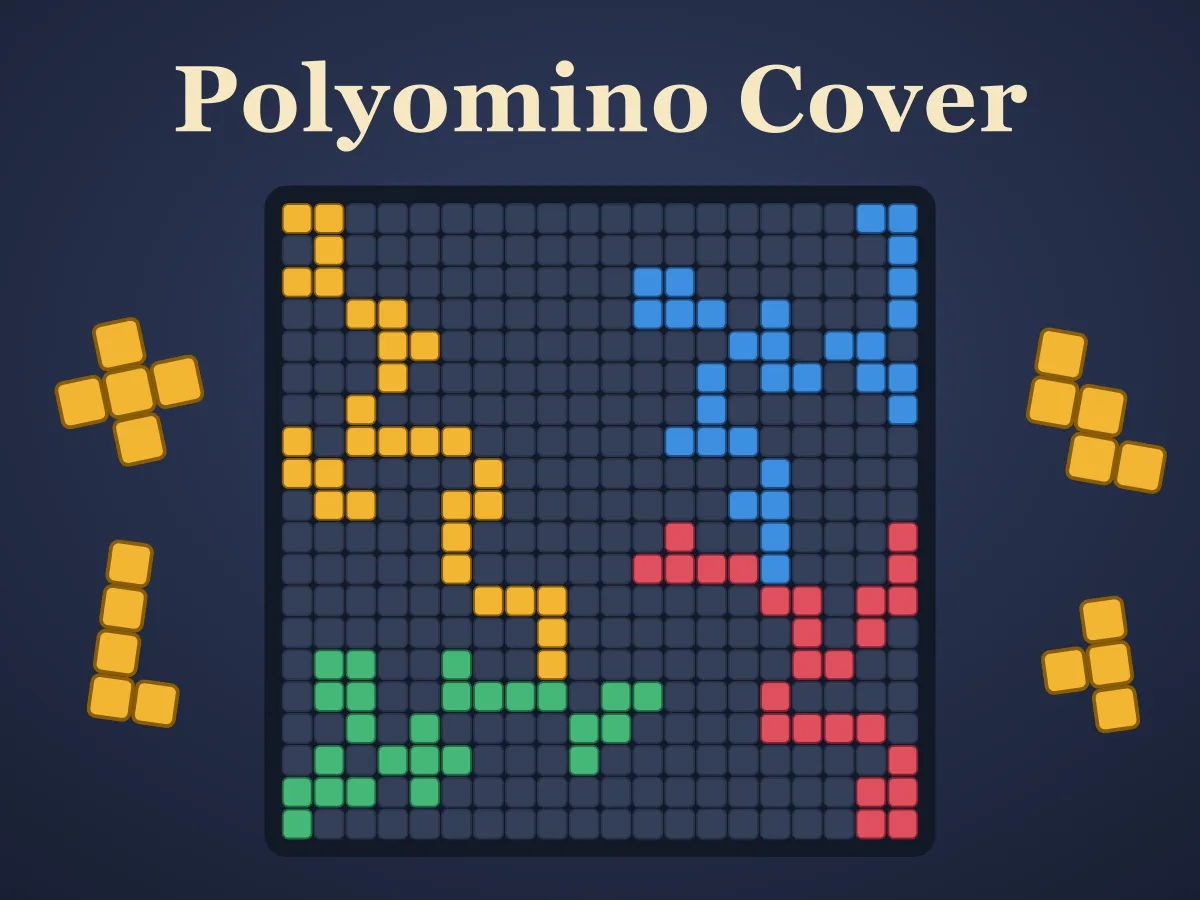
Polyomino Cover is a free online territory board game against the computer, for two players on a 14×14 board or four on a 20×20 board. Everyone owns the same 21 pieces: one of every shape of one to five squares, 89 squares in all. Each new piece must touch one of your own pieces at a corner and may never lie side by side with one of yours, so your colour branches across the board while you squeeze the others out of the gaps they need. A player who cannot lay any piece is out; when everyone is out, the most squares covered wins. Seven tables climb from a beginner who lays its biggest piece anywhere to a master that plays each idea out to the end before it moves. No download, and it works on phones.
How to play Polyomino Cover
- Press Play and pick a table. The first is two players on a 14×14 board against Pip; each table you win opens the next, up to four players on a 20×20 board.
- Everyone has the same 21 pieces: one each of the shapes of one to five squares. Your first piece must cover your start square — the ring in your colour, near the middle of your side at two players and in your corner at four.
- Pick a piece in the tray below the board. With a mouse it follows the pointer and one click lays it; on a phone the first tap shows it and a second tap on it (or Place) lays it, and dragging a finger slides it. Rotate (R) and Flip (F) turn it; clicking the chosen piece again turns it too.
- Every later piece must touch at least one of your own pieces at a corner, and may never share an edge with one of yours. Lying against the other players’ pieces is fine. The bright dots are your corners where the chosen piece fits; a red piece shows a spot that is not allowed, and the line above the board says why.
- A player who cannot lay any piece is out for the rest of the game, and the others play on. When everyone is out, whoever covered the most squares wins.
- Win for one star; finish far enough ahead of the best rival for two or three — the targets are shown above the board. Using Undo or Hint makes the win one star. From the keyboard: Q and E change piece, the arrows move it, Enter lays it.
Tips
- Lay the big five-square pieces first. Late in the game only small gaps are left, and a single square or a domino still fits where the cross never will.
- Head for the middle early. The first colour to reach open ground gets the most corners to grow from, and stands in the way of everyone else.
- Count corners, not just squares: a piece that opens three new corners for you is worth more than one that covers a square more and leaves you one.
- Sit in their corners. A piece laid on a rival’s open corner — touching one of your own at a corner, of course — can shut a whole region of the board to them.
- Keep the single square, the domino and the threes for the end. They fill the last gaps, and in a close game those squares decide it.
- At the four-player tables you only need to beat the leader: block whoever is ahead, and let the others block each other.
FAQ
Is Polyomino Cover free to play?
Yes. Polyomino Cover is completely free to play online with no download, no account and no in-game purchases.
Does Polyomino Cover work on a phone?
Yes. Tap a piece in the tray, then tap the board: the first tap shows the piece there, a second tap on it (or the Place button) lays it, and dragging a finger slides it into place. Tapping the chosen piece in the tray again turns it. Held upright the board sits between the scores and the tray; held sideways the tray moves beside it.
What are the rules for laying a piece?
Your first piece must cover your start square. After that, every piece must touch at least one of your own pieces corner to corner, and none of your pieces may share an edge with another of yours. Pieces never overlap, and touching other players’ pieces along an edge is allowed. Each of the 21 pieces can be laid once, turned and flipped any way you like.
How do you win, and what happens when you cannot move?
When none of your pieces fits anywhere you are out for the rest of the game — the board only fills up, so a player who is stuck stays stuck — and the others carry on. When everyone is out the game ends, and the player who covered the most squares wins. Lay all 21 pieces and you have covered all 89.
Is this the same as the Pentomino Puzzle?
No. The Pentomino Puzzle on this site is a solo packing puzzle: fit the twelve five-square pieces into a box with no gaps. Polyomino Cover is a game against opponents with all 21 pieces of one to five squares, where each piece must meet your own only at the corners and the point is to take more of the board than the others.
Does it matter who moves first?
At two players it does: between two copies of the Builder computer, the player who moved first won 170 of the 288 games that were not tied, about three in five. You choose who moves first at the top of the game, and moving first is the easier setting. At four players it matters much less — over 160 games of four Builders the first seat won 41 and the others 36, 30 and 38 (15 were ties).
How strong are the computer players?
Pip lays its biggest piece anywhere it fits; it beat random play in 175 of 200 games. The Builder scores every placement by its size, the corners it keeps for itself and the corners it takes away from the others; it beat Pip in 171 of 200. Sage plays its six best ideas out to the end of the game three times each and picks the one that ended best; it beat the Builder in 136 of 200. The Master does the same with its sixteen best ideas, eight times each, and beat Sage in 66 of 100.
How hard are the tables?
Measured over 60 games a table with the Builder computer playing your seat, it won 59, 45, 35, 30, 18, 14 and 3 games on tables 1 to 7; with Sage in your seat it won 60, 60, 45, 42, 28, 26 and 26. The four-player tables are harder than they look: you have to finish ahead of all three rivals.
How are the stars worked out?
By how many squares you finish ahead of the best rival. Each table’s targets were measured by letting the next computer up play your seat for 60 games: two stars is its typical winning lead, three a lead only its best fifth of wins reached. Any win earns one star, and a win with Undo or a Hint is one star.