
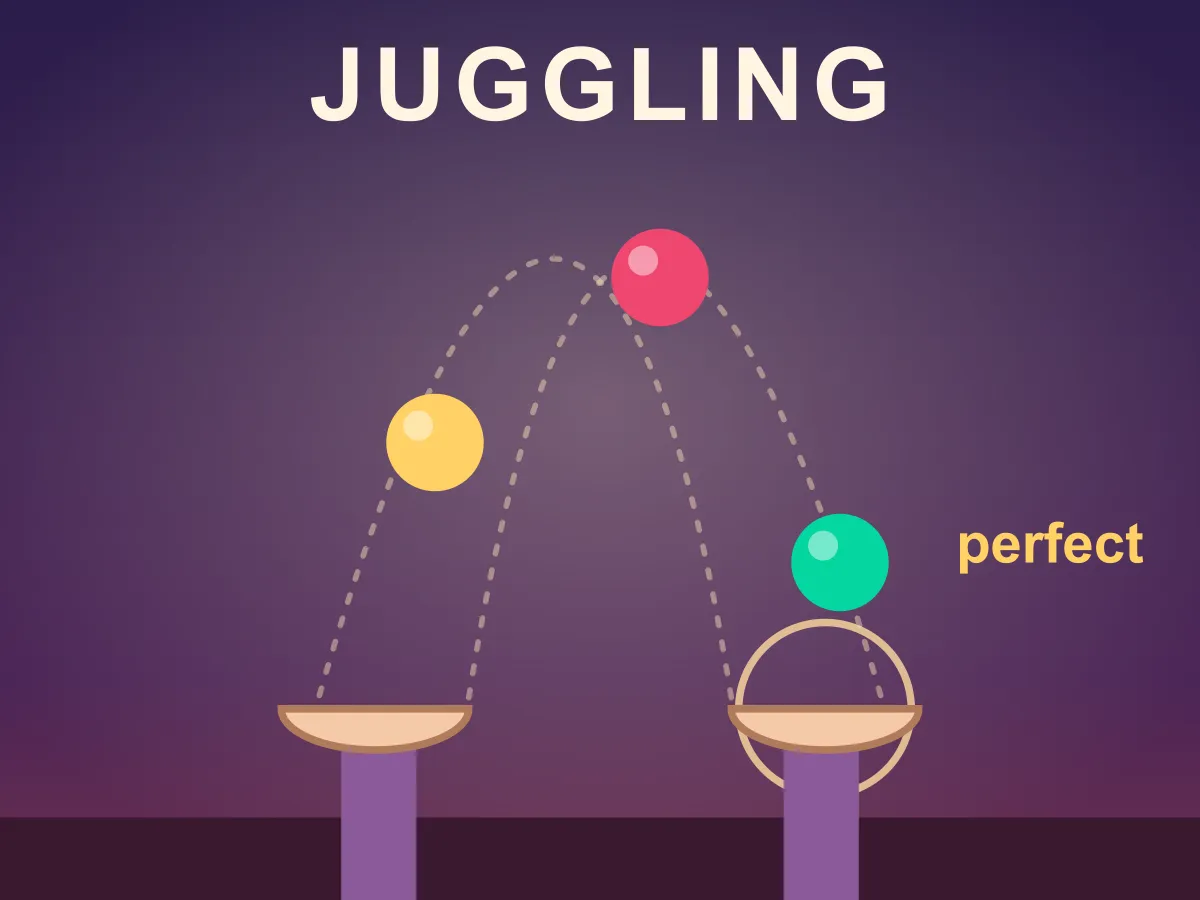





Juggling is a free online juggling game built on how the real pattern works. You have two hands and one job: tap the left hand or the right hand as each ball comes down, and that catch throws it straight back up. With three balls every throw crosses to the other hand — the cascade — and with four each hand keeps its own balls, the fountain; the game does not script that, it falls out of the timing, exactly as it does for a real juggler. The skill is rhythm. A catch that is late throws the ball a little higher and later still, so a player who chases each ball keeps every mistake and adds to it until a ball comes down where no hand is waiting. A player who keeps the beat catches a late ball slightly early, throws it short, and the pattern pulls itself back together. Eight patterns run from a slow three-ball cascade to five balls at speed, with stars at 20, 50 and 100 catches; every pattern was measured with test jugglers of different steadiness so each one asks for a steadier hand than the one before. No download, no sign-up — play with a keyboard, a mouse or a phone.
How to play Juggling
- Press Start. The first balls go up by themselves, so you only have to take over.
- Tap the left hand (F, the left arrow, the left pad or the left half of the stage) when a ball lands in it, and the right hand (J, the right arrow or the right side) for the other.
- Every catch throws the ball straight back up. With three or five balls it crosses to the other hand; with four it comes back to the same hand.
- A gold ring closes on each hand at the moment its next catch is due. Tap as it closes — that is the beat.
- A catch that is early or late throws the ball short or long. A ball that has strayed wears a red ring: catch it on the beat, not on the ball, to pull it back.
- A ball thrown too far off its beat goes wild and comes down where your hand is not. A tap with nothing arriving is a fumble: it breaks your streak and takes one catch back, so pressing both hands at once gets you nowhere.
- The run ends at the first drop. Twenty catches earn one star and open the next pattern, fifty earn two, and a hundred complete the pattern with three.
Tips
- Listen to the rhythm, not the ball. The rings keep perfect time; your eyes will follow a late ball and make it later.
- If a ball is running late, meet it a touch early. The short throw that follows cancels most of the drift in one go.
- Do not mash. A hand needs a moment to recover after a throw, and a tap with nothing to catch breaks the streak multiplier.
- Say it out loud: left, right, left, right. Every pattern here alternates hands on every beat, whatever the number of balls.
- On the fountain patterns, balls never cross. Watch one side at a time; the other hand is keeping its own balls.
- Streaks multiply your score every ten catches, and perfect catches — within about a thirtieth of a second of the beat — are worth three times an ok one.
- The last two patterns, heavy clubs and five at speed, punish a sloppy catch hardest: an offset there comes back almost doubled. Precision matters more than speed.
FAQ
Is this juggling game free to play?
Yes. It runs free in your browser with no download, no install and no account, on a computer, tablet or phone.
How do you juggle in the game?
With two controls, one per hand. Tap the left hand (F or the left arrow) or the right hand (J or the right arrow) as a ball lands in it; the catch throws it straight back up. On a phone, tap the two hand pads or either half of the stage.
Should I watch the balls or keep the beat?
Keep the beat. A late catch throws the ball later still, so chasing each ball keeps every error and adds to it. In the game’s own tests, a juggler tapping on the beat keeps a hundred-catch run going with about one and a half to two times the timing error that sinks a juggler chasing the balls, on every pattern.
Why did a ball turn red and fall?
A red ring means the ball has drifted off its beat. If a throw is far enough off — how far depends on the pattern — the ball goes wild: it comes down where your hand will not be and cannot be caught.
What is the difference between a cascade and a fountain?
In a cascade, played with an odd number of balls, every throw crosses to the other hand. In a fountain, with an even number, each hand throws to itself. In the game that is not a separate rule: a ball is due back as many beats later as there are balls, and whether that beat belongs to the same hand decides the pattern.
How many patterns are there, and how do I get three stars?
Eight: three-ball cascades, four-ball fountains, heavy clubs and five balls at speed. Twenty catches in one run earn one star and unlock the next pattern, fifty earn two, and a hundred complete the pattern with three.
How is this different from Rhythm Ball Bounce?
In Rhythm Ball Bounce the notes sit on a fixed track, so a late tap costs you points and is then forgotten. Here nothing is on a track: a late catch throws that ball later, and you meet the error again when it comes down. The rhythm is something you keep, not something you follow.
Is anything random?
No. The balls, the beat and the throws are fixed, so the same taps always make the same run. Every drop is down to the timing of a catch.