
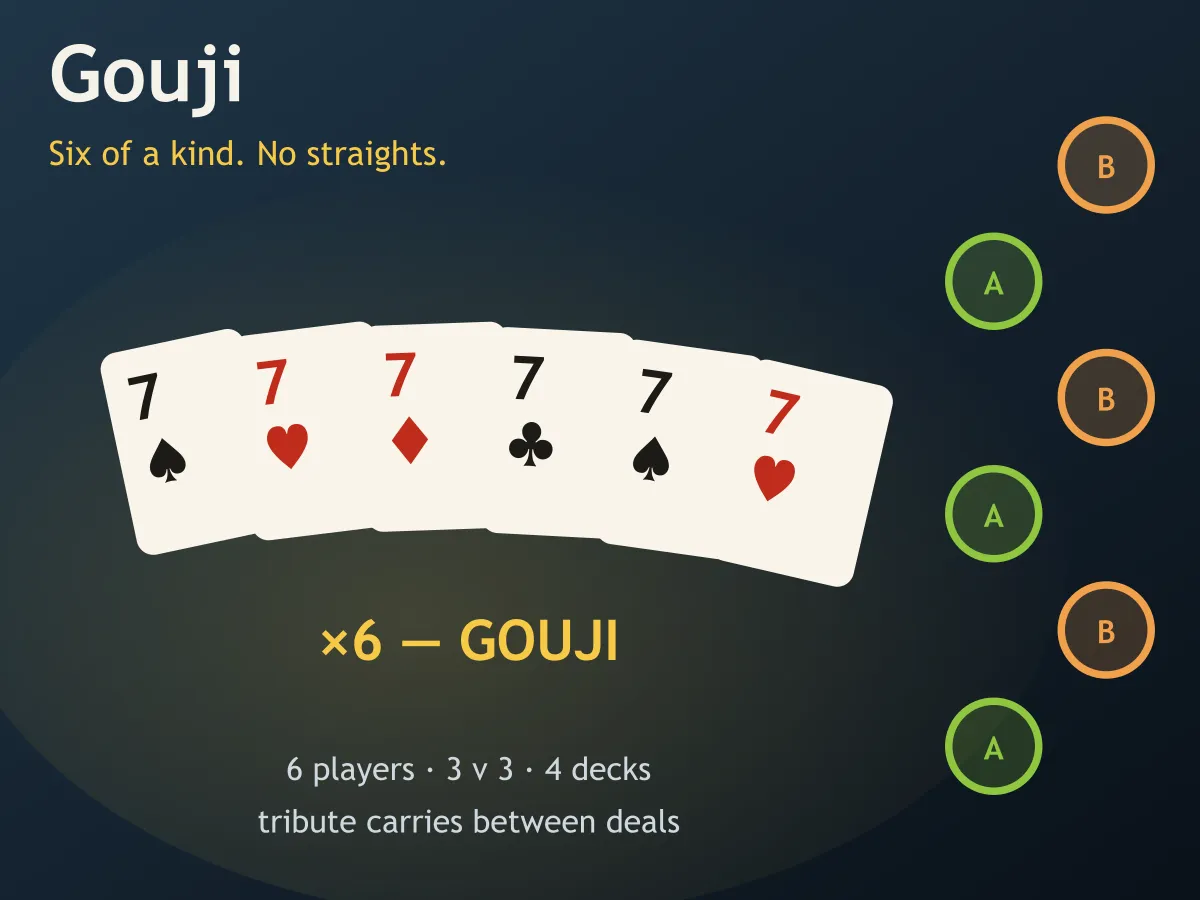




Gouji is a free online Shandong card game for six players, three against three, and it is built on a rule none of the other card games here have: there are no straights. Every legal play is simply a number of cards of one rank — one seven, four sevens, nine sevens — and you answer it with the same number of a higher rank. That turns a hand into a count of copies rather than a hunt for sequences. Four decks are in play, so sixteen copies of every rank exist and six of a kind is a real thing to build towards: that play is the gouji the game is named after, and it beats anything that is not one. Deals are not independent either. After each one the last two out pay their best card to the first two, so a level is a match with momentum rather than a series of unrelated hands. Seven tables, no download, no account, no real money.
How to play Gouji
- Four decks are dealt out completely: thirty-six cards to each of the six seats, nothing left over.
- Sides are fixed by the seating and public from the start. Your partners are the two seats opposite-ish you, and the interface tints allies green and opponents orange.
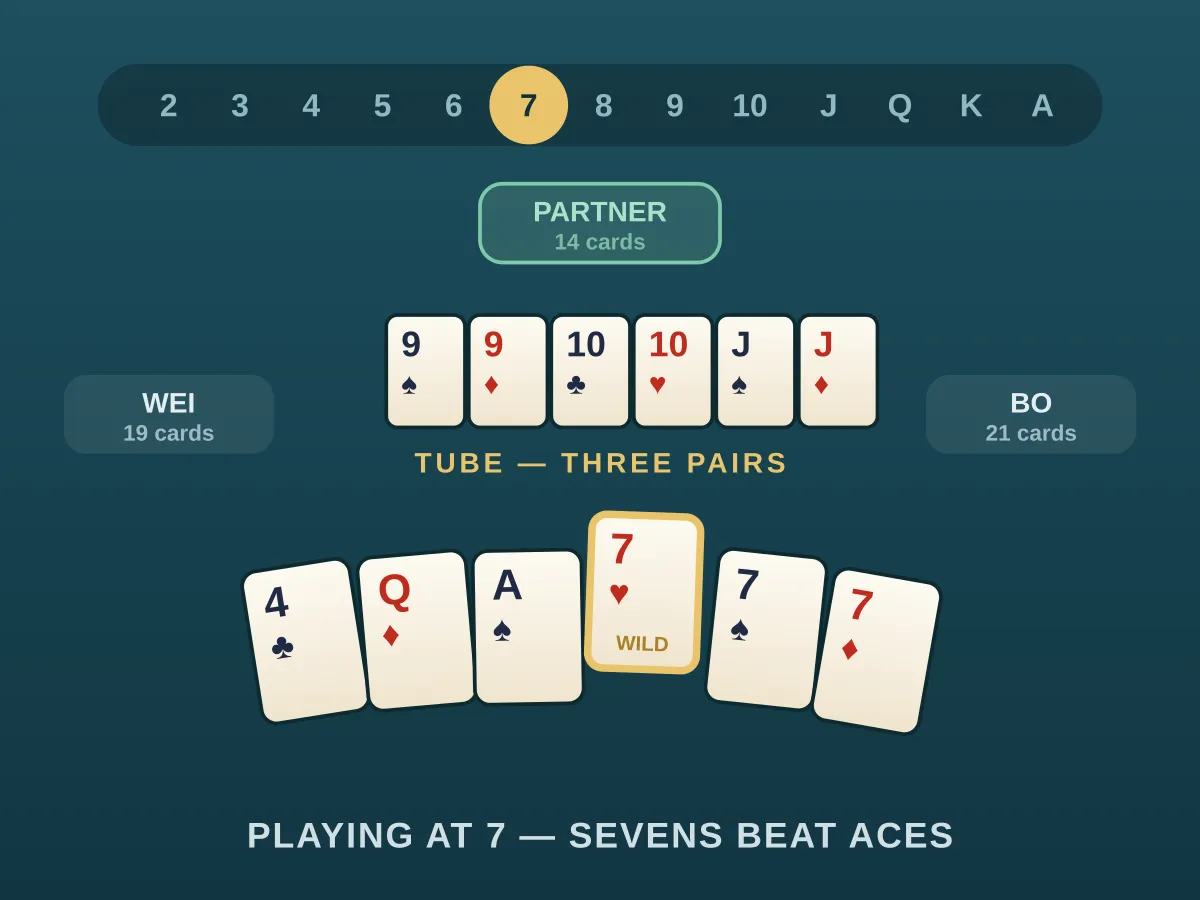
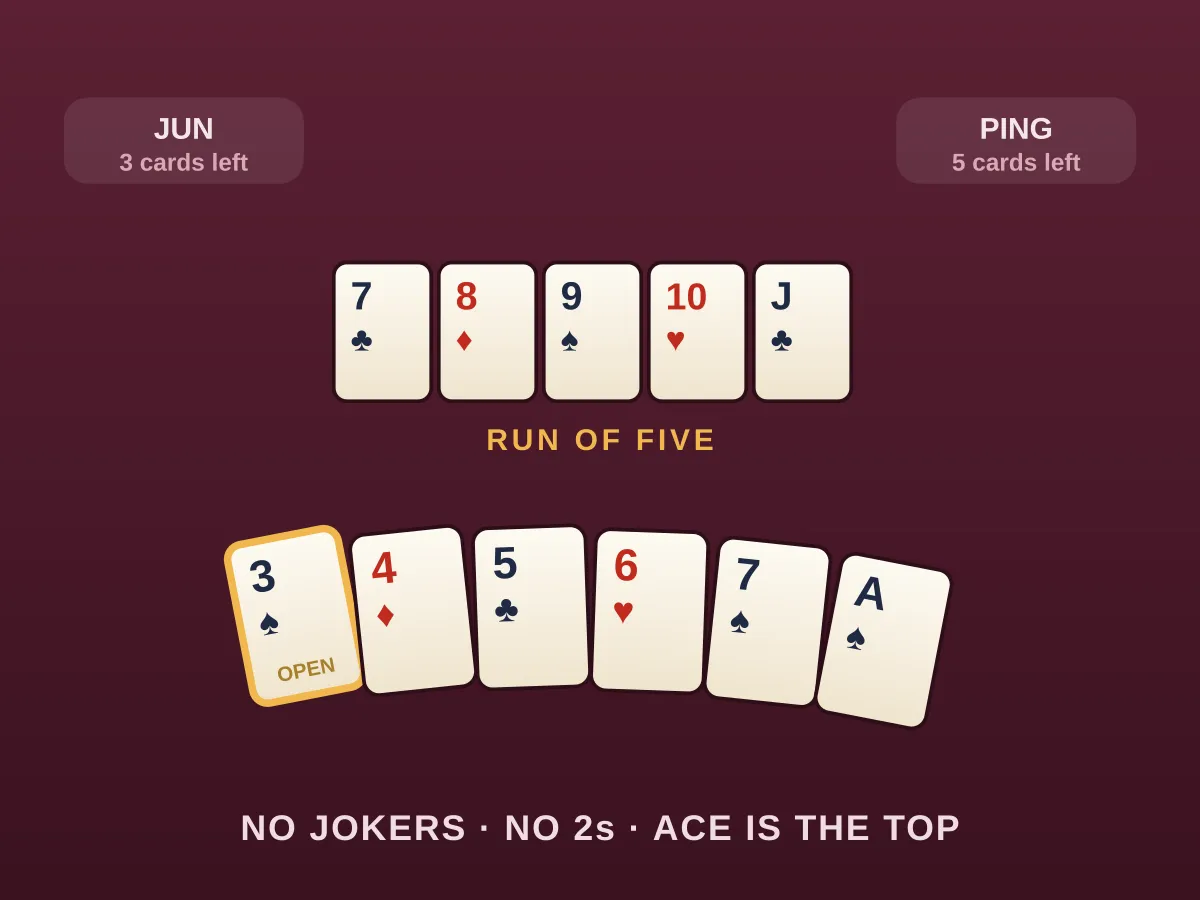
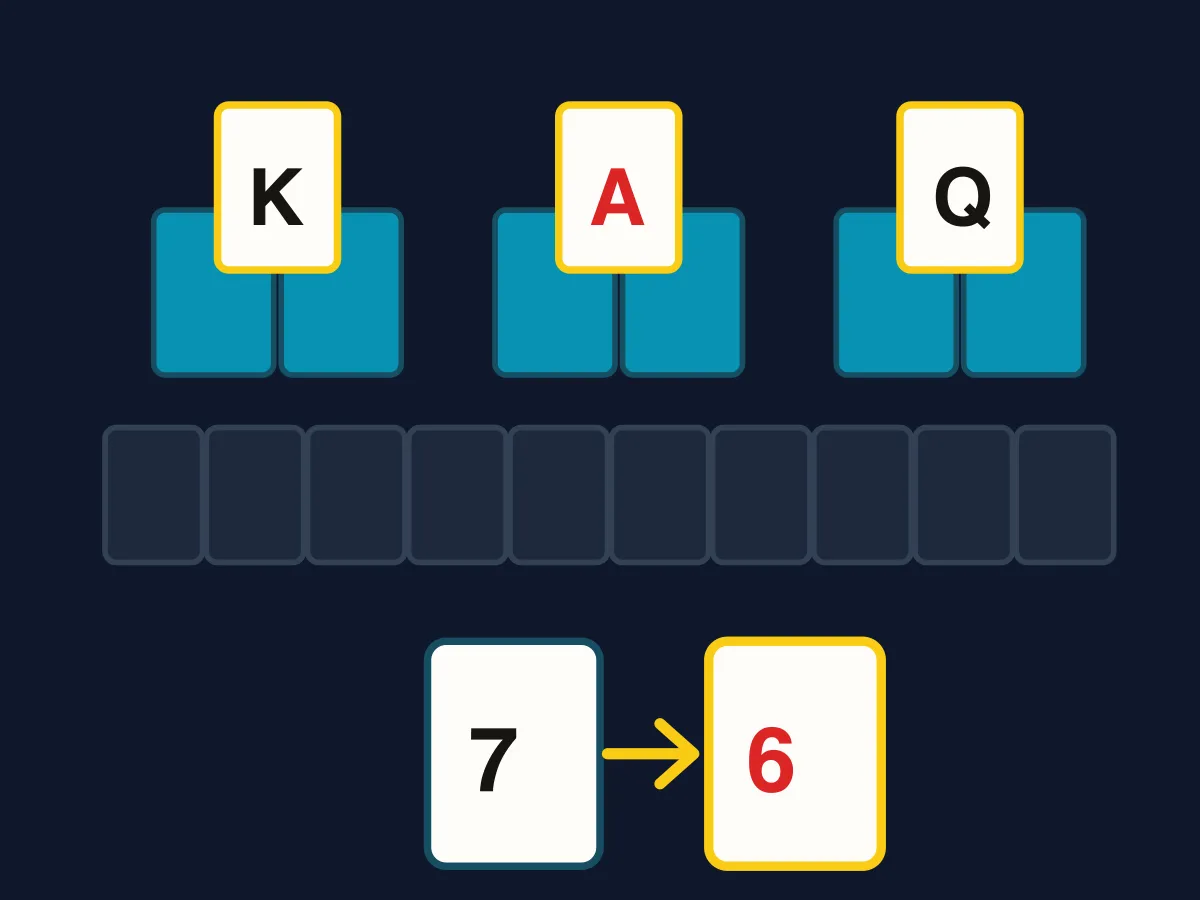
- Every play is a number of cards of one rank. There are no straights and no mixed hands in this game at all.
- To beat the table you must play the same number of cards of a higher rank. Three nines beats three sevens; four nines does not beat three sevens.
- Your hand is grouped by rank rather than fanned out. Tap a rank to take one card from it, tap again to take another, and tap past the end to clear it.
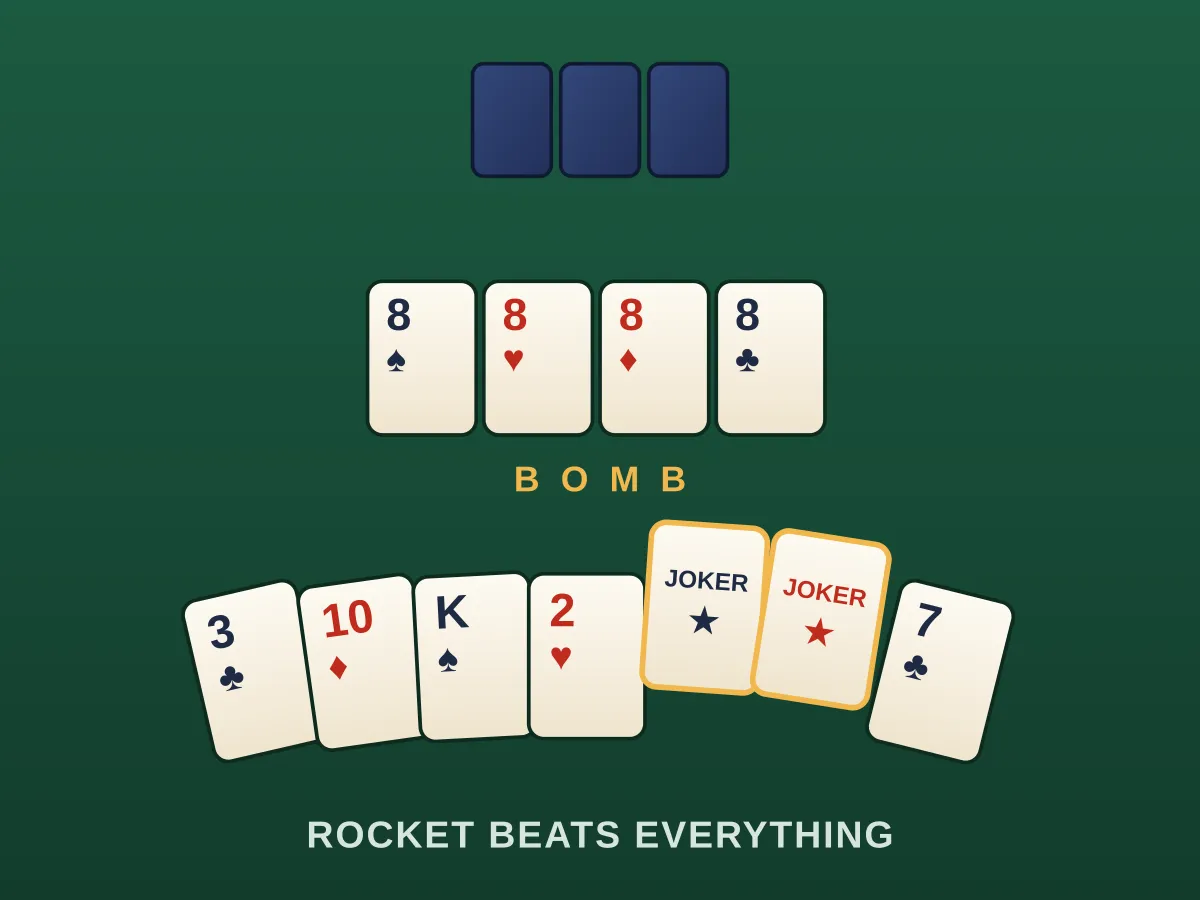
- Six or more of a rank is a gouji. It beats any play that is not one, whatever the counts, and only a bigger gouji beats a gouji.
- Pass if you cannot or will not beat the table. When everyone still holding cards has passed, the last player to put cards down leads again for free.
- Finishing positions score for your side, first place highest and last place worst, so a side that takes first and second beats one that takes first and last.
- After every deal the last two out each hand their highest card to one of the first two, who each hand back their lowest — so losing a deal costs you in the next one too.
Tips
- Count copies, not cards. A hand with four sevens and four nines is far stronger than one with eight different ranks, even though both hold eight cards.
- Never break a rank you hold six of. Six is a gouji and four-plus-two singles is nothing — this is the single most expensive mistake available in the game.
- Your ally leading is good news. Passing to let a partner keep the lead costs you nothing and starves the other side of turns.
- Save the gouji for when an opponent is close to going out. It is the only play that answers something you cannot match on count, so spending it early wastes its one job.
- Watch the count on the table, not just the rank. A five-card play locks out everyone holding fewer than five of anything, which on a thirty-six card hand is most people.
- Tribute cuts both ways: finishing fifth or sixth hands your best card to the other side. On a deal you cannot win, shedding to reach fourth is worth real points next deal.
- Leading small ranks in big counts is the classic Gouji opening. It clears your awkward groups while your high ranks are still intact.
- Two jokers are just a rank like any other here — four decks means eight of each, so a pile of jokers is a gouji waiting to happen.
FAQ
Is Gouji free to play?
Yes. It runs in the browser with no download, no sign-up and nothing to buy. All seven tables are included and unlock as you clear them. There is no real money and no wagering anywhere in the game.
Why are there no straights?
Because that is the game. Every play in Gouji is a number of cards of one rank, and that single rule is what makes it different from the other Chinese card games here, all of which are built around runs. It changes what a good hand is: you are counting copies of a rank rather than looking for sequences.
What exactly is a gouji?
Six or more cards of the same rank. It beats any play that is not one regardless of how many cards that play had, and only a bigger gouji beats a gouji — more cards first, then higher rank. Four decks are used precisely so that six of a kind is reachable.
How is this different from Baohuang here?
They are deliberately opposites. Baohuang hides the teams — the emperor is public but their ally is secret, and most of the game is working out who is who. Gouji makes the sides public from the first card and puts the difficulty in the card counting instead. Baohuang also has straights; this game has none.
What is the tribute between deals?
After each deal the two players who finished last each give their highest card to one of the two who finished first, who hand back their lowest. It means deals are not independent: a bad deal follows you into the next one, which is why finishing fourth instead of fifth is worth playing for even in a hand you cannot win.
How do I play four cards of one rank?
Tap that rank four times. The hand is grouped by rank rather than laid out as thirty-six separate cards, so each tap takes one more copy and tapping past the end clears the selection. Picking a different rank replaces your choice, since a play can never mix ranks.
Do the computer players cheat?
No. Each seat sees only its own hand and what has been played. What changes between tables is how often an opponent plays the best move it can find rather than a random legal one, and whether it plays as a team at all — from the third table up, opponents stop taking the lead away from their own partners.
Does it work on a phone?
Yes, and the rank-grouped hand is a large part of why: thirty-six cards from a four-deck shoe would be unusable as a fan on a narrow screen, but as thirteen or so rank buttons it fits comfortably and every play is a repeated tap on one target.