
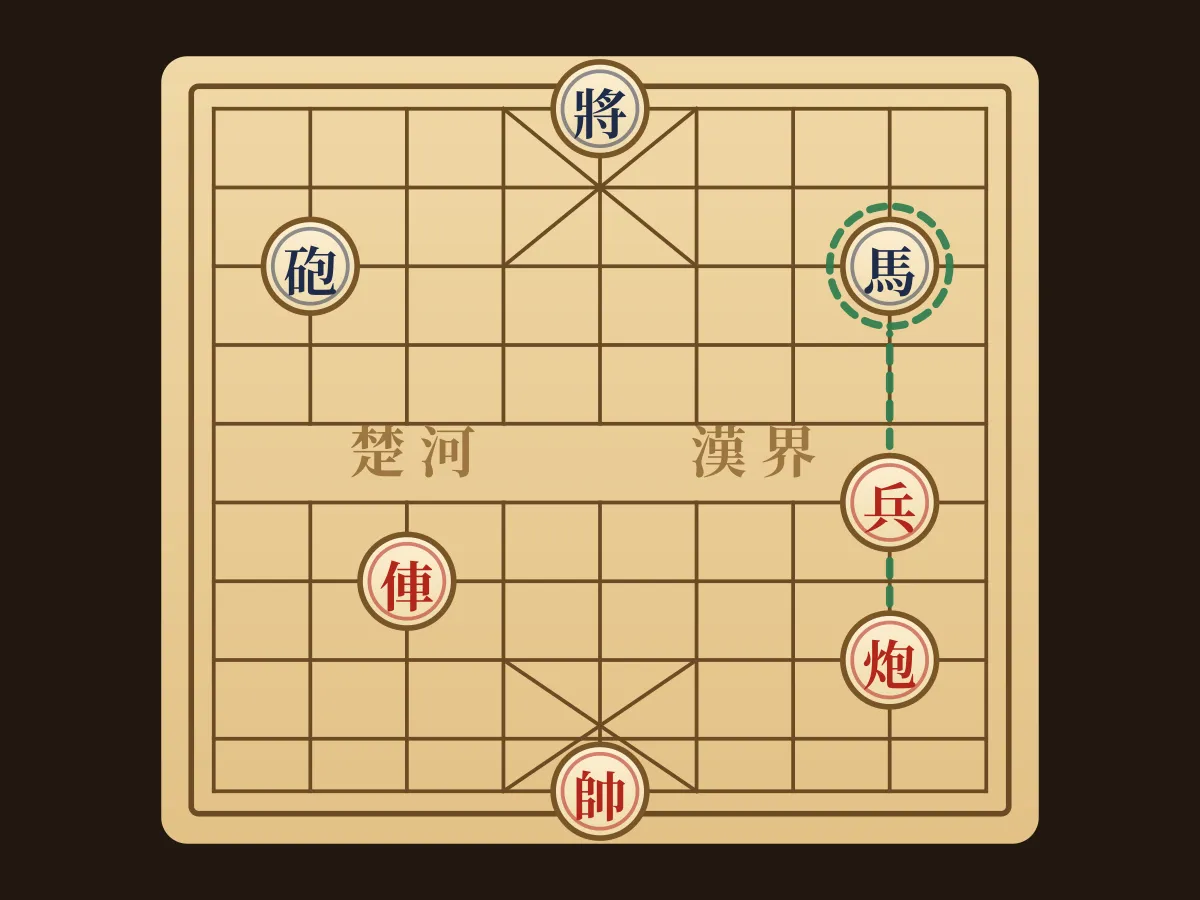





Xiangqi is a free online Chinese chess game you can play instantly in the browser against a computer opponent, with no download and no account. It is played on the intersections of a nine by ten grid rather than in the squares, split across the middle by a river and anchored at each end by a three-by-three palace. You take Red and move first. The full traditional ruleset is here: the chariot sweeps like a rook, the horse jumps an L but is hobbled if the point beside it is occupied, the elephant moves two points diagonally and is blocked if its eye is covered, and it may never leave its own half of the board. The advisors and the general are confined to the palace, and the two generals may never face each other down an open file — a rule that turns the middle column into a permanent tactical thread. The piece with no chess equivalent at all is the cannon: it slides like a chariot but can only capture by leaping exactly one intervening piece, so it threatens squares it cannot move to and moves to squares it cannot threaten. Soldiers march one point forward, never back, and gain a sideways step once they have crossed the river. Six levels of opponent run from a shallow teahouse player who will genuinely leave a piece hanging to a full-depth search that punishes a loose move immediately. Take Back rewinds a whole turn if a plan goes wrong, and being stalemated is a loss here, not a draw.
How to play Xiangqi
- You play Red, at the bottom of the board, and Red always moves first. Pieces sit on the intersections of the lines, not inside the squares.
- Tap a piece to select it. Every point it can legally reach is marked — a green dot for an empty point, a dashed ring around an enemy piece you can capture.
- The general moves one point up, down, left or right, and may never leave the nine-point palace at your end of the board. The two advisors move one point diagonally and are confined to the palace as well.
- The elephant moves exactly two points diagonally and is blocked if the point midway is occupied. It may never cross the river, so it defends your half and only your half.
- The horse moves one point straight then one diagonally outward. If the point directly beside it in the straight part of that move is occupied, the horse is hobbled and cannot jump that way.
- The chariot moves any distance in a straight line, exactly like a rook in Western chess. It is the strongest piece on the board.
- The cannon moves like a chariot when it is not capturing, but to take a piece it must jump exactly one piece of either colour along the way. No screen means no capture; two pieces in between means no capture either.
- Soldiers move one point forward and never backward. Once a soldier crosses the river it may also move one point sideways, which roughly doubles what it is worth.
- The two generals may never face each other down a file with nothing in between. That makes any move which opens the middle illegal, and it is a real winning method — clearing the file can be checkmate on its own.
- You win by checkmate, or by leaving the computer with no legal move at all. In Xiangqi being stalemated is a loss, not a draw, so it counts for you the same way.
- Take Back rewinds your last move and the reply to it together. New Game deals a fresh game at the same level, and the level picker moves between opponents.
Tips
- Get the cannons working early. A cannon behind your own soldier is aimed at the enemy palace before either of you has developed, and the classic opening is to put one on the middle file for exactly that reason.
- Watch the middle file all game. Generals may not face each other, so a piece you move off that file can hand the game away in one move — and equally, clearing it is a way to win outright.
- Chariots want open files. A chariot still tucked on the back rank behind its own pieces is doing nothing, and trading one off for a horse is usually a bad deal even though the horse looks busier.
- Cannons get weaker as pieces come off, because a cannon needs a screen to capture at all. Horses get stronger in the same endgame, since there is less around to hobble them. If you are ahead, trading down favours your horses.
- Advance a soldier across the river when you can spare the move. A soldier that has crossed can move sideways, and two of them near the enemy palace are a genuine mating force.
- The elephants and advisors never leave your half — treat them as the walls of the palace rather than as pieces to develop. Losing both advisors is what usually makes a general indefensible against chariots.
- A horse defended by nothing is the piece most often lost to a cannon, because the cannon takes it from far down a file over any screen at all. Before leaving a horse, look along its rank and file for a screen and a cannon behind it.
- If a level keeps beating you, drop a rung. The steps between opponents are small, and the difference between level 4 and level 6 is how many moves ahead it looks, not a different set of rules.
FAQ
Is Xiangqi free to play?
Yes. It runs in the browser with no download, no sign-up and nothing to buy. All six opponent levels are here, unlocking as you beat them.
What is the difference between Xiangqi and Western chess?
They share an ancestor but almost nothing else. Xiangqi is played on the intersections of a 9x10 grid, has a river across the middle and a palace at each end, and adds the cannon — a piece that can only capture by jumping over exactly one other piece. The king, called the general, cannot leave its palace, and the two generals may never face each other down an open file. There is no castling, no queen, and no pawn promotion; soldiers instead gain a sideways step once they cross the river.
How does the cannon actually work?
It moves any distance in a straight line while it is not capturing, exactly like a chariot. To capture, there must be exactly one piece — yours or the opponent’s, it does not matter — somewhere between the cannon and its target. That piece is the screen. With no screen the cannon cannot take, and with two pieces in the way it cannot take either. So a cannon attacks squares it is unable to move to, which is the single most common thing new players miss.
What is the flying general rule?
The two generals may never see each other down a file with no piece in between. In practice this means you can never make a move that clears the middle file while your general is opposite the other one, and it is also a way to win: forcing the last piece off that file can end the game on the spot.
What happens if I have no legal move?
You lose. Unlike Western chess, being stalemated in Xiangqi is a defeat rather than a draw — a player who cannot move has lost. The game tells you which of the two happened, but both end it.
How strong is the computer?
It varies a lot on purpose. Level 1 looks only one move ahead and will genuinely leave a chariot hanging about half the time, which is what a real beginner needs to play against. Level 6 searches four plies with no deliberate mistakes and will take any piece you leave loose. The middle levels sit between the two, and every level plays by exactly the same rules.
Can I take a move back?
Yes. Take Back rewinds your last move and the computer’s reply together, so you get the same position you were thinking about rather than a free preview of what it intends to play. You can use it as often as you like.
Does it work on a phone?
Yes. The board scales to the width of the screen and the touch targets are sized for a fingertip rather than to the pieces, so the crowded opening rows are still comfortable in portrait. Tapping works exactly like clicking.