
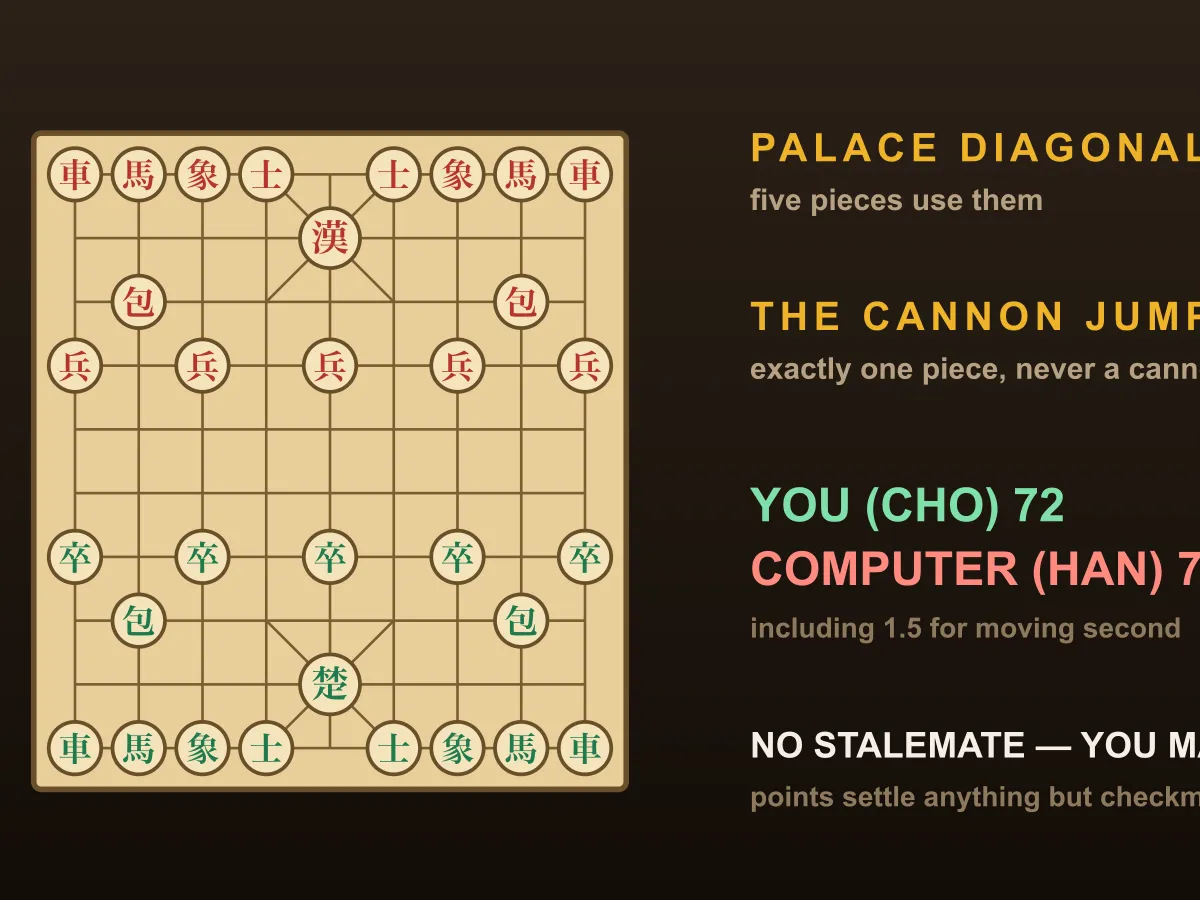






Janggi is a free online version of Korean chess, played against the computer on a nine-by-ten board where the pieces sit on the intersections. Two things shape every game. The first is the palace: a three-by-three square at each end with diagonals drawn across it, and those diagonals are used by five different pieces — the general and its two guards move along them, a chariot runs corner to corner through the middle, a cannon jumps across, and an enemy soldier gains them once it is inside. The second is the cannon itself, which must jump exactly one piece to move at all, may not use another cannon as its screen, and may not capture one. The elephant is not a bishop: it walks one point straight and then two diagonally, blocked at every step. The soldier moves forward or sideways and never back. There is no stalemate, because a player who dislikes every move may simply pass — so the only forced ending is checkmate, and everything else is settled on points, with Han carrying a point and a half for moving second. That running score is on screen the whole game.
How to play Janggi
- Press Play. You are Cho, in green at the bottom; the computer is Han, in red. Pieces sit on the intersections, not in the squares.
- Tap one of your pieces and every point it can legally reach is marked. Tap a marked point to move there.
- The general and its two guards stay inside the palace — the three-by-three square at your end — moving one point at a time, and along the palace diagonals where those are drawn.
- The diagonal points are marked with a small dot. Only the four corners and the centre of each palace are on a diagonal; the four side points are not.
- The chariot slides along ranks and files like a rook, and also runs corner to corner through a palace along the diagonals.
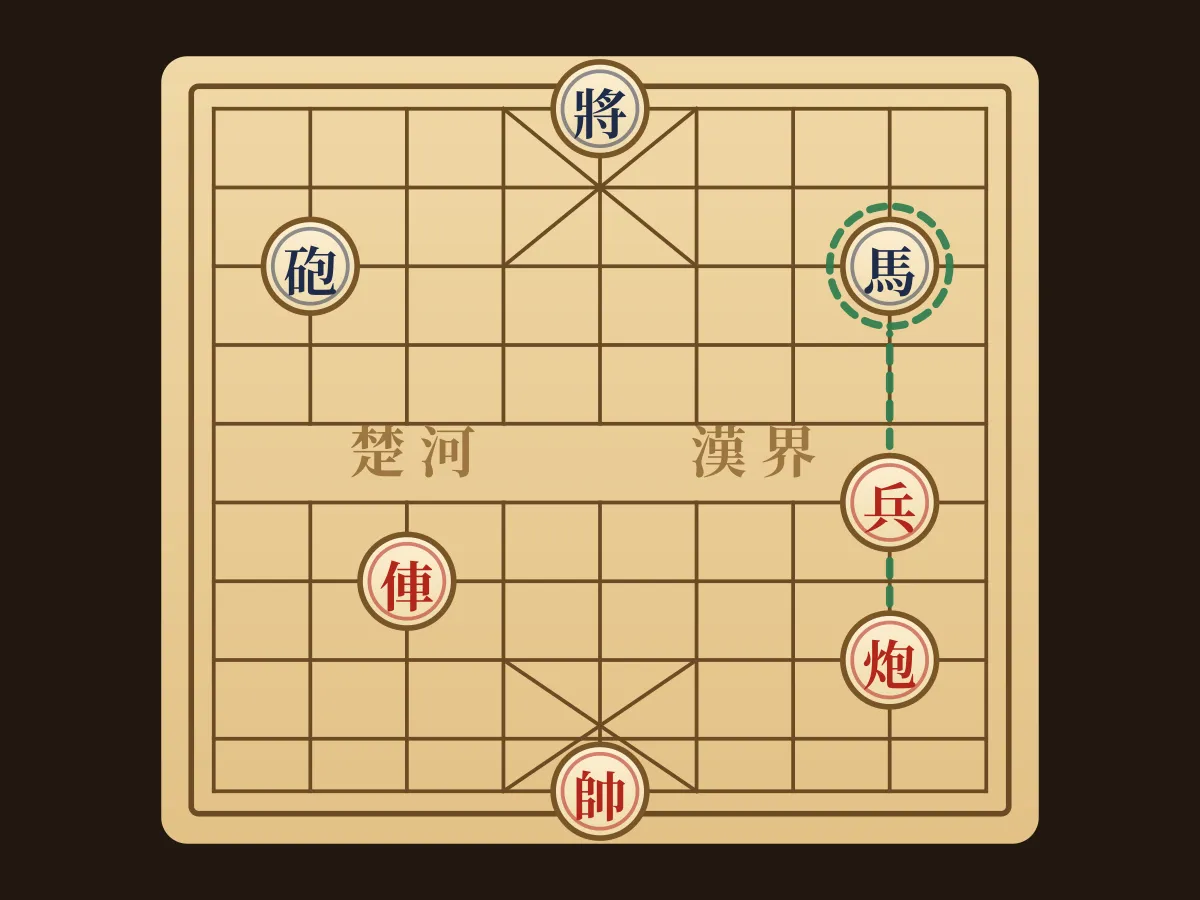
- The cannon must jump exactly one piece — the screen — and then lands or captures on the far side. It cannot use another cannon as a screen, and it cannot capture a cannon.
- The horse moves one point straight then one diagonally, and is blocked by anything standing on the straight step.
- The elephant moves one point straight then two diagonally, and is blocked at every one of those three steps. It is a long, clumsy piece, not a bishop.
- Soldiers move one point forward or sideways and never backwards. Once inside the enemy palace they also get its diagonals, moving forward along them.
- You may pass instead of moving — janggi has no stalemate — but not while your general is in check.
- Checkmate wins outright. Otherwise the game is settled on points: chariot 13, cannon 7, horse 5, elephant and guard 3, soldier 2, with 1.5 to Han for moving second.
Tips
- Learn the palace diagonals first. A chariot on a palace corner attacks the opposite corner through the centre, which is the single most common way a beginner loses their general.
- Cannons need screens, so they get weaker as the board empties. Use them early, while there is still something to jump over.
- Put a piece where the enemy cannon wants a screen and it stops dead. Removing your own piece from a cannon's line is often better than blocking it.
- Elephants are worth three and cover ground nothing else does, but they are blocked constantly. Give them open diagonals or they do nothing all game.
- Count the points. Han starts a point and a half ahead, so an even trade all game is a loss for you — Cho needs to be two points up to be level.
- Passing is a real move. Late in a game where you are ahead on points, declining to move can be better than walking into an exchange.
- Soldiers become dangerous inside the palace, where the diagonals let them attack the general from a point they could never otherwise reach.
- Guard the point in front of your general. Almost every mating net in janggi runs through it, and a guard sitting there is worth more than the three points it scores.
FAQ
Is Janggi free to play?
Yes. It runs free in your browser with no download, no install and no account. Your record against the computer is saved on your own device.
How is Janggi different from Chinese chess?
Mainly the palace diagonals, which five pieces use; the cannon, which must jump to move as well as to capture and cannot jump or take another cannon; the soldier, which moves sideways from the start; and the fact that there is no river and no stalemate.
What are the lines across the palaces?
Diagonals, and they are real moves. The general, the guards, the chariot, the cannon and an enemy soldier inside the palace can all travel along them. Only the corners and the centre are on a diagonal — the side points are not, and are left unmarked.
Why will my cannon not move?
It needs exactly one piece to jump over in that direction, and that piece may not be another cannon. With nothing to jump, a cannon cannot move at all — which is why it gets weaker as the board empties.
Can I really pass?
Yes, and that is the rule rather than a convenience. Janggi has no stalemate: a player who dislikes every move may decline to move at all. The only thing you may not do is pass while your general is in check.
How does a game end if nobody is checkmated?
On points. Chariot 13, cannon 7, horse 5, elephant 3, guard 3, soldier 2, plus 1.5 to Han for moving second. The running total is on screen throughout, so it is something to play towards rather than a tiebreak you find out about at the end.
What is bikjang?
The two generals facing each other down an open file with nothing between them. It is a draw, and the game ends there.
How strong is the computer?
Three settings: gentle looks one move ahead, steady two, sharp three with a narrowed search. It is a club-level opponent rather than a strong one.