





Animal Chess, also called Jungle or Dou Shou Qi, is a free online board game you can play instantly in the browser against a computer opponent, with no download and no account. Eight animals a side on a seven-by-nine board, ranked elephant, lion, tiger, leopard, dog, wolf, cat, mouse. The headline rule is that a stronger animal eats a weaker or equal one, and every interesting thing in the game is an exception to it. The mouse eats the elephant — and only that way round, because the elephant may not touch the mouse. That single inversion is what stops the strongest piece simply walking down the board. Two ponds sit in the middle and only the mouse may swim; while it is in the water it can neither be attacked from land nor attack onto land, so a mouse in the river is safe and useless at the same time. The lion and the tiger can leap a whole pond in one move, which is the fastest way across the board — unless a mouse of either colour is sitting anywhere in the water they would fly over, which is the only defensive ability a piece has purely by standing still. And three trap squares surround each den: any animal standing in an enemy trap drops to rank zero and can be eaten by anything at all, including a mouse. You win by walking into the enemy den or by taking every animal they have. You may never enter your own den. Six levels of opponent search from one move ahead to four, and the weaker ones make bounded mistakes rather than random ones — they will still never hand you their den.
How to play Animal Chess
- You play the animals at the bottom of the board. Each side has eight: elephant, lion, tiger, leopard, dog, wolf, cat and mouse.
- Animals move one square up, down, left or right. Tap one to see everywhere it can go, then tap a highlighted square.
- A stronger animal eats a weaker one, and an equal rank eats an equal rank. The ranking from strongest is elephant, lion, tiger, leopard, dog, wolf, cat, mouse.
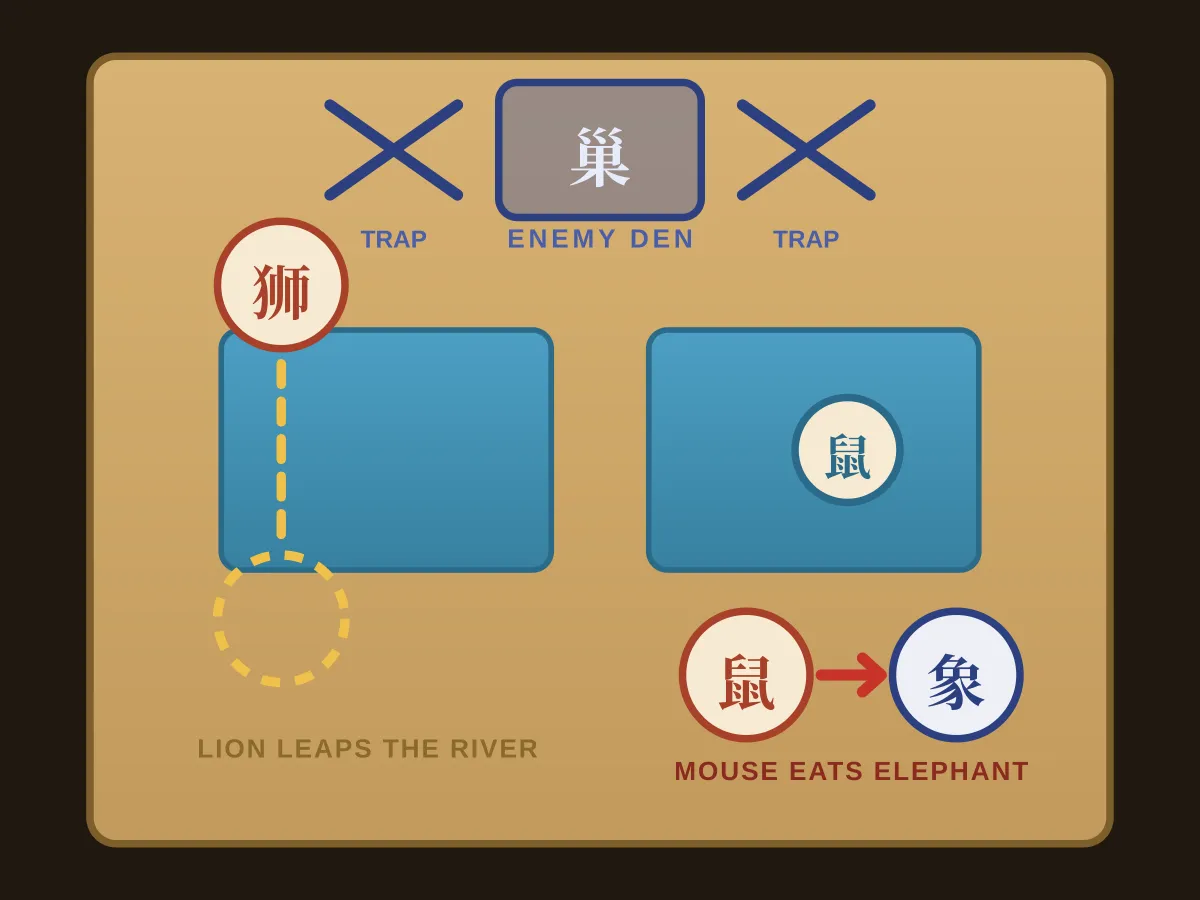
- The mouse eats the elephant. The elephant may not eat the mouse. This exception runs one way only and it is what keeps the elephant honest.
- The two blue ponds may only be entered by a mouse. While a mouse is in the water nothing on land can reach it, and it cannot reach anything on land either.
- Lions and tigers can leap right over a pond in one move, landing on the far bank and taking whatever is there if they outrank it.
- A leap is blocked if any mouse — yours or theirs — is anywhere in the stretch of water being crossed. It is the only way a piece defends by doing nothing.
- The three squares marked with a cross around each den are traps. Any animal standing in an enemy trap has no rank at all and can be eaten by anything, including a mouse.
- An animal standing in its own trap is unaffected — the traps only weaken invaders.
- You win by moving any animal into the enemy den, or by capturing every animal they have. You can never enter your own den.
- If neither side breaks through in 240 moves the game is settled on remaining strength, and an exact tie is a draw.
Tips
- Keep your mouse alive and near the water. It is the only answer to their elephant, the only piece that can block a leap, and it is safe from everything while it swims.
- Do not chase with the elephant. It cannot touch their mouse, so an elephant that walks into an open board is one mouse away from being lost for nothing.
- Lead invaders into your traps. A lion standing in your trap can be eaten by your cat, so letting a strong animal come to you is often better than meeting it in the middle.
- Use the lion and tiger leaps early, while the ponds are still empty. Once a mouse is sitting in the water that route is closed and you have to walk around.
- Watch which side of the board their strong animals are on. A den is only three squares deep, and the game is very often decided by who can get an animal to the far rank first, not by who wins the trades.
- Equal ranks eat each other, so a dog attacking a dog is a straight trade. Take it when you are ahead on material and avoid it when you are behind.
- Do not park an animal in your own den — you cannot enter it at all, so the square is simply unavailable to you and the trap squares around it do the defending.
- If a level keeps beating you, drop a rung. The steps are search depth plus a bounded mistake rate, so the difference is how far ahead it sees rather than a different set of rules.
FAQ
Is Animal Chess free to play?
Yes. It runs in your browser with no download, no sign-up and nothing to buy. All six opponent levels are here and unlock as you beat them.
Why does the mouse beat the elephant?
It is the game’s defining rule, traditionally explained by the mouse running into the elephant’s ear. Mechanically it exists to stop the strongest piece from dominating: without it the elephant could simply advance down the board and nothing could answer. Note that it only works one way — the elephant may never take the mouse.
Who can go in the water?
Only the mouse. While it is in a pond it cannot be attacked by anything on land and cannot attack anything on land either — a mouse in the river is completely safe and completely inactive. Two mice in the same pond can take each other.
How does the river leap work?
A lion or a tiger standing on the bank can jump the whole pond in a single move and land on the far side, capturing there if it outranks whatever it finds. The jump is blocked if any mouse is sitting in the water it would cross — and it does not matter whose mouse it is, so your own mouse can block your own lion.
What do the crossed squares do?
They are traps, three around each den. An animal standing in an enemy trap has no rank at all, so anything can eat it — a mouse can take a lion that has stepped into your trap. Your own animals are unaffected by your own traps.
How do I win?
Move any of your animals into the enemy den, or capture all eight of their animals. Reaching the den ends the game immediately, so a race can be won by a cat while the elephants are still fighting in the middle.
Can the game end in a draw?
Yes, though it is rare. If neither side breaks through within 240 moves the game is settled on the total strength of the animals each side has left, and if that is exactly equal it is a draw. Without a rule like this, two cautious sides can shuffle forever.
Does it work on a phone?
Yes. The board is seven by nine, which is almost exactly the shape of the phone playfield, so it fills the screen with comfortably tappable squares and nothing is scaled down to fit.