
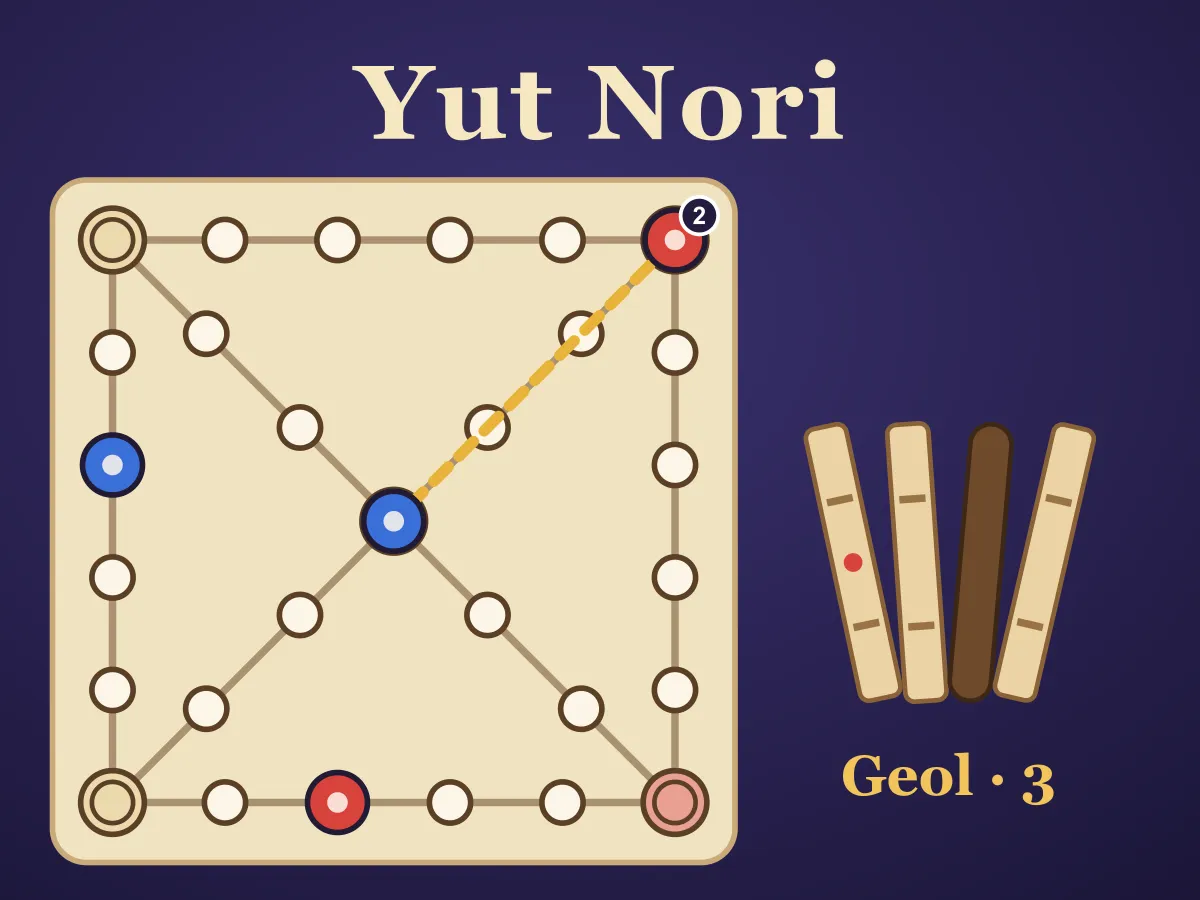


Yut Nori is the Korean family board game traditionally played at Seollal, the Lunar New Year. Throw four sticks — do, gae, geol, yut or mo — and race four horses round a board of 29 stations. Stop on a corner to cut across the diagonals, stack your horses to move them together, and land on a rival to send them home and throw again. Play seven tables against Cousin, Auntie, Uncle, Grandma and Grandpa, with back-do from the third. Free in your browser, no download, and it works on phones.
How to play Yut Nori
- You play the red horses and throw first. Press Throw: four sticks fall, and the number landing flat side up is your move — one is do (1 step), two gae (2), three geol (3), four yut (4) and none at all mo (5). A yut or a mo earns another throw straight away.
- Use every result you threw, in any order, each on one horse: tap the horse, or its glowing landing spot on the board, or press New horse to bring a horse on from the start. Horses travel anticlockwise — up the right side from the start corner, along the top, down the left and back along the bottom.
- A horse that stops on the top-right or top-left corner takes the diagonal across the board on its next move, and one that stops on the centre heads straight for home. A horse that only passes a corner keeps to the outside.
- Land on a rival’s horses to send them all back to the start and earn another throw. Land on your own to stack them: a stack moves as one, but a rival who lands on it sends the whole stack home.
- A horse is home once it moves past the start corner; stopping exactly on the start is not enough. Bring all four home before anyone else to win. From the third table one stick carries a mark — if it is the only flat one, that is back-do, and a horse steps one station back.
Tips
- Aim for the corners. A horse stopped on the top-right corner is only 12 steps from home instead of 16, and one stopped on the top-left corner only 7 — a mo straight from the start lands exactly on the first corner.
- Stacking is strong in a race but risky near a rival: two horses moving together need half the throws, and one unlucky catch costs both. Stack when no rival horse stands one to five stations behind you.
- With two results to use, think about the order. A gae then a geol can land a horse on a corner that a geol then a gae would run past — and a catch with the first result earns another throw before you use the second.
- Gae is the most likely throw (6 in 16), then geol and do (4 in 16 each, one of the four a back-do where it is in play); yut and mo come up 1 time in 16. So the most dangerous place to stand is two stations in front of a rival horse.
- Back-do is not always bad news: a horse one step past the start that steps back onto the start corner leaves for home with the next throw, whatever it is.
FAQ
Is Yut Nori free to play online?
Yes. Yut Nori is completely free to play in your browser, with no download, no account and no in-game purchases.
Can I play Yut Nori on my phone?
Yes. Press Throw, then tap the horse you want to move or the glowing spot where it will land; New horse brings a horse on from the start. It plays held upright or sideways, and on a computer you can also use the keyboard: Space throws and moves, the arrow keys choose a horse or a result, and E brings on a new horse.
How do you count the yut sticks?
Count the sticks that land flat side up: one is do (move 1), two is gae (2), three is geol (3), four is yut (4) and none at all is mo (5). Yut and mo give you another throw. The names are traditionally said to stand for farm animals — the pig, dog, sheep, cow and horse. Here every stick is an even chance, so gae comes up 6 times in 16, do and geol 4 times each (one of those do throws is a back-do where back-do is played), and yut and mo once each.
What is back-do?
One of the four sticks carries a mark. If it is the only stick that lands flat side up, the throw is back-do instead of do, and one of your horses must step one station back along the way it came. With no horse on the board a back-do is lost. Back-do is in play from the third table onward; the first two tables play without it.
How do the shortcuts on the yut board work?
The board has 29 stations: 20 round the outside and two diagonals that cross in the centre. A horse that ends its move exactly on the top-right corner goes down the diagonal on its next move, and one that ends on the top-left corner takes the other diagonal straight towards the start. A horse that stops on the centre also takes that short way home. Passing over a corner without stopping does nothing — the horse stays on the outside track.
What happens when you land on another horse?
Landing on a rival’s horses sends every one of them back to the start, and you throw again. Landing on your own horses stacks them: from then on they move together on one throw, which saves throws, but a rival who lands on the stack sends all of it home.
Does it matter who throws first?
Not that we could measure. With the same strong computer in every seat for 600 games, the first player won 294 games to the second player’s 306 at two players; at three players the seats won 208, 188 and 204, and at four 150, 161, 148 and 141. So you always throw first.
How strong are the computer players?
There are three strengths. Cousin often plays any move at all. Auntie and Uncle always take the move that gains the most ground or makes a catch, but never think about danger. Grandma and Grandpa also count a stack as moving once, and weigh the risk of being caught against the chance to catch you. Over 600 games on the same throws with the seats swapped, Cousin beat a random mover 432 times, Auntie beat Cousin 418 times, and Grandma beat Auntie 367 times — the sticks keep every game open.
How hard are the seven tables?
They go from one rival to three, and from Cousin to Grandma and Grandpa together. Measured over 400 games a table with the Grandma-strength computer playing your side, it won 332 at the first table, 254 at the second, 218 at the third, 175 at the fourth, 165 at the fifth, 135 at the sixth and 101 at the last, Seollal night, against three players.
How are the stars worked out?
By how far behind the closest rival was when your last horse came home, counted in steps (a horse still at the start counts 21). Each table’s targets were measured from the Grandma-strength computer’s own wins there: two stars is a lead seven in ten of its wins reached, three stars one only its best third reached. Any win earns at least one star, and a win after using a hint is one star.
When is Yut Nori played in Korea?
Yut Nori (윷놀이) is a traditional Korean game played above all at Seollal, the Korean Lunar New Year, when families gather and play, often in teams with lively commentary on every throw. Here you play it against a family of computer players, from Cousin to Grandpa.