
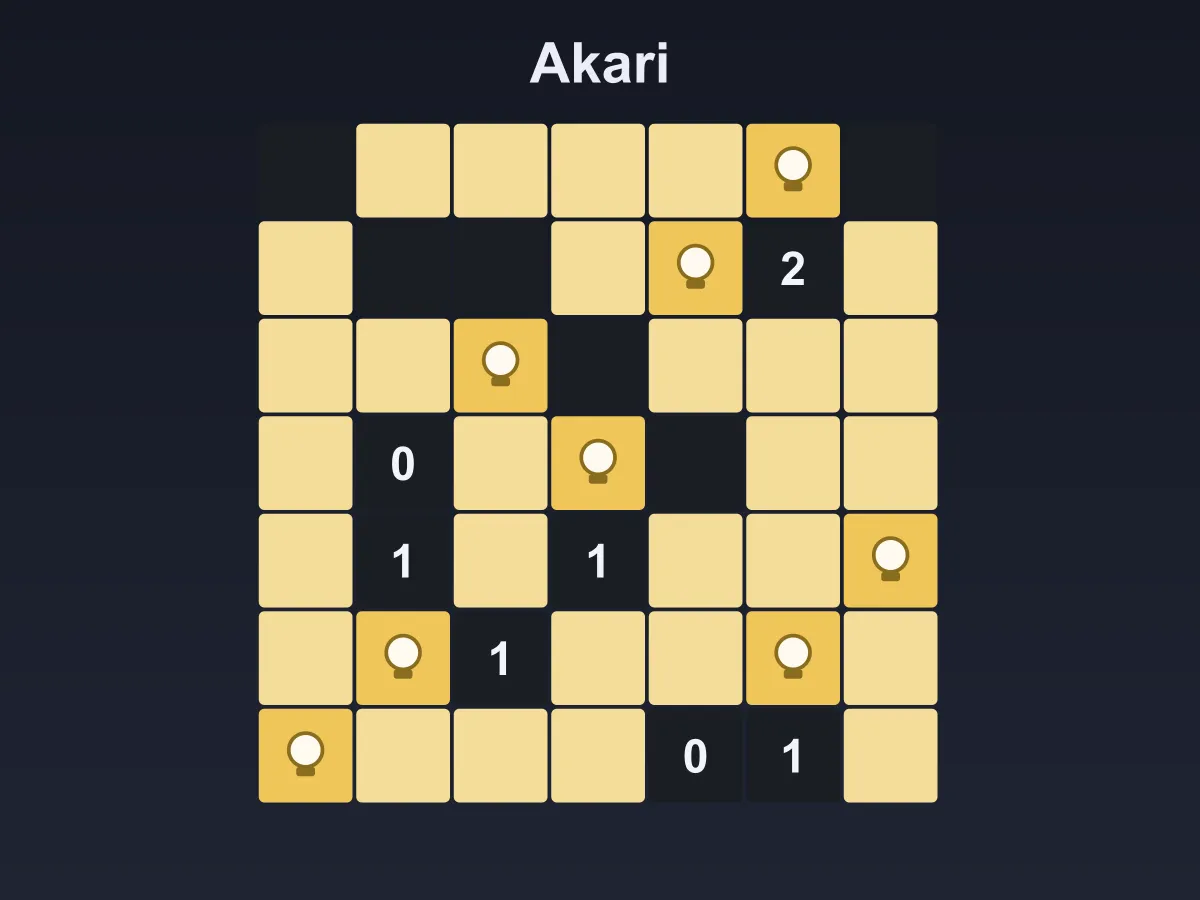





Akari, also known as Light Up, is a free online logic puzzle played on a grid of white squares and black walls. You place light bulbs on white squares. A bulb lights its own square and everything in the four directions until a wall stops it, and the board is solved when every white square is lit and no two bulbs can see each other along a clear row or column. Some walls carry a number, and that wall must end up with exactly that many bulbs in the four squares beside it — a 0 means none of them. The numbers are where the deduction starts, and the walls with no number on them are where it gets hard: they block light without telling you anything, so the corridors they leave have to be worked out from what still needs lighting. The board shows you exactly which squares are lit as you go, so you are never tracing beams by eye. Every level is verified by an exhaustive solver to have one answer before you see it. Eight levels grow from a 6×6 to a 9×9 with more walls and fewer numbers each time. No download, no account.
How to play Akari
- Tap a white square once to place a bulb, again to mark it as having no bulb, and again to clear it.
- A bulb lights its own square and every square up, down, left and right of it until a black wall gets in the way.
- Lit squares turn amber as soon as you place a bulb, so you never have to trace a beam by eye.
- No two bulbs may be able to see each other. If one bulb lights another, both turn red.
- A wall with a number on it must have exactly that many bulbs in the four squares directly beside it — not diagonally.
- A 0 on a wall means none of the four squares beside it holds a bulb, which is usually the most useful clue on the board.
- Walls with no number still block light. They are what make the board hard, because they tell you nothing directly.
- The board is solved when every white square is lit, every number is matched, and no bulb shines on another.
- The header counts how many white squares are still dark, so you always know how far you have to go.
- Arrow keys move the highlighted square, and clicking one keeps the keyboard working from there.
- Undo steps back one change. Clear wipes your bulbs without changing the board. New Puzzle generates a different board on the same level.
- The ? button fixes one square for you — it removes a wrongly placed bulb first, and places a missing one otherwise. Three per board.
Tips
- Start with every 0. A 0 marks all four of its neighbours as bulb-free immediately, and those marks are what force the first real bulb.
- A 4 is just as good the other way: all four squares beside it are bulbs, and each of those lights a whole row and column.
- Look for a wall number whose free neighbours exactly match what it still needs. If a 2 has only two squares left, both are bulbs.
- Any white square in a dead-end corridor — one that only one square could ever light — tells you exactly where a bulb has to go.
- Mark as you go. Every square a bulb lights can never hold a bulb itself, and those marks are what make the next wall number decide itself.
- A corner square surrounded by walls on two sides is often only reachable from one direction, which pins a bulb somewhere down that line.
- When two bulbs turn red, one of them is wrong — usually the newer one, but check which of the two is forced by a number first.
- If a board feels arbitrary, it is not: every one is verified to have a single answer before you see it, so there is always a next square you can justify.
FAQ
Is Akari free to play?
Yes. It runs in the browser with no download, no sign-up and nothing to buy. All eight levels are included and unlock as you clear them.
What are the rules of Akari?
Place bulbs on white squares so that every white square ends up lit, no two bulbs can see each other along a clear row or column, and every numbered wall has exactly that many bulbs in the four squares beside it. A bulb lights its own square and outwards in four directions until a wall stops it.
Is Akari the same as Light Up?
Yes — they are two names for the same puzzle, and you will see both used. The rules are identical.
Can two bulbs be in the same row?
Only with a wall between them. The rule is that no bulb may light another, so two bulbs in one row are fine as long as something blocks the line of sight — which is exactly the kind of gap the unnumbered walls create.
What do the walls without numbers do?
They block light, and nothing else. That makes them the hard part: a numbered wall hands you a fact, while a blank one only changes the shape of what still needs lighting. Later levels leave more of them blank on purpose.
Does every puzzle have exactly one answer?
Yes, and it is checked rather than assumed. Each board starts from a real bulb arrangement, every wall is numbered from it, and numbers are then removed one at a time with any removal put back that would leave a second answer — using an exhaustive solver. That is what makes a correct board impossible to reject and a guess never necessary.
Why has a square turned red?
Either two bulbs can see each other, or a numbered wall already has too many bulbs beside it, or it can no longer reach its number because you have marked the remaining squares as bulb-free. A square that is merely still dark is never marked, because an unfinished board is not a mistake.
How many levels are there?
Eight, from a 6×6 with seven walls to a 9×9 with twenty-six. Each level adds walls and hides more of the wall numbers, and hiding numbers is what actually makes a board harder.
Does it work on a phone?
Yes. Tapping a square is the whole input, and the board scales to the frame so the full grid stays on screen in portrait.