





Home / Puzzle / Gokigen Naname
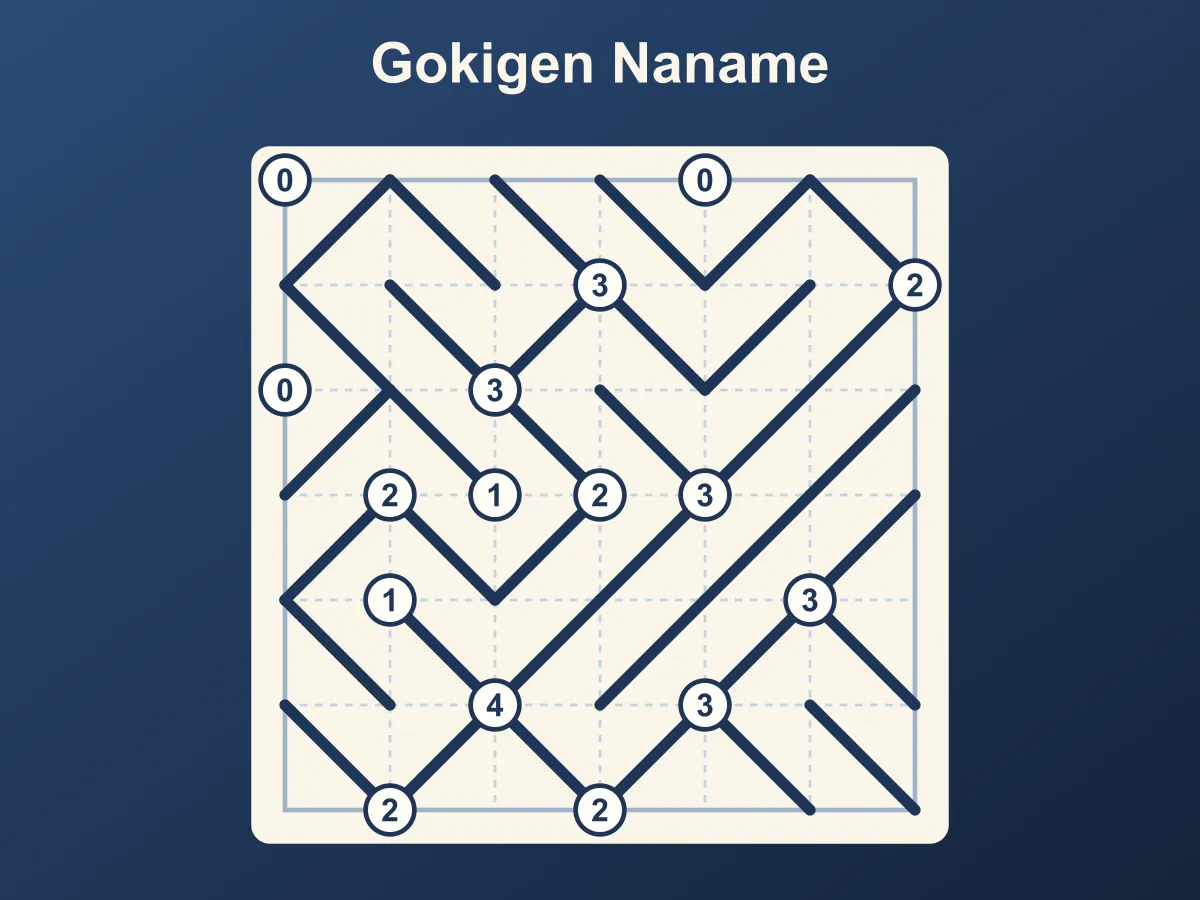
Gokigen Naname is a free online logic puzzle, known in English as Slant. Every square of the grid needs one diagonal line, either \ or /. Numbers sit on the grid points where squares meet, and each one says how many lines end at that point, from 0 to 4. The one other rule: the lines may never join up into a closed loop. They may branch and run off in any direction, and they do not have to form one network. Tap a square to draw \, tap again for /, and once more to empty it, or drag to draw the same line across several squares. A number turns red when it already has too many lines or can no longer reach its count, and the lines of a closed loop turn red too. Every board is generated by the game, has exactly one answer, and is proved solvable by reasoning alone before you see it. Eight levels run from a 5×5 grid to a 10×10. No download, no account.
How to play Gokigen Naname
- Every square of the grid gets exactly one diagonal line: \ from its top-left corner to its bottom-right, or / from its top-right corner to its bottom-left.
- A number sits on a grid point, where up to four squares meet. It tells you how many of the lines end at that point — from 0 to 4. Points without a number can have any count.
- The lines must never form a closed loop, however large. They may branch, and they do not all have to join up.
- Tap a square to draw \, tap again to switch it to /, and once more to empty it; a right-click goes round the other way. Drag across the board to draw the same line in every square you pass.
- On a keyboard, the arrow keys move a cursor, the backslash key (or B, or 1) draws \, the slash key (or F, or 2) draws /, Enter or Space cycles, and Backspace empties the square.
- The board is solved the moment every square has a line, every number is right and nothing loops.
- A red number already has too many lines or too few squares left to reach its count, and red lines mark a closed loop. The ? button settles one square — fixing a wrong line first — three times per board.
Tips
- Start with the 0s and 4s. A 0 means every square around that point leans away from it; a 4 means all four lean in, forming an X.
- Points on the edge touch only two squares and corner points only one, so a 2 on the edge or a 1 in a corner settles every square it touches.
- Once a number has its full count, every other square around it must lean away. If it needs every square left around it, they all lean in.
- Watch for loops before they close. If a line in a square would join two points that are already connected by other lines, that square must take the other diagonal.
- A diagonal always joins two points of the same checkerboard colour, so \ and / in one square can never both close a loop — one of them is always safe. On the last four levels, try one line in your head and follow it until something breaks.
FAQ
Is Gokigen Naname free to play?
Yes. It runs in the browser with no download, no sign-up and nothing to buy. All eight levels are included and unlock as you solve them, and New Puzzle deals more boards on any level you have reached.
What are the rules of Gokigen Naname?
Draw one diagonal line in every square of the grid. Each number on a grid point must equal the number of lines that end at that point, and the lines may never form a closed loop. Nothing else is required — the lines do not have to connect into one network.
Is Gokigen Naname the same as Slant?
Yes. Gokigen Naname is the name the Japanese puzzle publisher Nikoli prints it under, and Slant is the usual English name — Simon Tatham's Portable Puzzle Collection, for one, includes it as Slant. The rules are the same.
What does Gokigen Naname mean?
It is a Japanese pun. Naname means slanted or diagonal, and gokigen naname is an everyday phrase for being in a bad mood — literally a mood that is tilted. A fitting name for a grid full of slanted lines.
Does every puzzle have exactly one answer?
Yes, and it is checked rather than assumed. Each board is built from a real answer, and a program that only makes forced deductions — no guessing — must finish it before it is shown; a board it can finish that way has only one answer. The tests also count the answers of every sampled board with a separate program that does no reasoning, and find exactly one.
Will I ever have to guess?
No. Level 1 needs only counting the lines around each number. Levels 2 to 4 also need the loop rule. Levels 5 to 8 each need "what if" steps — trying a line and seeing it break a rule: one or two on level 5, up to three on level 6, four to seven on level 7, and eight or more on level 8.
Can a number be 0?
Yes. A 0 means no line ends at that point, so every square around it leans the other way. A 4 is the opposite: all four squares lean in to form an X.
How many levels are there?
Eight, from a 5×5 grid to a 10×10. Each level's boards are built fresh from a seed, so Replay gives the same board again and New Puzzle a different one at the same difficulty.
Does Gokigen Naname work on a phone?
Yes. Tap to cycle a square through \, / and empty, or drag with a finger to draw the same line across several squares. On a phone held upright the board fills the screen's width; held sideways, the buttons move beside it.