


Home / Puzzle / Greater Than Sudoku
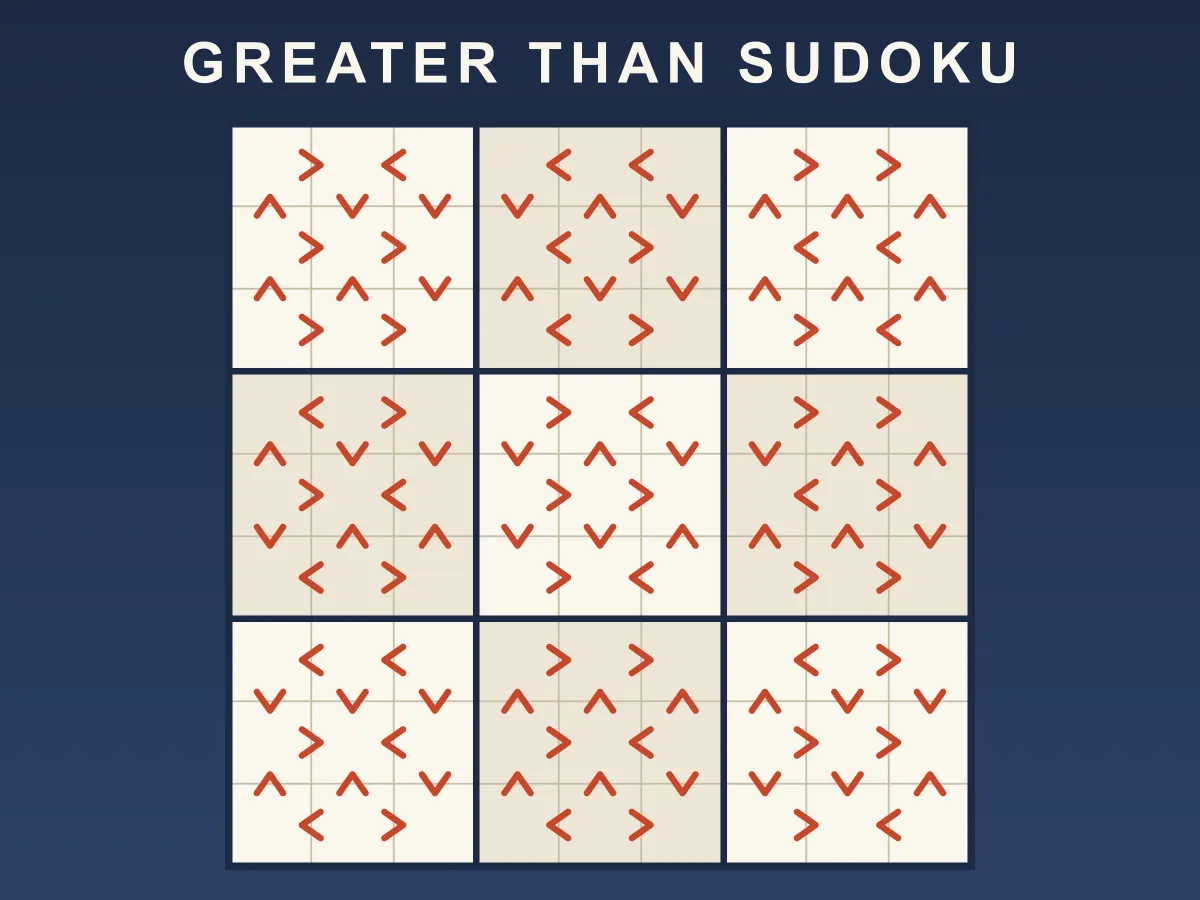
Greater Than Sudoku, also called Comparison Sudoku or Inequality Sudoku, is a free online Sudoku variant played on the ordinary 9×9 grid with its nine 3×3 boxes. Every row, column and box still holds 1 to 9 once, but the clues are different: inside each box, every pair of squares that share a side carries a less-than or greater-than sign — 12 per box, 108 on the board — and the finished grid has to make all of them true. The puzzle in its pure form prints no digits at all; you start by counting the arrows. Tap a square and pick a digit, or type it. Pencil in notes, undo, and spend up to three hints that explain their reasoning — a hint from the signs rings the squares it narrowed. Twelve levels run from 35 printed digits down to boards with not one, each needing exactly its own step, from counting signs up to chain counting. Every board is generated, has exactly one answer, and is solved by logic alone before you see it. No download, no account.
How to play Greater Than Sudoku
- The board is an ordinary 9×9 Sudoku grid split into nine 3×3 boxes by heavy lines. Inside each box, a small red chevron sits between every two squares that share a side — 12 in a box, 108 on the board. Signs never cross a box line.
- Fill every square with a digit from 1 to 9 so that every row, every column and every box holds each digit exactly once — the usual Sudoku rule.
- Every sign must also hold in the finished grid. A sign opens towards the bigger digit and points at the smaller one, the way < and > do: across a row it reads < or >, down a column it reads ∧ (the top square is smaller) or ∨ (the top square is bigger).
- Tap a square to select it, then tap a digit on the pad, or type it on a keyboard. The signs that touch the selected square are drawn bolder, so you can see what the digit has to beat. Arrow keys move the cursor, and Backspace, 0 or the ⌫ key clears a square.
- Turn on Notes (or press Space or N) to pencil small candidate digits into a square. Writing a digit clears it from the notes of every square in the same row, column and box.
- A digit repeated in a row, column or box turns red, and so does a sign whose two squares break it. A sign whose two squares are written and agree fades back, so the open signs stand out. The board is solved the moment every square is filled and every rule and sign holds.
- Stuck? A hint writes one square of the answer and names the step that finds it; for a sign step it rings the squares it narrowed. Three hints per board. New Puzzle draws a fresh board on the same level, and the level picker moves between the twelve levels you have unlocked.
Tips
- Count the arrows first. Inside a box, a square that sits above two other squares (directly or down a chain of signs) is at least 3; a square with nothing below it and eight squares above it is 1. Do this for every box before writing anything — on a board with no digits it is the only way in.
- Find where each box's 1 and 9 can go. The 1 sits in a square that every one of its signs points at, and the 9 in a square that none of its signs points at. When a box has only one square of either kind, that digit is settled.
- Read a chain as a staircase. Three squares in a row joined by < < must climb, so the middle one is at least 2 and at most 8 — and if the end of the chain is already capped by a row or column, the cap travels back down the stairs.
- A sign does work even before its neighbour is written: below a square that can be at most 6, a square is at most 5. That is the Squeeze step, and it is what opens the middle levels.
- Then use the rows and columns as you would in any Sudoku: a digit with only one place left in a row, column or box goes there, and the usual lined-up and pairs reasoning still applies.
- On the last levels, count what can actually go below a square, not just how many squares are below it. Three squares below it that can only be 4, 5 or 6 between them push it to 7 or more — the Chain Count step.
- Notes are worth it here. Pencil the possible range into a square as soon as its signs give one; ranges narrow fast once a single digit in the box lands.
FAQ
Is Greater Than Sudoku free to play?
Yes. Every level is free in your browser, with no download, no account and nothing to buy. Your progress through the twelve levels is saved in your own browser.
What is Greater Than Sudoku?
A Sudoku variant whose clues are inequality signs instead of printed digits. The grid is the ordinary 9×9 with nine 3×3 boxes, and each box carries a < or > sign between every two squares that share a side — twelve per box. The finished grid must keep every Sudoku rule and make every sign true. It is the form Wikipedia’s Sudoku article describes under that name, and it is also sold as Comparison Sudoku or Inequality Sudoku.
How do you read the signs?
The open side of a sign faces the bigger digit and the point faces the smaller one, exactly as with < and > in arithmetic. Across a row it reads < or >; down a column it reads ∧ when the top square is smaller and ∨ when the top square is bigger.
How do you solve Greater Than Sudoku with no numbers?
By counting arrows. In a box, a square with k squares below it down chains of signs is at least k + 1, and a square with k squares above it is at most 9 − k. That gives every square a range before anything is written; then the 1 and the 9 of each box fall out, and ordinary Sudoku reasoning on rows and columns takes over. The hints on this page name each step as they use it.
How is Greater Than Sudoku different from Futoshiki?
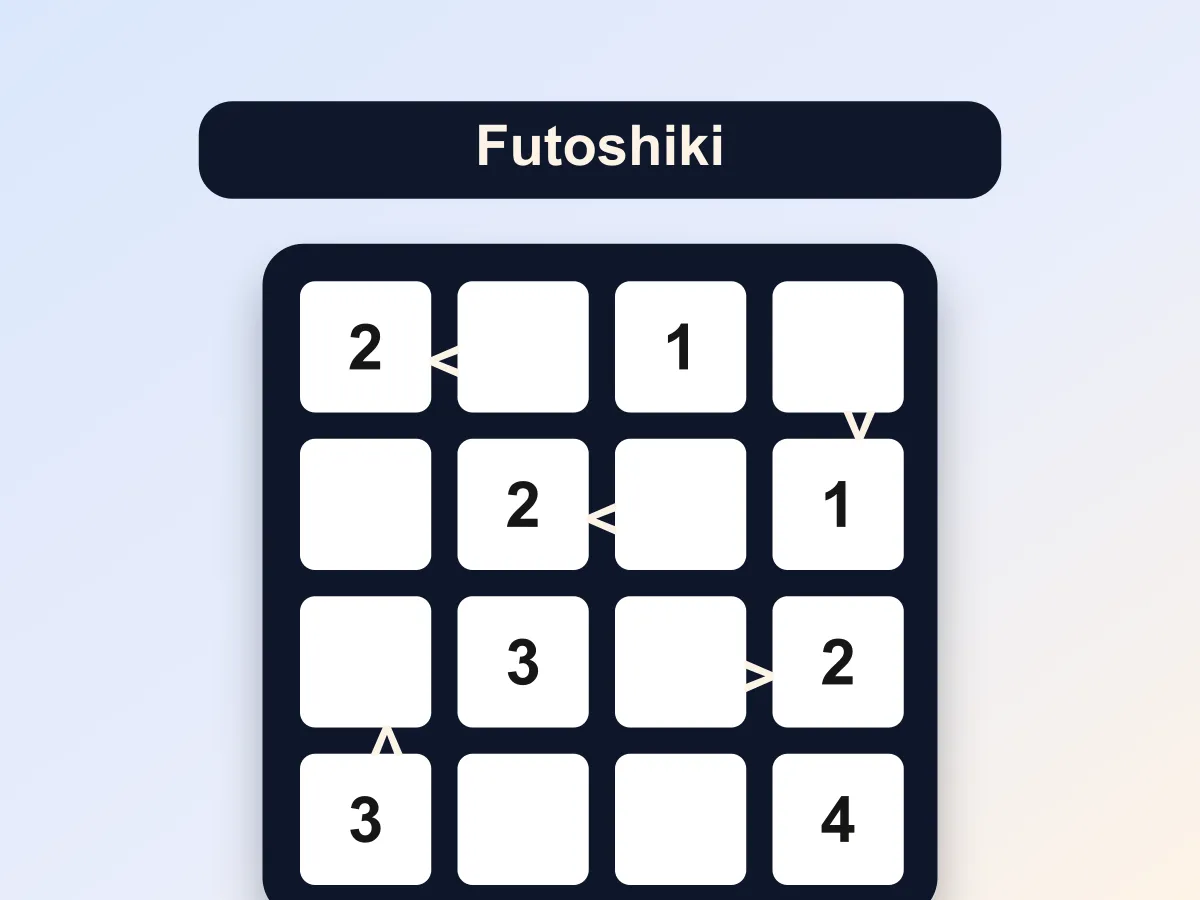
Futoshiki is a Latin square — rows and columns only, no boxes — usually on a smaller grid, with just a few signs scattered between cells and usually some digits printed. Greater Than Sudoku keeps the full 9×9 Sudoku with its 3×3 boxes, and prints a sign between every pair of neighbours inside each box: all 108 of them, every board, so the signs are the whole puzzle. This site has both; Futoshiki is the gentler place to learn the signs.
Does every puzzle have exactly one answer?
Yes. Every board is generated and then solved by a program that only makes forced deductions, so if it finishes, the answer is the only one — and a separate exhaustive count confirms each board has exactly one solution. That matters more here than in most Sudoku: in a sample of 100 random grids, the signs alone pinned down a single answer for only 16, so the no-digit levels are drawn from the grids that do.
Will I ever have to guess?
No. Each level is built to need exactly one named step and nothing harder — Only Place, Only Digit, Squeeze, Lined Up, Pairs, or Chain Count — and the generator checks that the step is really needed. If you feel stuck, there is always a forced square somewhere; a hint will point to it and say why.
Does Greater Than Sudoku work on mobile?
Yes. The board fills the width of an upright phone, with the number pad and buttons underneath; tap a square, then tap a digit. Held sideways, the pad moves beside the board. A keyboard works too on a desktop or tablet.