
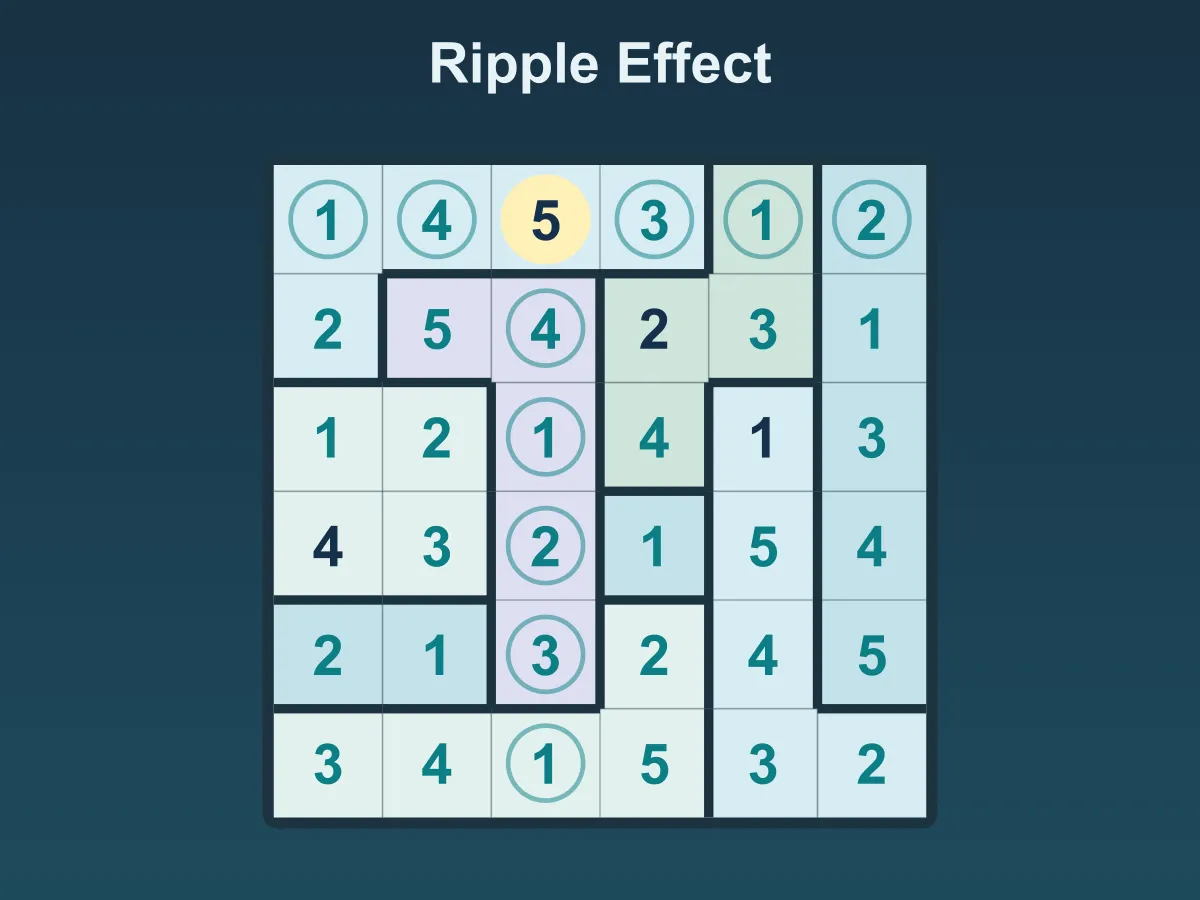


Ripple Effect is a free online number logic puzzle. The grid is cut into rooms by thick lines, and a room of three squares holds 1, 2 and 3, a room of five holds 1 to 5, each exactly once. One rule ties the rooms together: when the same number appears twice in a row or a column, there must be at least that many squares between them. Two 1s can never sit side by side, two 2s need two squares between them, two 4s need four — every number sends a ripple along its row and column as far as its own value, and no twin may land inside it. A handful of numbers are given and every other square follows from them. Tap a square and type or tap a number to write it in; select a number and its ripple lights up on the board. Switch on Notes to pencil in what a square could still be, and anything that breaks a rule turns red at once. Every grid is built by the game itself, each has exactly one answer, and each is proved solvable without guessing before you see it. Eight levels grow from a 5×5 to a 10×10. No download, no account.
How to play Ripple Effect
- The grid is divided into rooms by thick lines. A room has one to six squares.
- Fill every room with the numbers 1 up to its size, each once: a 4-square room holds 1, 2, 3 and 4.
- When the same number k appears twice in one row or one column, at least k squares must lie between them. Two 1s may never be side by side; two 3s need three squares between them.
- That spacing rule ignores the thick lines: it counts across room walls just the same. Numbers on a diagonal never clash.
- Tap a square to select it, then tap a number on the pad or type 1 to 6. Numbers bigger than the selected square's room are greyed out.
- Select a square holding a number and its ripple is ringed along its row and column — the squares where that number may not go again.
- Tap the same number again, press 0, Backspace or Delete, or use the ⌫ key to rub a square out.
- Press Notes (or N) to pencil in small numbers instead; hold Shift while typing to pencil one in without switching. Writing a number in ink rubs it out of the notes in its room and in its ripple.
- A number that breaks a rule turns red, and the line under the grid says how many squares are breaking one. On a keyboard, arrow keys move between squares.
- The grid is solved when every square is filled and no rule is broken. Undo steps back one change, Clear wipes your numbers and notes, and New Puzzle deals a different grid on the same level.
- The ? button writes one square of the answer, correcting a wrong number first. Three per grid.
Tips
- Start with the small rooms. A one-square room is always a 1, and a 1 rules out a 1 in the four squares beside it.
- Big numbers ripple far. A 5 forbids another 5 in five squares each way along its row and column, so in a narrow grid the big numbers often have only one place left.
- When a number has only one square left in its room, write it in — even if that square could hold other numbers.
- Look along the lines, not just the rooms. If every place a room could put its 3 lies within three squares of the same outside square, that square cannot be a 3, whichever place the room picks.
- Two squares of a room that can only be 1 or 2 between them take 1 and 2 away from the rest of that room.
- Select a given and read its ripple: the ringed squares are where that number is already ruled out.
- Pencil in notes on the bigger boards. Writing a number rubs it out of the notes in its ripple, so the notes stay honest as you go.
- On the later levels, try a number in your head. If writing it leaves another square or room with nothing it can hold, that number is wrong.
FAQ
Is Ripple Effect free to play?
Yes. It runs in the browser with no download, no sign-up and nothing to buy. All eight levels are included and unlock as you solve them.
What are the rules of Ripple Effect?
The grid is divided into rooms. Fill each room with the numbers from 1 up to the number of squares it has, each exactly once. If the same number k appears twice in one row or one column, there must be at least k squares between the two. Those are the rules as Nikoli, the Japanese puzzle publisher, prints them.
What does "at least k squares between them" mean?
Count the empty-or-filled squares strictly between the two equal numbers. Two 2s in a row need at least two squares between them, so they can be in columns 1 and 4 but not 1 and 3. Two 1s just cannot touch. The rule only looks along rows and columns, and it ignores the room walls; two equal numbers on a diagonal never clash.
Is Ripple Effect the same as Hakyuu?
Yes. Hakyuu is the puzzle's Japanese name at Nikoli, and Ripple Effect is the English name it is published under. The rules here are the classic ones with nothing added; only the grids are new, built by this game.
Does every puzzle have exactly one answer?
Yes, and it is checked rather than assumed. Each grid is built from a real, complete answer, and givens are removed only while a program that makes forced moves alone can still finish it; a grid it can finish that way has only one answer. The tests confirm that with an exhaustive search on every level as well.
Will I ever have to guess?
No. A grid only ships if it can be finished by deduction alone. On levels 1 and 2 every move is direct — a square with one number left, or a number with one square left in its room. Levels 3 to 5 each need at least one step that reads along a line: a square that every place a room could put a number would reach, or two squares of a room that share out two numbers between them. From level 6 on, each grid needs at least one "what if": try a number, follow it through, and see it break.
How many levels are there?
Eight, from a 5×5 grid to a 10×10, with rooms of up to four squares on the first level and up to six from level 5. The reasoning gets harder as well as the grid getting bigger: over forty grids a level, the typical grid needed about three "what if" steps on level 6 and about twelve on level 8. New Puzzle deals a fresh grid on any level you have reached.
Why are there so few numbers given?
Because the rooms and the ripples do most of the work. A one-square room is already a 1, and every number you write rules itself out of the rest of its room and of every square in its ripple. The generator removes every given it can while the grid stays solvable by logic, so a 10×10 usually starts with about ten numbers.
Does it work on a phone?
Yes. Tap a square and tap a number on the pad under the grid. On a phone held upright the game uses a taller frame, so even the 10×10 grid keeps squares large enough to tap accurately.