
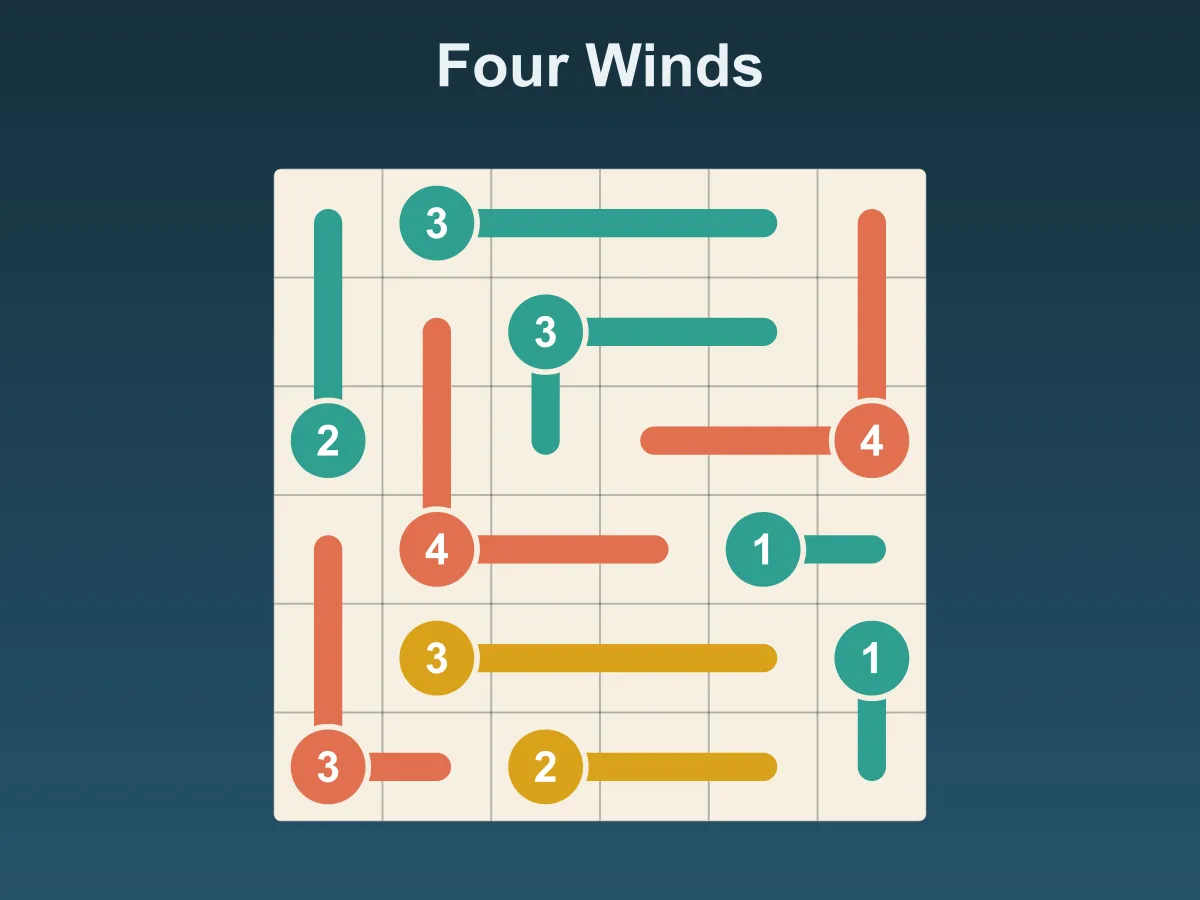





Four Winds is a free online line-drawing logic puzzle. Some squares of the grid hold a number, and from each number you draw straight lines up, down, left or right — as many of the four directions as you like, any length, including none. A number is the total length of its lines, counted in squares, and the numbered square itself does not count. Lines never cross or overlap, never run through another number, and when the puzzle is solved every empty square is covered by exactly one line. Drag out of a number to pull a line across the board, or tap an empty square and the line that can reach it grows to meet it; tap a line to cut it short. Each number's lines are drawn in its colour, and the number fills with that colour once its count is reached. A number with too much line, a number boxed in short of its count, and a square no line can reach any more all turn red straight away. Every board is built by the game and proved to have exactly one answer, which you can reach by reasoning alone — no guessing. Eight levels grow from a 5×5 to a 10×10: the first four fall to working out which line can reach which square, and the last four each need you to count what a number has room for. No download, no account.
How to play Four Winds
- Some squares hold a number. From each number you may draw straight lines in any of the four directions — up, down, left and right — each as long as you like, or none at all.
- A number is the total length of its lines, counted in squares. The numbered square itself is not counted: a 3 might be one line of three, or a line of two and a line of one.
- Lines never cross or overlap, and a line can never run through another number.
- The puzzle is solved when every number has exactly its count and every empty square is covered by a line.
- Drag out of a number to draw a line, and drag back to shorten it; drag onto the number itself to pull the line all the way in. You can also start a drag on a line that is already drawn.
- Tap an empty square to grow a line out to it. If only one number can reach it, that one grows. If several can, tap the number you mean first — it lights up, along with every square it can still reach — then tap the square.
- Tap a square on a line to cut the line there, so that square is its last one. Tap the last square of a line to take that square off too.
- On a keyboard, arrow keys move between squares, Shift and an arrow on a number grows its line that way by one square, Enter or Space acts as a tap, Backspace cuts a line at the square you are on (on a number, it takes all its lines away), and Escape lets go of the selected number.
- Undo steps back one change, Clear wipes the board, and New Puzzle deals a different board on the same level. The ? button settles one line, fixing a mistake first. Three per board.
Tips
- Look for a square only one number can reach. Check its row and column: if exactly one number sits in line with it, with nothing in between and enough count to get there, that line has to run all the way to it.
- A line stops before any square another line already covers. Once a line is drawn, cross it off every other number's reach — that is usually what leaves the next square with just one way in.
- A number that has reached its count is finished, and its other directions are closed. Watch for the 1s and 2s: they finish fast and stop blocking their neighbours.
- On the later levels, count. Add up how far a number could still reach in three directions; if that is less than its number, the fourth direction must make up the rest — so its line runs at least that far.
- The corners are good places to start. A corner square has only two directions a line can come from, and often only one number in either of them.
FAQ
Is Four Winds free to play?
Yes. It runs in the browser with no download, no sign-up and nothing to buy. All eight levels are included and unlock as you solve them.
What are the rules of Four Winds?
Draw straight lines up, down, left or right out of the numbers. Each number is the total length of its own lines, not counting its own square. Lines never cross, overlap or pass through another number, and every empty square must be covered by exactly one line.
Does the numbered square count towards its number?
No. Only the squares the lines cover count. A 1 covers one square next to it, in whichever direction the puzzle needs, and a 4 might send one line of four or split its four squares between up to four directions.
Does every puzzle have exactly one answer?
Yes, and it is checked rather than assumed. Each board is built from a real answer, and a program that only ever makes moves the rules force has to be able to finish it before it is shown; a board it can finish that way has only one answer. The tests also confirm boards on every level with an exhaustive search that works a different way.
Will I ever have to guess?
No. On levels 1 to 4 every square can be settled by working out which line can reach it: a square only one line can reach belongs to that line, a line stops before a square that is already taken, and a finished number stops growing. Levels 5 to 8 each need one more step at least once — counting how much room a number has left in three directions to see how far it must reach in the fourth.
How many levels are there?
Eight. Levels 1 to 4 grow from a 5×5 to an 8×8 and are solved by reach alone, with longer chains of "this square, therefore that one" as they grow. Levels 5 to 8 run from a 7×7 to a 10×10 and each needs the counting step. New Puzzle deals a fresh board on any level you have reached.
Why are the lines different colours?
So two lines that meet end to end still read as two lines. Numbers that share a row or a column never share a colour, and a number fills with its colour once its lines add up to it.
What does red mean?
A number with a red ring has a mistake: either its lines already add up to more than it, or it is boxed in and can no longer reach its count. A square shaded red is one that no line can reach any more, so something around it has to change.
Does it work on a phone?
Yes. Drag a finger out of a number to draw, or tap squares to grow and cut lines. On a phone held upright the game uses a taller frame, so the board spans the full width of the screen.