
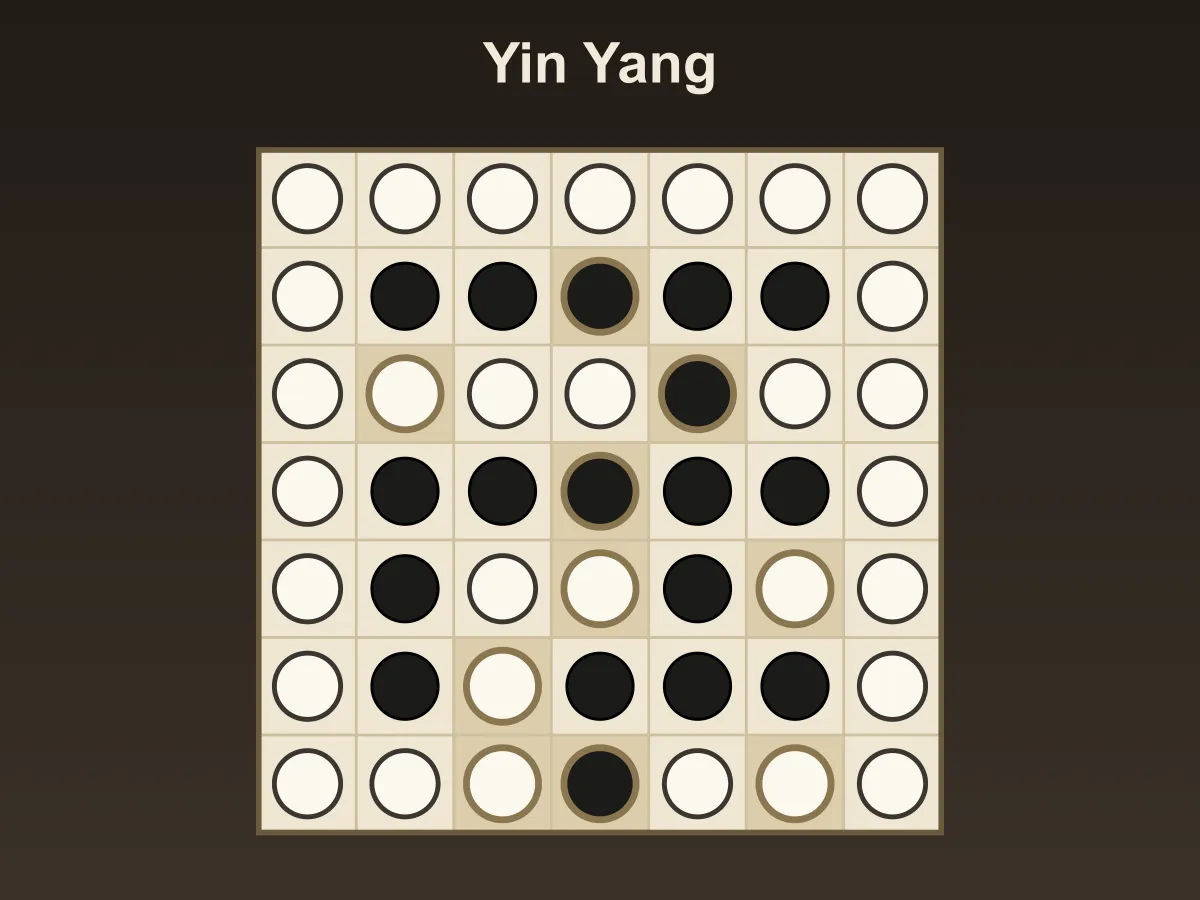


Yin Yang is a free online black and white logic puzzle. Every square of the grid must end up black or white, and a few are given to start you off. All the black squares have to join into one group, side to side rather than corner to corner, and so do all the white ones; and no 2×2 block may be all black or all white. Tap a square to turn it black, tap again for white, and once more to empty it, or drag across the board to paint several at once. A red frame marks a 2×2 block of one colour, and a red ring a group already cut off from the rest of its colour. Every board is generated by the game, has exactly one answer, and is proved solvable by reasoning alone before you see it. Eight levels run from a 5×5 grid to a 9×9. No download, no account.
How to play Yin Yang
- Every square of the grid must end up black or white. The squares that start with a stone on a darker background are given and cannot be changed.
- All the black squares must form one group, each joined to the next along a side; touching only at a corner does not count. The white squares must form one group the same way.
- No 2×2 block of squares may be all black or all white.
- Tap a square to make it black, tap again to make it white, and once more to empty it; a right-click goes round the other way. Drag across the board to paint every square you pass with the colour the first one turned to.
- On a keyboard, the arrow keys move a cursor, B or 1 colours a square black, W or 2 white, Enter or Space cycles it, and Backspace empties it.
- A red frame marks a 2×2 block of one colour, and a red ring marks a group cut off from the rest of its colour: nothing added later can join it up again.
- The board is solved the moment every square is coloured and every rule holds. Undo steps back one change, Clear removes everything you added, and New Puzzle deals another board on the same level.
- The ? button settles one square: a square coloured against the answer is turned the right way first, otherwise it colours the next square the reasoning reaches. Three per board.
Tips
- Look at every 2×2 block with three squares filled. If they are all one colour, the fourth is the other; if they make two of a checkerboard's corners and one of the other pair, the fourth cannot finish the checkerboard.
- A 2×2 checkerboard — black and white on one diagonal, white and black on the other — can never happen: the two blacks would have to join up round the block, and so would the two whites, and a black chain and a white chain cannot cross.
- Walk round the edge of the grid. The colour can change at most twice on the way round, so between two black squares on the border with no white between them, everything is black.
- When two groups of one colour can only meet through one square, that square is their colour. Likewise a square no chain of black squares could ever reach has to be white.
- On the last three levels, try one square in your head. If colouring it black leads to a block of four or a cut-off group, it is white.
FAQ
Is Yin Yang free to play?
Yes. It runs in the browser with no download, no sign-up and nothing to buy. All eight levels are included and unlock as you solve them, and New Puzzle deals more boards on any level you have reached.
What are the rules of the Yin Yang puzzle?
Colour every square black or white. All the black squares must be connected into one group through shared sides, all the white squares must be connected the same way, and no 2×2 block may be a single colour. Some squares are given at the start; find the one colouring that keeps every rule.
Why can a 2×2 block never be a checkerboard?
It is not a separate rule; it follows from the others. In a checkerboard block the two black squares touch only at a corner, so they have to join up by a path of black squares round the outside, and the two white squares likewise. Those two paths would have to cross, and a black path and a white path cannot share a square. The same reason means the colours change at most twice going round the edge of the grid.
Does every puzzle have exactly one answer?
Yes, and it is checked rather than assumed. Each board is built from a real colouring, and a program that only makes forced deductions — no guessing — must finish it before it is shown; a board it can finish that way has only one answer. The tests also count every possible answer row by row and find exactly one.
Will I ever have to guess?
No. Level 1 needs only the 2×2 blocks. Levels 2 to 5 also need joining up: a square every connection between two groups must pass through, a square no group of its colour can reach, and the two colour runs round the edge. Levels 6 to 8 each need "what if" steps — one or two on level 6, two to four on level 7, and five or more on level 8.
How is Yin Yang different from Nurikabe?
Both shade a grid with no 2×2 block of one kind. In Nurikabe only the shaded wall has to be connected, and the numbers say how big each unshaded island is. In Yin Yang there are no numbers: both colours must form a single connected group, and a few given squares are all you start with.
Where does the Yin Yang puzzle come from?
Erik Demaine's notes on the puzzle trace its earliest known printing to the Japanese puzzle magazine Puzzler, issue 137, in March 1993; a year later the magazine called it Shiromaru-Kuromaru, "white circle, black circle". Where the name Yin Yang comes from is not known.
How many levels are there?
Eight, from a 5×5 grid to a 9×9. Each level's boards are built fresh from a seed, so Replay gives the same board again and New Puzzle a different one at the same difficulty.
Does Yin Yang work on a phone?
Yes. Tap to cycle a square through black, white and empty, or drag with a finger to paint. On a phone held upright the board fills the screen's width; held sideways, the buttons move beside it.