
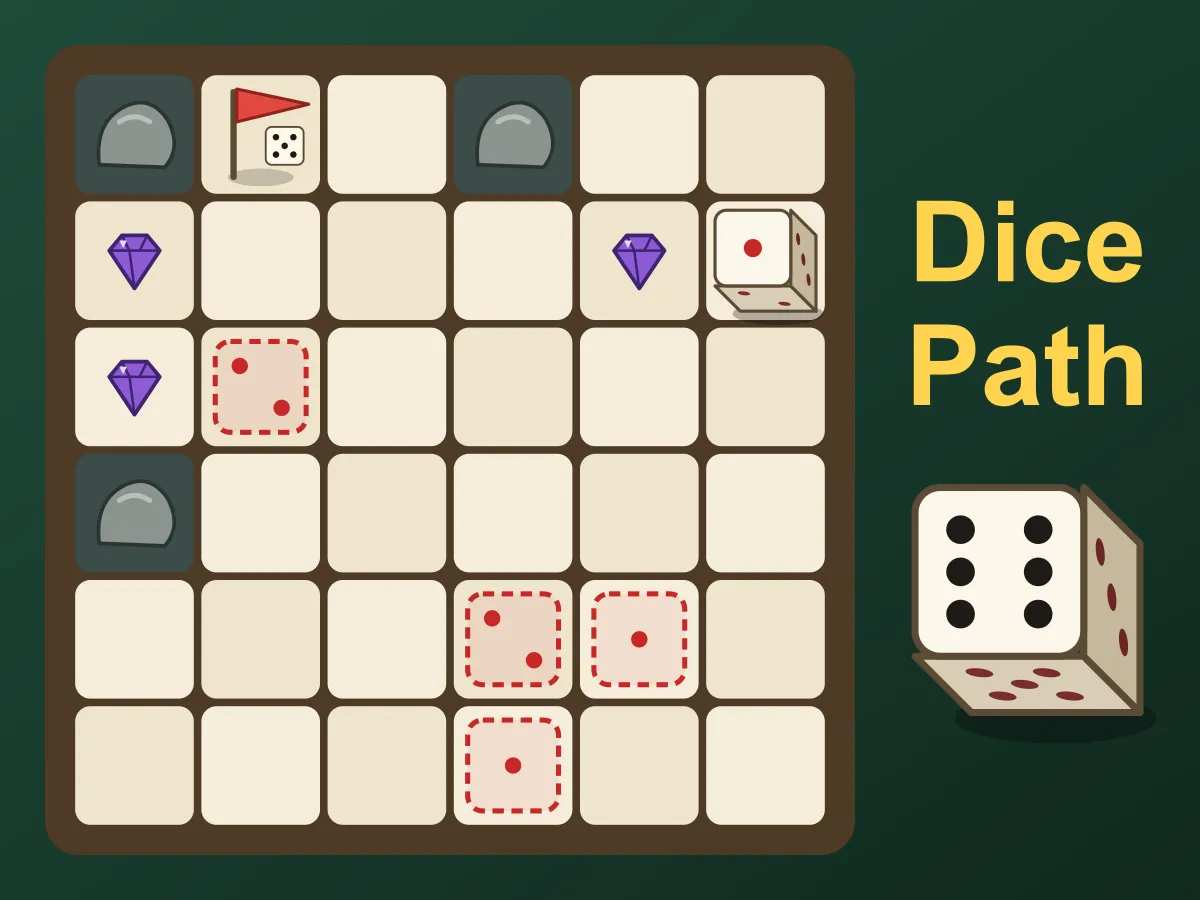






Dice Path is a free online rolling-dice puzzle. One die sits on a grid, and every move tips it over an edge onto the next square, so a different face comes up each time: roll north and the face that was looking south comes to the top. The flag wants a set number on top, stamp squares only take the die showing their number, gems must be picked up on the way, and on the total boards every roll adds the new top face to a running sum that has to finish at exactly the target. Twelve boards in four chapters, from a 4×4 warm-up to a 7×7 finale, each with a par worked out by computer search, plus a roll pad that shows what each roll brings up, hints and unlimited undo. Plays in the browser on a phone or a computer, no download.
How to play Dice Path
- Each board has one die, a start square and a flag. Roll the die onto the flag the way the board asks to win.
- Roll by tapping a square next to the die, swiping on the board, pressing an arrow key (or WASD), or pressing the roll pad. The squares you can roll onto are outlined.
- A roll tips the die over one edge, so the face on top changes: rolling north brings up the face that was looking south, rolling east brings up the face that was looking west. Opposite faces always add up to seven.
- The roll pad beside the board shows the face on top in the middle and, on each arrow, the number that roll would bring up.
- On most boards the flag shows a small die face: the die must arrive showing that number. It can roll across the flag without stopping if the number is wrong.
- Squares printed with red pips are stamps. The die can only land on a stamp with that number on top. Rocks cannot be entered at all.
- Purple gems must be picked up — rolled onto — before the flag counts. On the total boards every roll adds the new top face to a running total, and the flag only counts at exactly the target; a roll that would pass it is refused.
- Every roll counts. Finish in par — the fewest rolls possible — for three stars, within the two-star line for two, and any finish earns one. Hint shows the next roll of a best route, and Undo takes rolls back.
Tips
- Rolling the same way four times brings the die back to the face it started with, and rolling there and back undoes a roll. Short wiggles are how you dial in a face.
- The face looking south comes up when you roll north, and the face looking west comes up when you roll east. The die on the board shows its south and east faces, so you can read two of the four next tops at a glance.
- Opposite faces add to seven. If a 2 is on top, the 5 is underneath, and one roll in any direction can never bring the 5 up.
- On a stamp board, work backwards from the stamp: which face has to be looking that way just before you roll onto it?
- On a total board the flag is usually close; the work is adding up. Rolling back and forth between two squares adds the same two faces over and over, which is an easy way to count up in steps.
- High faces finish a total fast and low faces let you fine-tune it. Check the pad before the last few rolls so you do not overshoot.
- If you are stuck, ask for a Hint. When the flag can no longer come out right from where you are, it says how many rolls to undo.
FAQ
Is Dice Path free to play?
Yes. It runs in the browser with no download, no sign-up and nothing to buy. All twelve boards are included and unlock one after another as you finish them.
How does rolling change the number on top?
The die tips over the edge it is rolling towards. Roll north and the face that was looking south comes to the top; roll south and the face that was looking north comes up; roll east and the west face comes up; roll west and the east face comes up. Opposite faces of a die always add up to seven, so the number underneath is seven minus the number on top.
What are the red squares with pips?
Stamps. The die may only land on a stamp when the number on top matches the pips printed on it. A roll that would land with a different number is refused, and the message tells you what it would have shown. Stamps first appear on board 4.
How do the total boards work?
From board 10 on, every roll adds the new top face to a running total shown above the board. The flag only counts when the total is exactly the target, and any roll that would take the total past the target is refused. Rolling back and forth between two squares is a handy way to add up.
Can I get stuck?
You can reach a position the flag can no longer be won from — for example a total too high to finish on the flag. Nothing is lost: Undo takes rolls back one at a time, and Hint says how many to undo.
How are par and the stars worked out?
A computer search tries every position a board can reach — the square, which of the 24 ways the die is turned, the gems picked up and the running total — and finds the fewest rolls, so three stars are always possible. The two-star line is the median of 41 runs by a player who knows the way but strays on one roll in four, and never less than two over par: every roll moves the die to a square of the other colour, so a finish is always an even number of rolls away from par. Any finish earns one star.
Do I need to know how a die is numbered?
No. The die on the board shows its top, south and east faces, and the roll pad shows the number each roll would bring up, so you can always see what is coming. Knowing that opposite faces add to seven just makes planning quicker.
Does Dice Path work on a phone?
Yes. Tap the square you want to roll onto, swipe on the board, or use the roll pad. On a phone held upright the board sits above the pad and buttons; on a wider screen they sit beside it.