


Home / Board / Royal Game of Ur
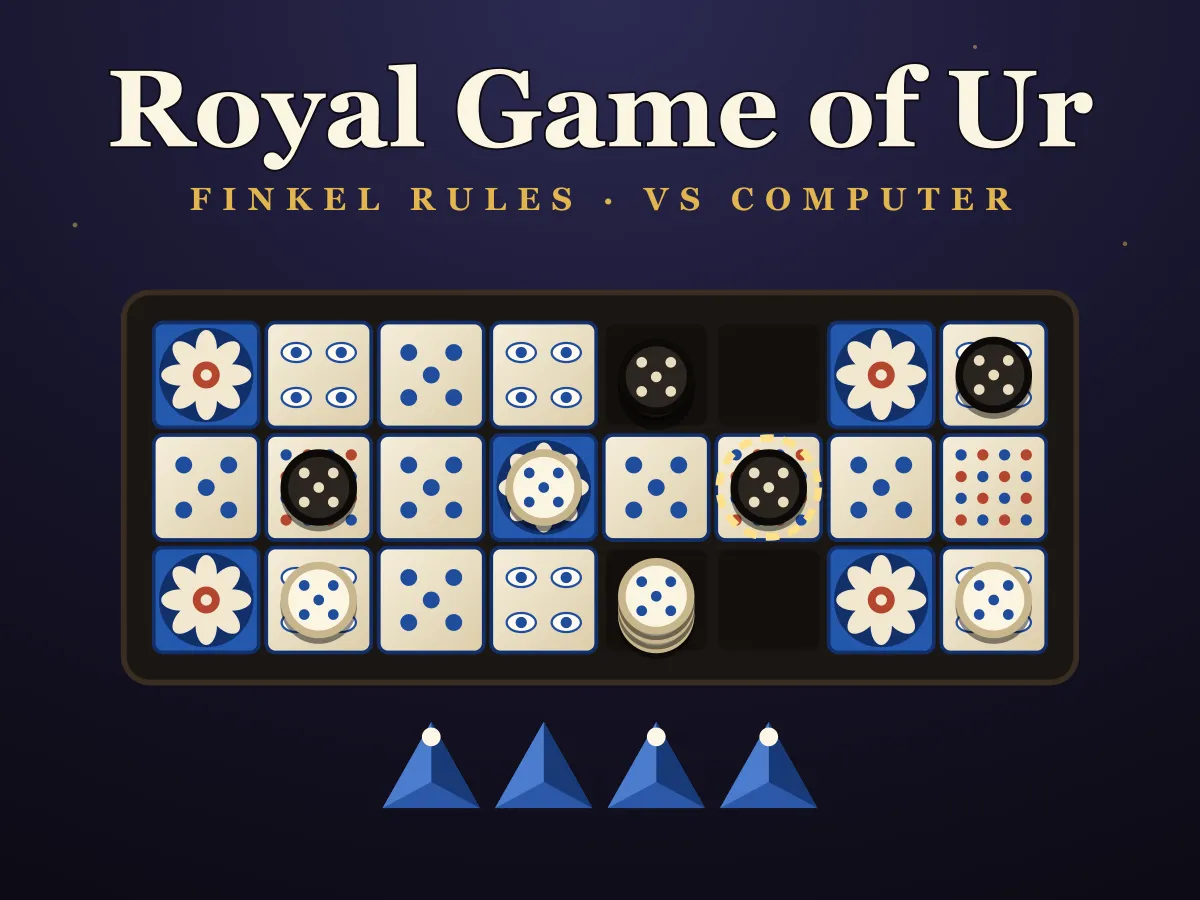
The Royal Game of Ur is one of the oldest board games ever found — and, unusually for a game that old, one whose rules were written down — and you can play it here free in your browser against the computer, with no download and no sign-up. Its boards were dug out of the Royal Cemetery at Ur, in what is now southern Iraq, and are about 4,500 years old; the rules come from a Babylonian clay tablet of 177 BC, which Irving Finkel of the British Museum deciphered and turned into the version most people play today. Each side races seven pieces along a path of fourteen squares — four along its own row, eight up the shared middle row where the fighting happens, and two back down its own side — and bears every piece off the far end. Four pyramid-shaped dice give a move of 0 to 4. Land on an opposing piece in the middle row and it goes back to the start; land on one of the five flower-shaped rosettes and you roll again, and the rosette in the very middle is a safe square no one can capture you on. Five computer opponents, from a Shepherd who leaves pieces hanging to a King of Ur who looks three rolls ahead, are each measured against a plain racing player, so you know exactly how hard each one is.
How to play Royal Game of Ur
- You play the white pieces along the bottom row; the computer plays the black ones along the top. Both sides start with seven pieces waiting in the tray beside their row, and you roll first.
- Tap the dice to roll. Each of the four pyramid dice has two of its four tips marked, and your move is the number of marked tips pointing up: 0, 1, 2, 3 or 4. A roll of 0 is no move at all.
- Move one piece that many squares. Your path is fourteen squares long: four along your own row to the corner rosette, eight back the other way along the shared middle row, then two along the end of your own row and off the board. Gold rings show where each piece would land.
- Enter a new piece by moving it from the waiting tray onto your row, or move a piece that is already on the board. You may never land on one of your own pieces.
- Land on one of the computer's pieces in the middle row and it is captured: it goes back to its tray and has to start the whole journey again. The squares on your own row are yours alone, so nothing can be captured there.
- Land on a rosette — the flower squares in the corners and in the centre — and you roll again straight away. A piece on the centre rosette cannot be captured, and the other side cannot land there while you hold it.
- A piece leaves the board only on the exact roll: a 1 from the last square, a 2 from the one before it, and so on. The first side to bring all seven pieces home wins.
Tips
- The centre rosette is the most valuable square on the board. It is safe, it gives you an extra roll, and while you sit on it your opponent cannot use it — many good players park a piece there for most of the game.
- Count the danger before you step into the middle row. A piece one to four squares in front of an opposing piece can be hit next roll, and a 2 comes up 6 times in 16, so two squares ahead is the riskiest place to stand.
- A piece far along the middle row is worth far more than a fresh one, because losing it costs the whole journey. Get your advanced pieces out of the shared row before you start new ones.
- Use your own row as a waiting room. Squares 1 to 4 are safe from capture, so a piece parked there can wait for the right roll to jump past danger or onto the centre rosette.
- When a roll lets you capture, take it unless it leaves the capturing piece badly exposed — sending back a piece that was nearly home is often the turning point of a game.
- Plan for the exact finish. A piece on your last square needs exactly a 1 to leave, and a 1 comes up only 4 times in 16, so moving a piece onto the home stretch early can leave it stuck there while the pieces behind it need room.
- Use Hint when you are unsure. It thinks with the same three-roll look-ahead as the strongest opponent and lights the piece it would move.
FAQ
Is the Royal Game of Ur free to play?
Yes. You can play every level free in your browser, with no download, no account and nothing to buy. The level you have reached is saved in your own browser.
Can I play the Royal Game of Ur on my phone?
Yes. Every move is a tap — tap the dice to roll, then tap the piece you want to move — and the board turns upright when you hold your phone upright, so the squares stay large enough to hit. It works with a mouse or the keyboard on a computer too.
What are the rules of the Royal Game of Ur?
This game uses Irving Finkel's rules. Each side has seven pieces and a path of fourteen squares, sharing the eight squares of the middle row. Four pyramid dice give a move of 0 to 4. You cannot land on your own piece; landing on an opposing piece in the middle row sends it back to the start; landing on a rosette gives you another roll, and the centre rosette is safe from capture. Pieces leave on the exact roll, and the first side with all seven pieces home wins.
Where do the rules come from?
The boards were found by Leonard Woolley in the Royal Cemetery at Ur in the 1920s, but no rules were buried with them. The rules come from a cuneiform tablet written in 177 BC by a Babylonian scribe, which Irving Finkel, a curator at the British Museum, deciphered and published. His reconstruction is the one most modern sets and online versions play, and it is the one this game follows. Other rule sets exist, so treat any version, this one included, as a reconstruction rather than the certain ancient game.
What are the odds on the four dice?
Each die has two marked tips out of four, so it counts 1 half the time. With four dice that gives a 2 six times in 16, a 1 or a 3 four times in 16 each, and a 0 or a 4 only once in 16. That is why two squares is the most dangerous distance to stand in front of an opposing piece.
How do you win the Royal Game of Ur?
Be the first to bring all seven of your pieces around the board and off the far end. A typical game takes about 240 rolls between the two sides, so it is a long race with plenty of swings: captures in the middle row and extra rolls from the rosettes decide most games.
How strong is the computer?
There are five opponents, and each was measured over 1,000 games against a player that simply captures whenever it can, takes a rosette whenever it can and otherwise pushes its leading piece. The Shepherd wins 38% of those games, the Scribe 70%, the Merchant 81%, and the High Priestess and the King of Ur 93% each. The King looks one roll further ahead than the High Priestess and beats her 55% of the time head to head. Win a game to unlock the next opponent.
Is going first an advantage?
A little. When the same player takes both sides, the side that rolls first wins 53.4% of games between two strong players and barely 50.35% between two simple racers. You always roll first here, so the edge is yours.
How is the Royal Game of Ur different from Senet?
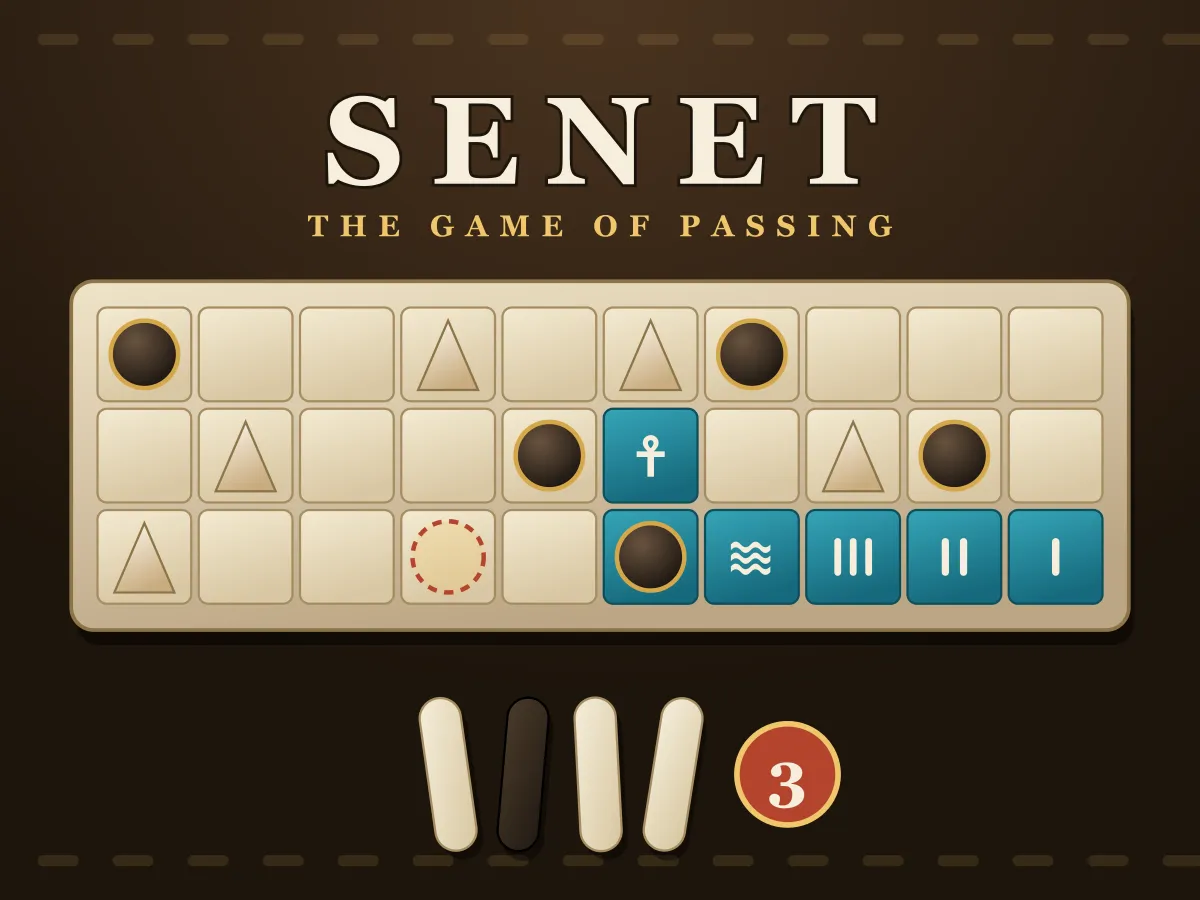
They are both ancient race games, but they play very differently. Senet, from Egypt, is a single track of thirty squares that both sides share from the start, played with four throwing sticks where a throw of nothing is worth five, and a piece that is landed on swaps places rather than going home. Ur, from Mesopotamia, gives each side its own safe row, uses pyramid dice where a 0 means no move, sends captured pieces all the way back, and rewards the rosettes with extra rolls. Both are on this site if you want to compare them.