
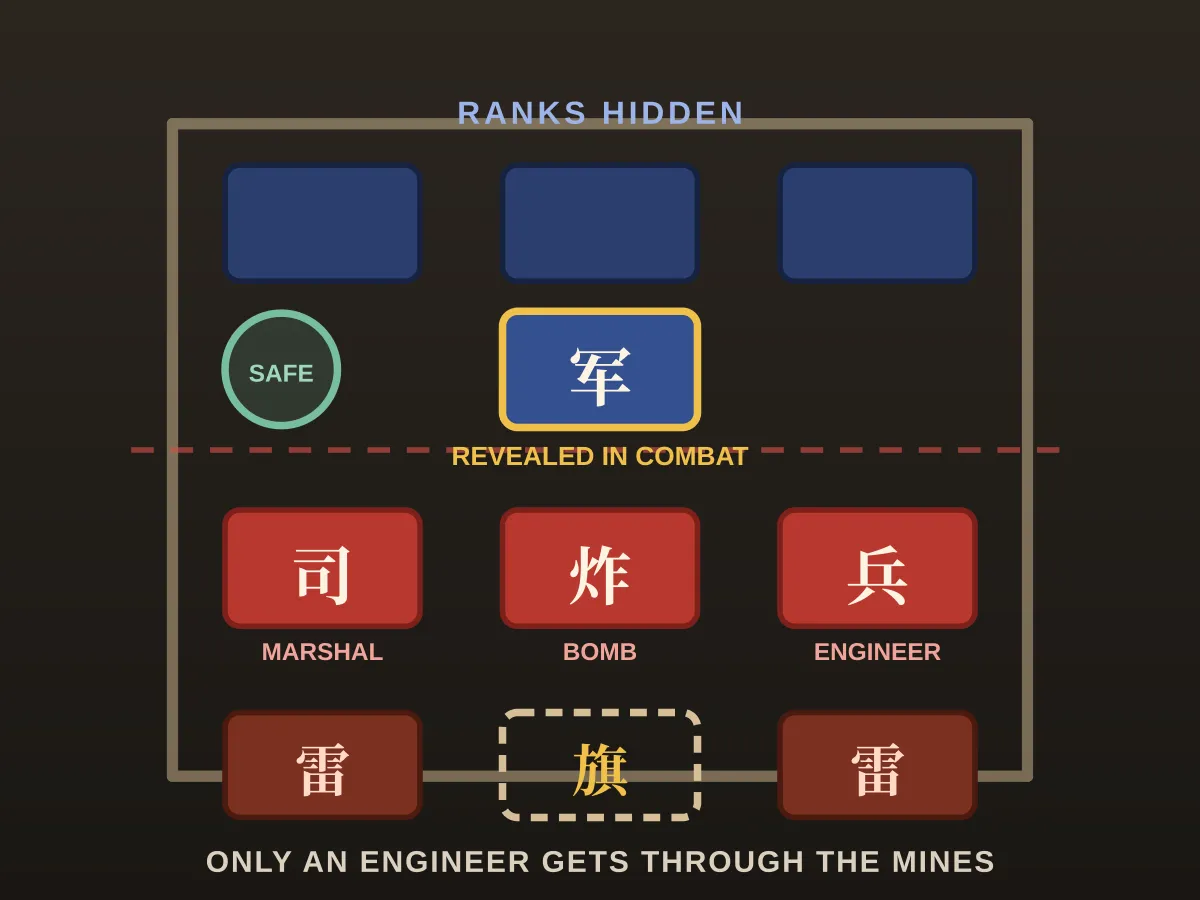






Junqi, also called Luzhanqi or Chinese military chess, is a free online board game you can play instantly in the browser against a computer opponent, with no download and no account. Both armies are 25 pieces on a five-by-twelve board, and the whole game turns on one thing: you cannot see the opponent’s ranks. Their army is blank tiles until something bumps into it, and when two pieces meet the higher rank wins and both are revealed to everybody. So this is not a game of calculating lines. It is a game of spending a platoon to find out what is guarding the left flank, and of remembering what you were told twenty moves ago. Three pieces ignore the rank ladder entirely and they are what make the bluffing work. A bomb destroys itself and whatever it touches, so a field marshal dies to one exactly like a platoon does. A landmine cannot move at all and kills anything that attacks it — except an engineer, who defuses it and survives, which is the only reason a rank-one piece is worth keeping. And the flag cannot move, loses to anything, and ends the game when it is taken. Movement runs on two networks: roads, where you step one square, and railways, where you slide any distance in a straight line. Engineers alone may turn corners on the railway, so an engineer can cross the whole board in a move while a marshal on the same rail cannot. Camps are safe squares where a piece cannot be attacked at all. Six levels of opponent differ in one thing above all — how much they remember of what you have already shown them.
How to play Junqi
- You command the red army at the bottom. You can see your own ranks the whole game; the blue army is blank tiles until its pieces fight.
- Tap one of your pieces to see every square it can reach, then tap one of the highlighted squares to move there.
- When you move onto an enemy piece they fight. The higher rank wins, equal ranks destroy each other, and either way both pieces are revealed to both sides from then on.
- The ranks from strongest down are: Field Marshal, Army Chief, Division Chief, Brigade Chief, Regiment Chief, Battalion Chief, Company Leader, Platoon Leader, Engineer.
- A Bomb destroys itself and whatever it meets, at any rank. It is the answer to a marshal, and it is why walking your marshal into an unknown piece is a real risk.
- A Landmine cannot move and destroys anything that attacks it — except an Engineer, who defuses it and survives. Mines can only be placed in your back two rows, so the flag always sits behind a minefield.
- The Flag cannot move, must sit in a headquarters, and loses to anything. Taking it wins the game immediately.
- Roads move you one square. Railways — the thick lines down both flanks and across four rows — let a piece slide any distance in a straight line, as long as nothing is in the way.
- Engineers are the only pieces that may turn corners on a railway, which lets one cross the whole board in a single move. That is what a rank-one piece is really for.
- The five circular camps are safe squares: a piece standing in one cannot be attacked at all. A piece that enters a headquarters, though, can never move again.
- The two front lines are joined at three columns only, not five, so the middle of the board is a set of chokepoints rather than an open border.
- If a side loses its Field Marshal, its flag is revealed. If neither army can break through, the game is settled on remaining strength after 300 moves.
Tips
- Probe with your cheapest pieces. A platoon spent finding out that the enemy left flank is a division chief is a platoon well spent — you cannot plan anything until you know something.
- Write nothing down but remember everything. Every fight tells both players a rank permanently, and the levels above three punish a player who forgets faster than they punish a bad move.
- Keep your marshal off the front line early. It beats everything except a bomb, and a bomb is exactly what an opponent leaves in the way of a marshal that has been advertising itself.
- Send an engineer around the railway. It can turn corners where nothing else can, so it reaches the back of the board while the opponent is still watching the middle.
- Camps are the strongest squares on the board and they cost nothing. Parking a piece in one makes it permanently safe and forces the opponent to go around.
- Do not walk into a headquarters. Anything that enters one is frozen there for the rest of the game, which is a way to lose a marshal without a shot being fired.
- Mines sit in the back two rows, so the last two ranks in front of the flag are almost always mined. Keep at least one engineer alive for that moment — nothing else gets through.
- When your marshal dies your flag is revealed. That is a reason to trade it off only when the exchange is genuinely worth it, not simply because it wins the fight in front of you.
FAQ
Is Junqi free to play?
Yes. It runs in your browser with no download, no sign-up and nothing to buy. All six opponent levels are here and unlock as you beat them.
Can I see the computer’s pieces?
No, and neither can it see yours. Both armies start face-down to the other side and a piece is only revealed once it has fought. The computer plays entirely on what it has been shown — it does not read hidden ranks, which is a design decision rather than a limitation: an opponent that peeks is not harder, it is just unbeatable in ways you cannot learn from.
What beats a Field Marshal?
A bomb, a landmine, or another marshal. The marshal is the top of the rank ladder and beats every officer, but bombs and mines ignore rank completely — a bomb destroys itself and whatever it touches, and a mine destroys anything that attacks it apart from an engineer.
What is the Engineer for if it is the weakest piece?
Two things, and both matter more than its rank. It is the only piece that can defuse a landmine and survive, which makes it the only way through the minefield in front of the flag. And it is the only piece that can turn corners on the railway, so it can cross the entire board in one move while everything else is limited to straight lines.
What are the circles and the dashed squares on the board?
The circles are camps: a piece standing in one cannot be attacked at all, and they connect diagonally as well as up and down. The dashed squares at each end are headquarters — the flag must be in one, and any piece that moves into a headquarters can never move again.
How do railways work?
The thick lines down both flanks and across four of the rows are railways. A piece standing on one can slide any distance along it in a straight line, provided nothing is in the way. Only engineers may turn corners; everything else has to stay on the one straight run it started on.
Can I arrange my own army?
Not piece by piece — a fresh legal deployment is generated for you each game, and New Deployment gives you another one before the first move. Placements always obey the real rules: the flag in a headquarters, mines only in the back two rows, and no bombs on the front line.
Does it work on a phone?
Yes. The pieces are wide rectangular tiles, the way a real Junqi set is made, so a five-by-twelve board still fits a phone screen with tappable squares. The casualty list is shown beside the board on wider screens only, where there is room to spare.