
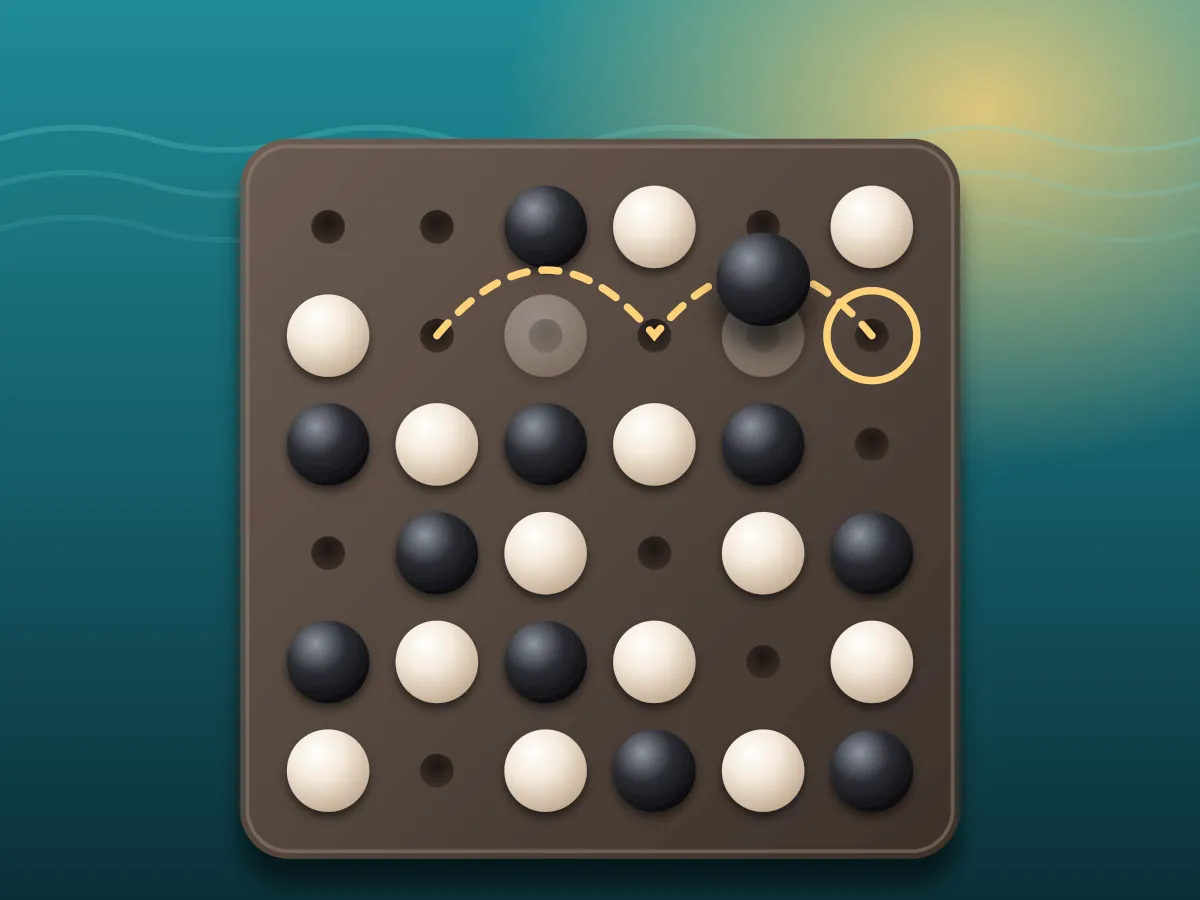



Kōnane is the traditional Hawaiian board game, free to play online against the computer with no download and no sign-up. The board starts completely full of black and white stones. After two stones are lifted to open a gap, every move is a capture: jump one of your stones straight over an enemy stone into an empty point, and keep jumping in the same line if you can. There are no plain moves and no draws — the first player who cannot jump loses, so the real game is keeping moves for yourself while starving your opponent of theirs. Choose the standard 8×8 board or a quick 6×6, play Black or White, and climb five computer opponents from a Novice to a Master that reads endgames to the very last jump, with hints, undo and saved games.
How to play Kōnane
- Pick a board — the standard 8×8 or a quick 6×6 — and whether you play Black or White. The board starts full, black and white stones alternating like the squares of a chessboard, and Black always moves first.
- Opening: Black lifts one of its own stones from the middle four points or from a corner (the glowing ones). White then lifts one of its stones right next to that hole.
- Every move after that is a jump. Tap one of your stones with a ring, then a glowing empty point: your stone jumps straight over a neighbouring enemy stone — up, down, left or right — and the jumped stone comes off. You can also drag the stone.
- A stone may keep jumping over more enemy stones, but only on in the same straight line, and it may stop after any jump. Diagonal jumps, turns and plain steps are not allowed.
- You win by making the last move: the first player who has no jump on their turn loses. Every move takes at least one stone, so a game always ends, and it can never be a draw.
- Beat an opponent to unlock the next one. Hint shows the Master’s choice of move, Undo takes back your last move and the computer’s reply, and an unfinished game is saved for next time.
Tips
- Count moves, not stones. A player with more stones left can still lose — what matters is who still has a jump when it is their turn.
- Before each jump, look at what it opens up for your opponent: the point your stone leaves becomes a landing spot, and that is how most jumps get answered.
- Keep a jump in reserve. A move that only you can make, and that your opponent cannot block or use, is worth saving for the endgame when everything else has run out.
- Stones on the edge of the board can only be jumped along the edge, so they are hard to capture but have few jumps of their own. Use them as safe reserves.
- A long multi-jump is not always best. Stopping after the first jump can leave your stone where it blocks an enemy landing point or keeps a second jump for later.
FAQ
Is Kōnane free to play online?
Yes. Kōnane is free to play in your browser with no download, no account and no in-game purchases.
How do you win at Kōnane?
By making the last move. Every turn must be a jump, and the first player who has no jump available on their turn loses. It does not matter how many stones either side has left at that point.
How does a Kōnane game start?
The board starts completely full, black and white stones alternating. Black removes one of its own stones from one of the middle four points or from a corner, and White then removes one of its stones next to that empty point. On this 8×8 board that gives Black four ways to open — two middle points and two corners — and from then on every move is a jump.
Can a stone jump more than once in Kōnane?
Yes, but only in a straight line. After jumping over one enemy stone, your stone may jump again over the next enemy stone in the same direction if there is an empty point beyond it — and it may also stop after any jump. It can never change direction partway, and it can never jump diagonally.
How is Kōnane different from checkers?
Kōnane is sometimes called Hawaiian checkers, but it plays very differently. Checkers starts with a half-empty board, pieces move diagonally, plain moves are allowed and kings can be crowned. Kōnane starts with every point filled, jumps go only up, down, left and right, there are no plain moves at all, and you win not by taking every enemy piece but by leaving your opponent without a jump.
Can Kōnane end in a draw?
No. Every move removes at least one stone, so the game always ends, and when it does one player has made the last jump. That is also why mathematicians like the game: whoever moves last wins, which makes it a classic example in combinatorial game theory.
Is it better to play Black or White?
It is close. With the Expert playing both sides from random openings, Black won 103 of 200 games on the 8×8 board and 120 of 200 on the 6×6 board, so moving first matters a little more on the small board. You can choose your colour before every game.
How strong is the computer?
Each pairing of levels was measured over 200 computer-against-computer games on the 8×8 board (100 random openings, each played with the colours swapped). The Novice beats a player who only looks one jump ahead in 66% of games; after that every level beats the one below it — the Apprentice 87% of games against the Novice, the Player 88% against the Apprentice, the Expert 75% against the Player, and the Master, which reads as deep as the board allows, 84% against the Expert.
Where does Kōnane come from?
Kōnane is a traditional game from Hawaiʻi. It was played on a stone board called a papamū, with black pebbles of basalt and white pieces of coral. The rules here are the common modern ones: a square board filled with alternating stones, Black opening from the middle or a corner, and orthogonal jumps only.
Does Kōnane work on phones?
Yes. Tap a stone and then where it lands, or drag it with your finger; on an upright phone the board sits above the controls, and the 6×6 board gives bigger points for small screens. A keyboard works too: the arrow keys move around the board, Enter plays, H asks for a hint, U undoes and N starts a new game.