
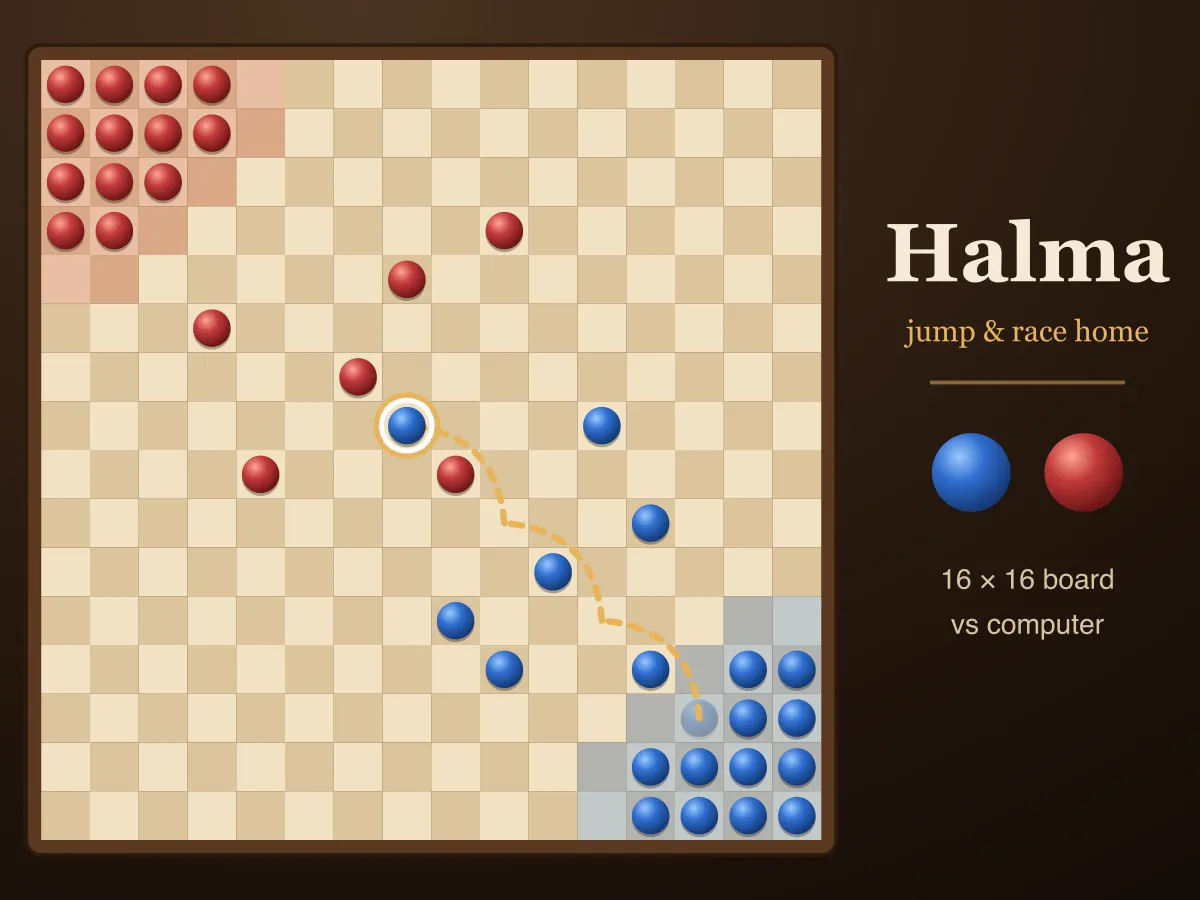



Halma is the classic jumping race game, free to play online here against the computer with no download and no sign-up. It was invented in the 1880s by the American surgeon George Howard Monks, and its name is the Greek word for "jump". You play the original two-player setup: a square 16×16 board with 19 pieces in each corner camp. Move one piece a turn, either a single step to any of the eight squares around it or a chain of jumps over any pieces, yours or the computer's, and be the first to fill the opposite camp. Nothing is ever captured, so every jump you build can carry the computer's pieces too. Play five opponents from Novice to Master, each measured against the one below, and switch to the quick 10×10 board with 10 pieces a side when you want a shorter game on a phone. Chinese Checkers grew out of this game; Halma keeps the square board and the diagonal moves.
How to play Halma
- You play blue and start with 19 pieces in the bottom-right camp; the computer plays red from the top-left camp. Your goal is the computer's camp, and its goal is yours.
- On your turn move one piece. Tap it to see where it can go, then tap a highlighted square.
- A step moves the piece to any of the eight squares around it — straight or diagonal — if that square is empty.
- A jump takes the piece over one neighbouring piece, yours or the computer's, into the empty square straight beyond it. From there it can keep jumping in any direction, as many times as the board allows, in the same turn. A turn is either one step or a jump chain, never both.
- Nothing is captured: jumped pieces stay where they are, so a ladder of pieces works for both sides.
- A piece that has reached the far camp may move inside it but cannot leave it again.
- The first side to fill every square of the opposite camp wins. If the computer leaves pieces at home to block you, you still win once the camp is full and at least one square holds your piece.
- If neither side is home after 150 moves each (80 on the quick board), more pieces home wins, then less distance left. Win a game to unlock the next opponent; who moves first alternates from game to game.
Tips
- Build ladders: two or three of your pieces spaced one square apart along a diagonal let a back piece fly the whole way in one turn. The long diagonal from corner to corner is the fastest road.
- Bring the back of your camp along early. The last two or three pieces left behind have nobody to jump over and crawl home one step at a time, and that is how most games are lost.
- Before a long jump, check what it leaves behind: a piece you park in the middle is also a stepping stone for the computer's next chain.
- Inside the target camp, slide pieces into the deepest corner squares first so the edge squares stay free for your stragglers to land on.
- Stuck for an idea? Hint shows the move the Expert would play, and Undo takes back your move and the computer's reply.
- Short on time or on a small phone? The Quick 10×10 board uses 10 pieces a side and finishes in about forty moves each.
FAQ
Is Halma free to play online?
Yes. Halma here is free in any modern browser, with no download, no account and nothing to buy. Your unlocked levels, board choice and a game in progress are saved in your browser.
What is the difference between Halma and Chinese Checkers?
Chinese Checkers is a later variant of Halma played on a six-pointed star with ten pieces a side, where pieces move in six directions. Halma is played on a square board — 16×16 with 19 pieces each in the two-player game — and pieces step and jump in all eight directions, diagonals included. The site has both: this page is the square-board original, and Chinese Checkers has its own page.
Can you jump over your own pieces in Halma?
Yes. A jump may go over any single neighbouring piece, yours or the computer's, into the empty square directly beyond it, and you can chain as many jumps as the board allows in one turn. Nothing is captured — jumped pieces stay put.
What happens if the computer leaves pieces in its camp to block me?
You still win. Under this version's no-spoiling rule a camp counts as filled once every square is occupied and at least one holds your piece, so pieces left at home cannot stop you finishing. The same rule applies to you.
Can a piece leave the opposite camp once it gets there?
No. In this version a piece that has reached its target camp can still move around inside the camp, but it cannot end a move outside it again.
Who moves first, and does it matter?
The first move alternates from game to game. Opening is a small advantage: with one computer player taking both sides from the same seeded openings, the side that moved first won 58 of 100 games on the classic board and 109 of 200 on the quick board.
How good is the computer?
There are five levels — Novice, Apprentice, Player, Expert and Master — and their strength is measured, not guessed: computer-against-computer games from seeded openings, each played from both seats, 40 games a pairing on the classic board. The Novice wins 35% of games against a player who always takes the longest jump on offer. On the classic board every level beats the one below it at least 65% of the time, and the Player, Expert and Master each beat that longest-jump player in at least 39 games of 40. The quick board leaves less room to plan, so its steps are smaller: every level still beats the one below it at least 61% of the time.
How long does a game of Halma take?
A classic 16×16 game usually runs to about a hundred moves a side. In 20 games between two Apprentice-level computer players, the winner needed between 83 and 110 moves; on the quick 10×10 board it needed between 29 and 46. Choose the quick board when you want a short game.
Can I play Halma on my phone?
Yes. Tap a piece and then a highlighted square. On a small screen the quick 10×10 board is easier to tap and is chosen the first time you play on a phone; you can switch boards at any time.