



Home / Board / Chess960: Fischer Random Chess
Play Chess960 online against the computer. Also called Fischer Random Chess, it keeps every rule of chess but shuffles the pieces behind the pawns into one of 960 start positions, so memorised openings stop working and you have to think from move one. Deal a random setup, type a position number from 0 to 959 or pick 518, the classic layout. Castling works from any setup, six computer levels run from Beginner to Expert, and it is free in your browser with no download.
How to play Chess960: Fischer Random Chess
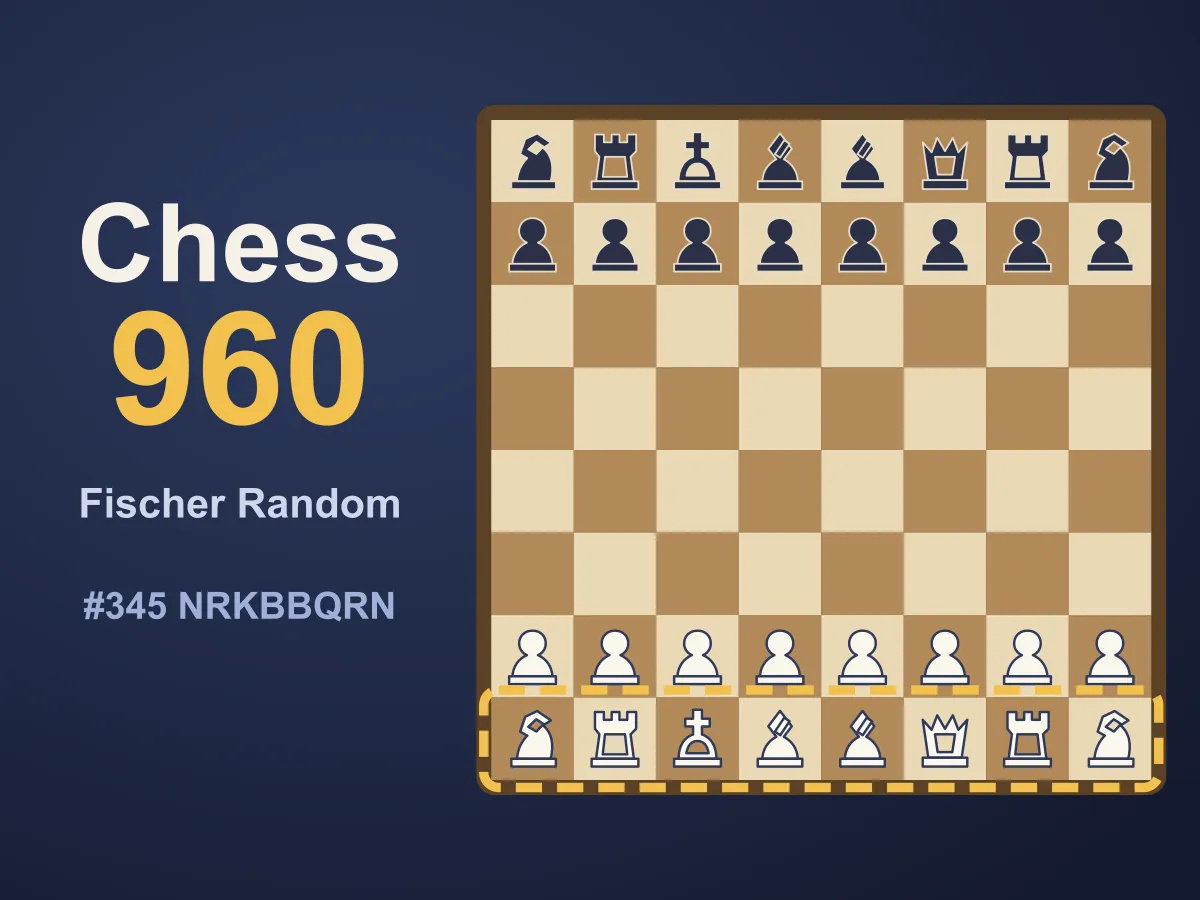
- Choose the computer level, whether you play White, Black or alternate colours, and a start position: Random deals one of the 960, the number box takes any position from 0 to 959, and Classic sets up 518, the normal chess layout. The board shows the setup before you press Start game.
- The pawns start on their usual ranks, but the pieces behind them are shuffled: the two bishops always stand on opposite-coloured squares, the king always stands somewhere between the two rooks, and Black’s setup mirrors White’s.
- Tap one of your pieces, then a highlighted square to move it. On a keyboard, the arrow keys move a cursor and Enter picks the piece and then the square. A pawn that reaches the far rank asks which piece it becomes.
- To castle, move the king onto the rook it castles with: that rook’s square shows a gold ring when castling is legal, and so does the king’s landing square when nothing else moves there. The king always ends on the g-file (castling short, towards h) or the c-file (long, towards a), with the rook beside it on f or d, wherever the two started.
- Win by checkmate. Stalemate, threefold repetition, the fifty-move rule and positions where neither side can mate are draws, and you can resign. Hint and Undo are there when you want them, but a game that uses either becomes practice and is left out of your record for that level.
Tips
- Spend your first few moves looking at the setup: which pieces are already pointing at the other side, which squares are weak, and where your king will be safe. Opening habits from normal chess often do not fit.
- A bishop in a corner, such as on a1 or h1, looks straight down the long diagonal across the whole board. Opening that diagonal with an early pawn move often makes it one of your best pieces.
- Undefended pawns are a common target in the first moves, because pieces can attack them from unusual squares right away. Check what every enemy piece already hits before you push.
- Castling can be the quickest way to bring a rook to the middle. Remember that the squares between the king, the rook and their landing squares must be empty, and the king cannot castle out of, through or into check.
- Play the same start position twice with Rematch, once with each colour, to learn it properly before you deal a new one.
FAQ
What is Chess960?
Chess960, also called Fischer Random Chess, is ordinary chess with the pieces on the back rank shuffled before the game. Bobby Fischer proposed it in 1996 so that games would be decided by thinking at the board rather than by memorised openings. There are exactly 960 setups that keep the bishops on opposite-coloured squares and the king between the rooks, which is where the name comes from.
How does castling work in Chess960?
After castling, the king and rook stand on the same squares as in normal chess: king on g1 and rook on f1 for castling short, king on c1 and rook on d1 for castling long (g8/f8 and c8/d8 for Black). Every square between where the king and that rook start and where they land must be empty apart from those two pieces, neither may have moved yet, and the king may not be in check, cross an attacked square or land in check. Sometimes only the rook moves, or only the king. Here you castle by moving the king onto its own rook; the rook shows a gold ring when it is legal.
What do the position numbers mean?
The 960 setups are numbered 0 to 959 in a standard scheme that counts through the bishop, queen and knight placements, so every Chess960 site and engine that uses it gives the same number the same setup. Position 518 is the usual chess layout, RNBQKBNR, and position 0 is BBQNNRKR. Type a number into the position box to replay a setup you saw elsewhere.
How strong is the computer?
There are six levels, and each one is clearly stronger than the one before. Played from both sides of the same start positions, Novice scored 65 of 80 points against Beginner, Casual 70 of 80 against Novice, Club 56.5 of 60 against Casual, Strong 37.5 of 40 against Club and Expert 27 of 30 against Strong (a draw counts half). Beginner won all 80 of its games against a player making random moves. Every level runs on your own device and plays the same way on a phone as on a computer.
Is Chess960 free, and does it work on mobile?
Yes. It is free with no download, sign-up or in-game purchases, and it works in the browser on phones, tablets and computers. On a phone held upright the board fills the width with the controls underneath; held sideways, the controls sit beside the board. A game in progress is saved on your device, so you can close the page and carry on later.
How is this different from Chess vs Computer?
Chess vs Computer on this site always starts from the normal setup and adjusts its strength to your results. Chess960 lets you start from any of the 960 Fischer Random setups and choose one of six fixed computer levels, with a separate win, draw and loss record for each.