
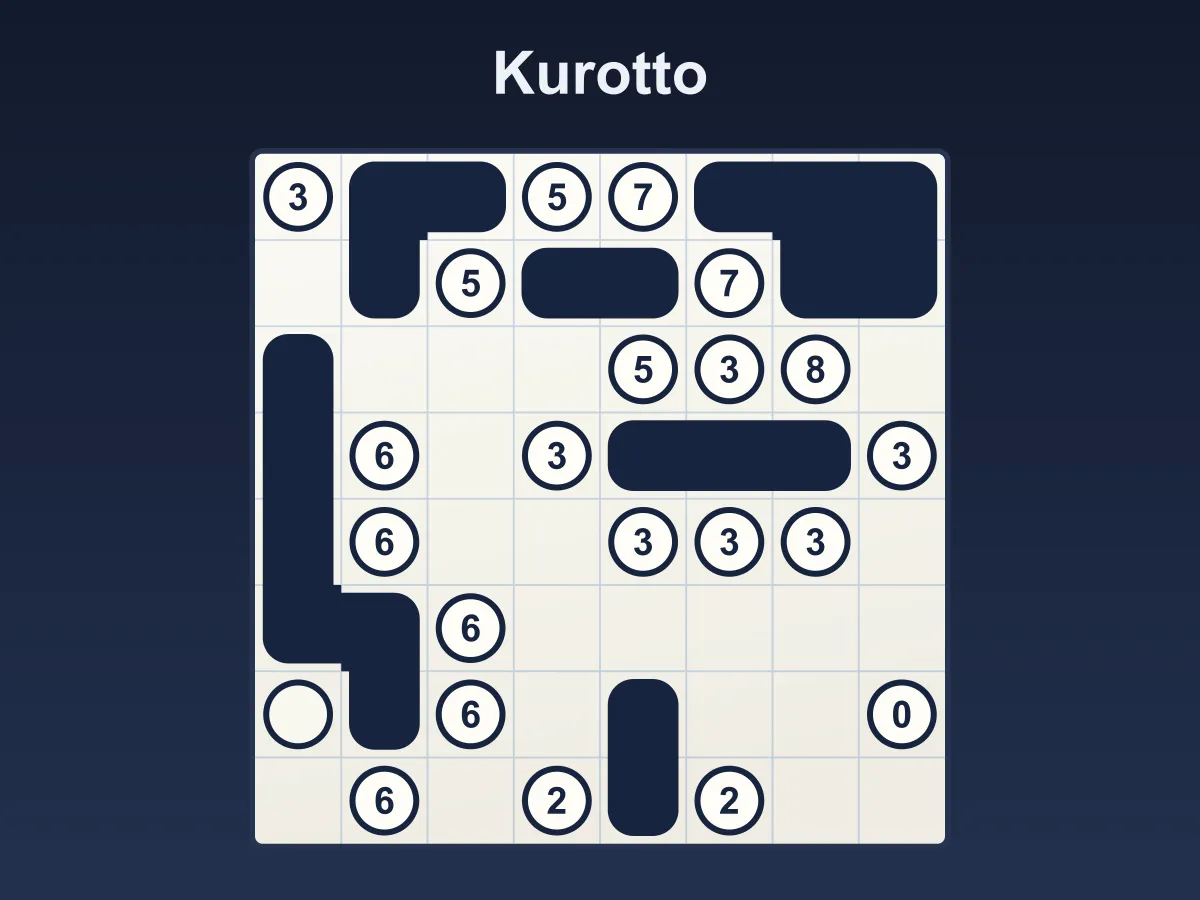


Kurotto is a free online shading logic puzzle from the family of Japanese pencil puzzles published by Nikoli. Some squares hold a circle, most of them with a number. You shade squares, and shaded squares that share an edge join into one block. The rule is a single sentence: each circled number is the total size of all the blocks that touch it — every shaded square in every block sharing an edge with that circle, each block counted once however many sides it touches. Circles are never shaded, and an empty circle places no limit at all. There is no other rule: blocks can sit anywhere, touch corner to corner, and fill 2×2 squares. Tap a square to shade it, tap again to mark it open with a dot, and drag to paint several at once. Shaded squares run together into ink blots, so every block is easy to read; tap a circle to see which blots it is counting, a number that is already met fades back, and one that goes over or can no longer be reached turns red at once. Every board is grown by the game itself and proved to have exactly one answer before you see it. Ten levels run from a 5×5 to three 10×10s: the first two need only counting, levels 3 to 5 add the joining rules, and from level 6 every board needs "what if" reasoning followed to a broken rule. No download, no account.
How to play Kurotto
- Some squares hold a circle, usually with a number in it. You decide which of the other squares are shaded.
- Shaded squares that share an edge form one block. Squares that only meet at a corner are separate blocks.
- Each circled number must equal the total number of shaded squares in all the blocks touching that circle. A block that touches the circle on two sides still counts only once, but every square of it counts — not just the squares next to the circle.
- Circles are never shaded. An empty circle is never shaded either, and any number of blocks may touch it.
- There are no other rules: blocks may sit anywhere on the board, touch each other at corners and fill 2×2 squares.
- Tap a square to shade it, tap again to mark it open with a dot, and a third time to clear it. Right-click marks a square open straight away. Drag across squares to paint them all the same way.
- Tap a circle to see which blocks it is counting: they turn green and the line under the board says how many squares it counts so far.
- On a keyboard, arrow keys move, S or X shades, D, O or the full stop marks a square open, Backspace clears it, and Space or Enter cycles it.
- The board is solved the moment every number is met. You do not need to dot the open squares. A met number fades back; one that is passed, or can no longer be reached, turns red. Undo steps back, Clear wipes the board, New Puzzle deals a different board on the same level, and the ? button settles one square, fixing a mistake first. Three per board.
Tips
- A 0 means none of the four squares beside the circle can be shaded. Dot them all.
- Once the blocks touching a number add up to it, everything around those blocks and around the circle stays open — shading any of it would add to the count.
- Look for a square that would join two blocks: if the joined block would be too big for a number it touches, that square stays open.
- A number that is still short and has only one square left that its blocks or its circle can grow into must grow there.
- Count everything a number could still reach. If that is exactly its number, all of it is shaded.
- One block can be counted by several numbers at once. Small numbers next to big ones decide where a big block cannot reach.
- From level 6, try a square in your head: shade it, follow what that forces, and if a number breaks, the square was open.
FAQ
Is Kurotto free to play?
Yes. It runs in the browser with no download, no sign-up and nothing to buy. All ten levels are included and unlock as you solve them.
What are the rules of Kurotto?
Shade some squares so that every circled number equals the total number of shaded squares in the blocks touching it, where a block is a group of shaded squares joined edge to edge and each block counts once. Circles are never shaded, and an empty circle places no limit on the blocks around it.
What does Kurotto mean?
Kurotto is a puzzle type from the Japanese publisher Nikoli, first published in 2012. Kuro is Japanese for black, and the name is a shortening of an earlier one meaning "black unit" — the blocks of shaded squares the numbers count.
How is Kurotto different from Nurikabe and Kuromasu?
In Nurikabe the numbers give the size of the open islands and the shaded squares must form one connected wall. In Kuromasu the numbers count the open squares they can see along their row and column, and shaded squares never touch. In Kurotto the numbers count shaded squares — the size of every block touching the circle — and there is no connectivity rule at all: blocks can sit anywhere.
What is an empty circle?
A circle with no number. It can never be shaded, but it puts no limit on the blocks around it. They can appear from level 4 — at most two on level 4 and three on later boards — where a board needs that square to be open but not a count.
Does every puzzle have exactly one answer?
Yes, and it is checked rather than assumed. Each board is grown from a real answer, and a program that only ever makes forced moves has to be able to finish it before it is shown; a board it can finish that way has only one answer. The tests then run two exhaustive searches on the first board of every level — the game's own and a second one written separately that shares none of its code — and both find exactly one answer.
Will I ever have to guess?
No. On levels 1 and 2 every move follows from counting: a number already met closes off its blocks, and a number that needs everything it can still reach shades it all. Levels 3 to 5 add joining: a square that would merge blocks into one too big stays open, and a short number with one way left grows there. From level 6 each board needs "what if" reasoning — one to three such steps at level 6, three to six at level 7, five to nine at level 8, ten to fifteen at level 9 and sixteen or more at level 10.
How many levels are there?
Ten: a 5×5, two 6×6 boards, a 7×7, two 8×8 boards, a 9×9 and three 10×10 boards that differ in how much "what if" reasoning they need. New Puzzle deals a fresh board on any level you have reached.
Do I have to mark the open squares?
No. Dots are only notes for yourself — undecided squares count as open, and the board is solved as soon as every number is met.
Does it work on a phone?
Yes. Tap a square to shade it and slide a finger across squares to paint several at once. On a phone held upright the game uses a taller frame, so the board spans the full width of the screen.