
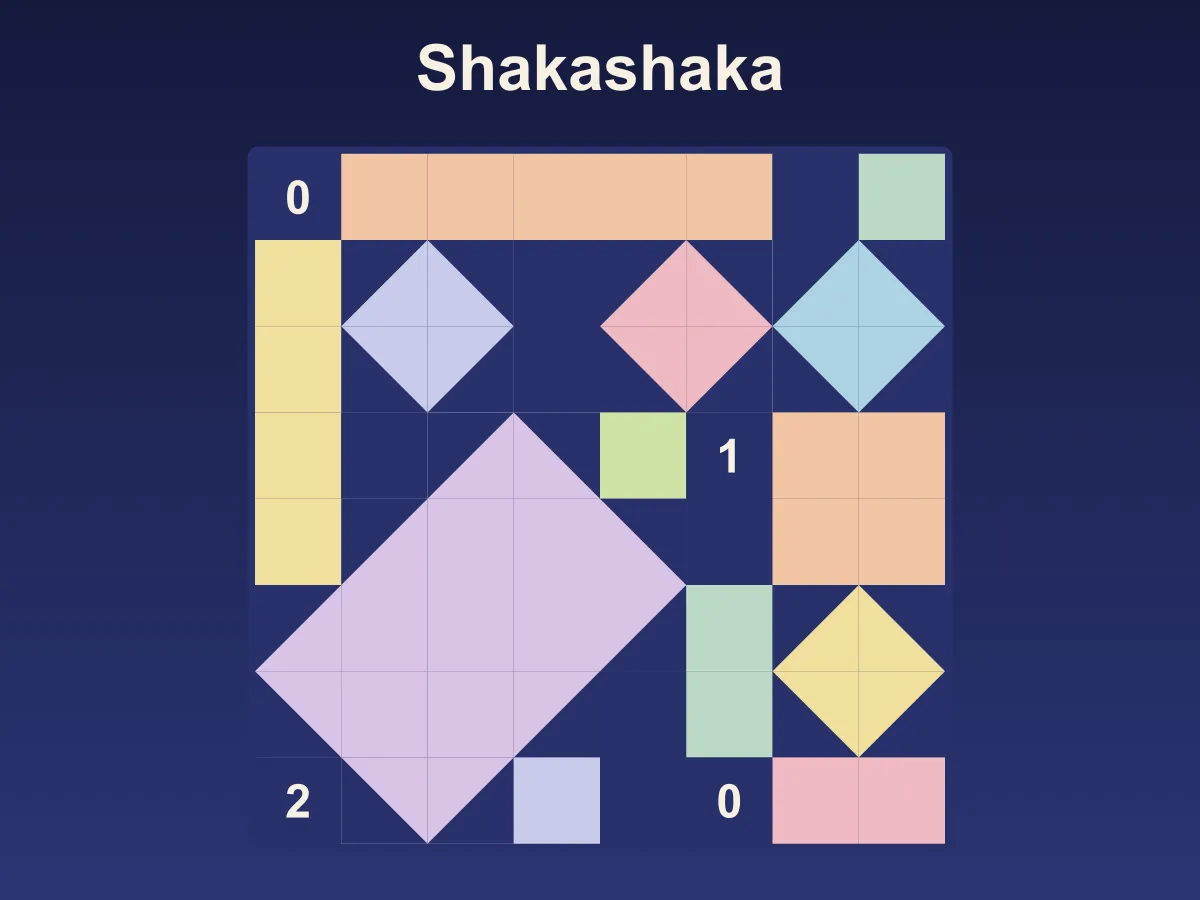
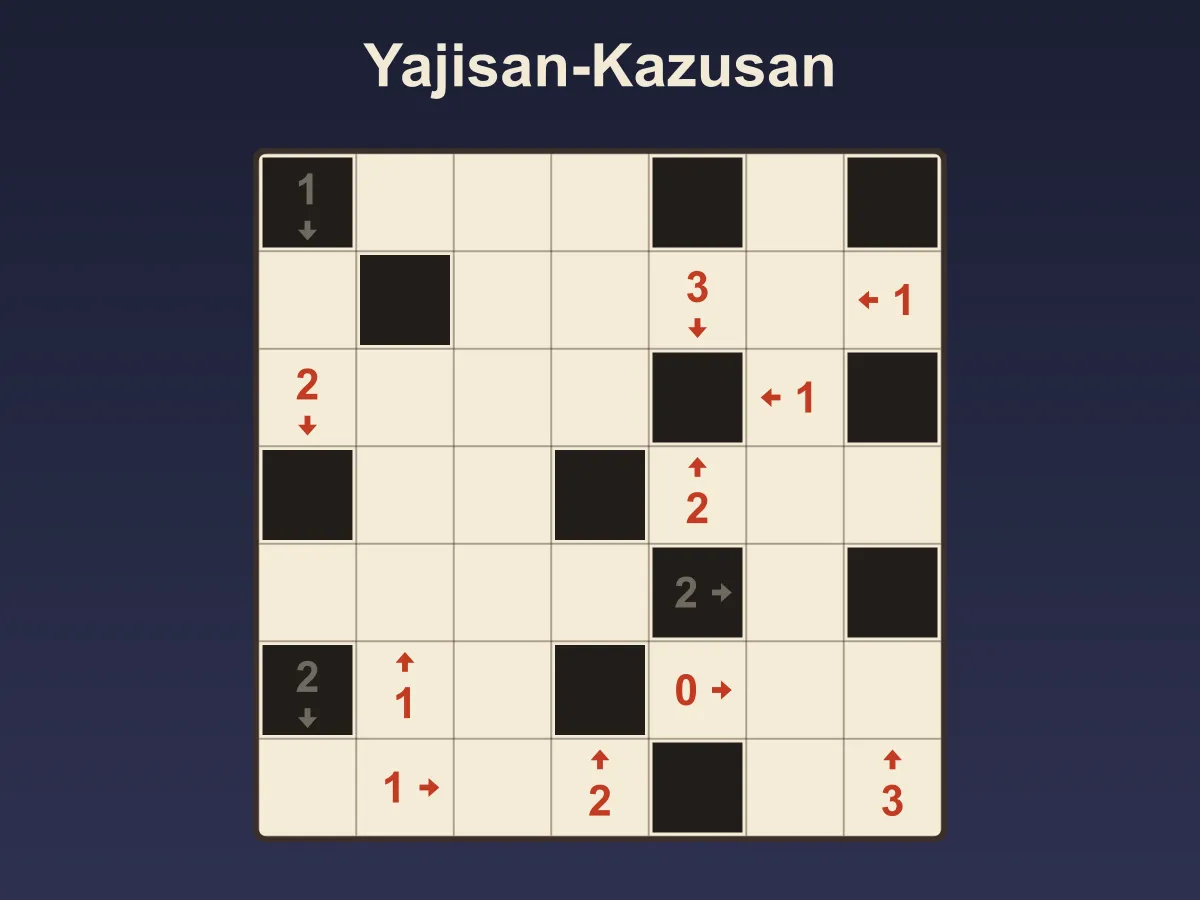
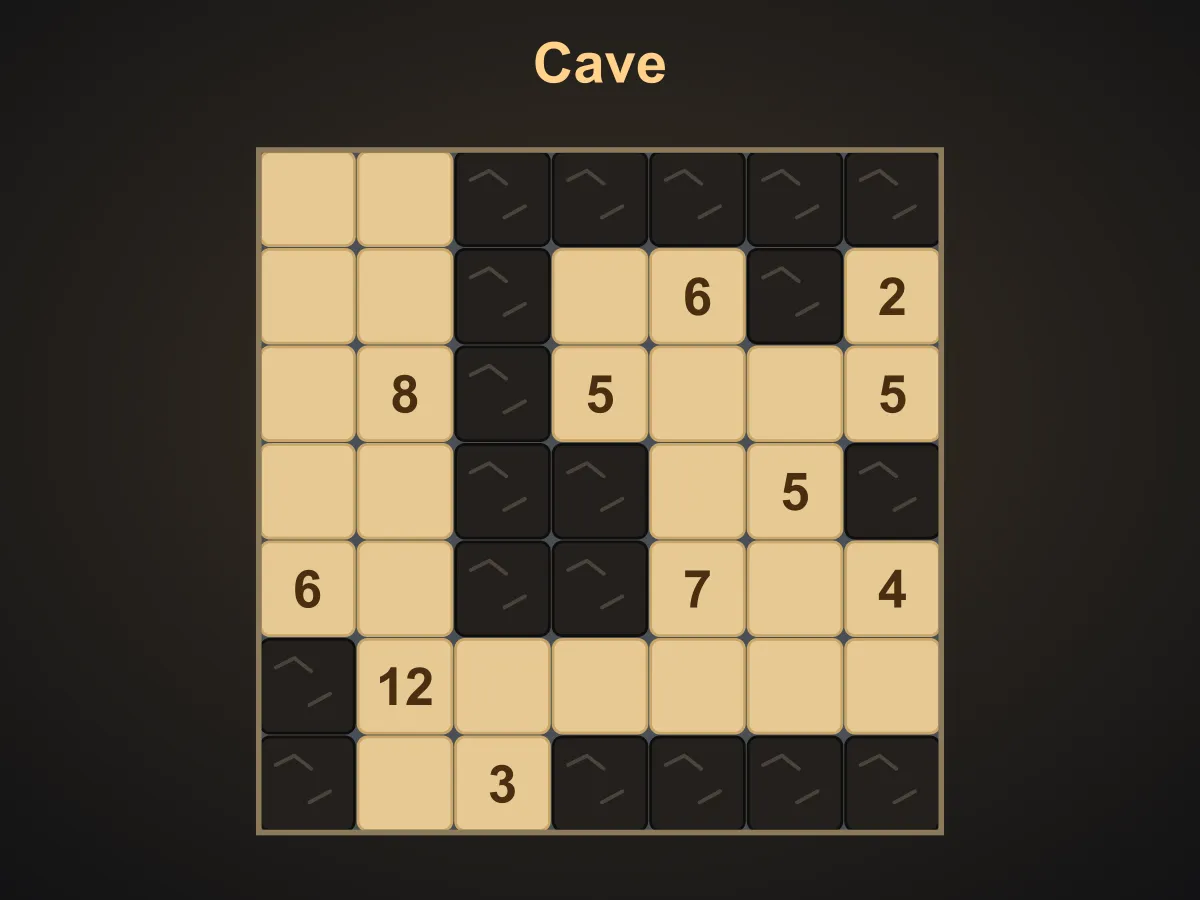
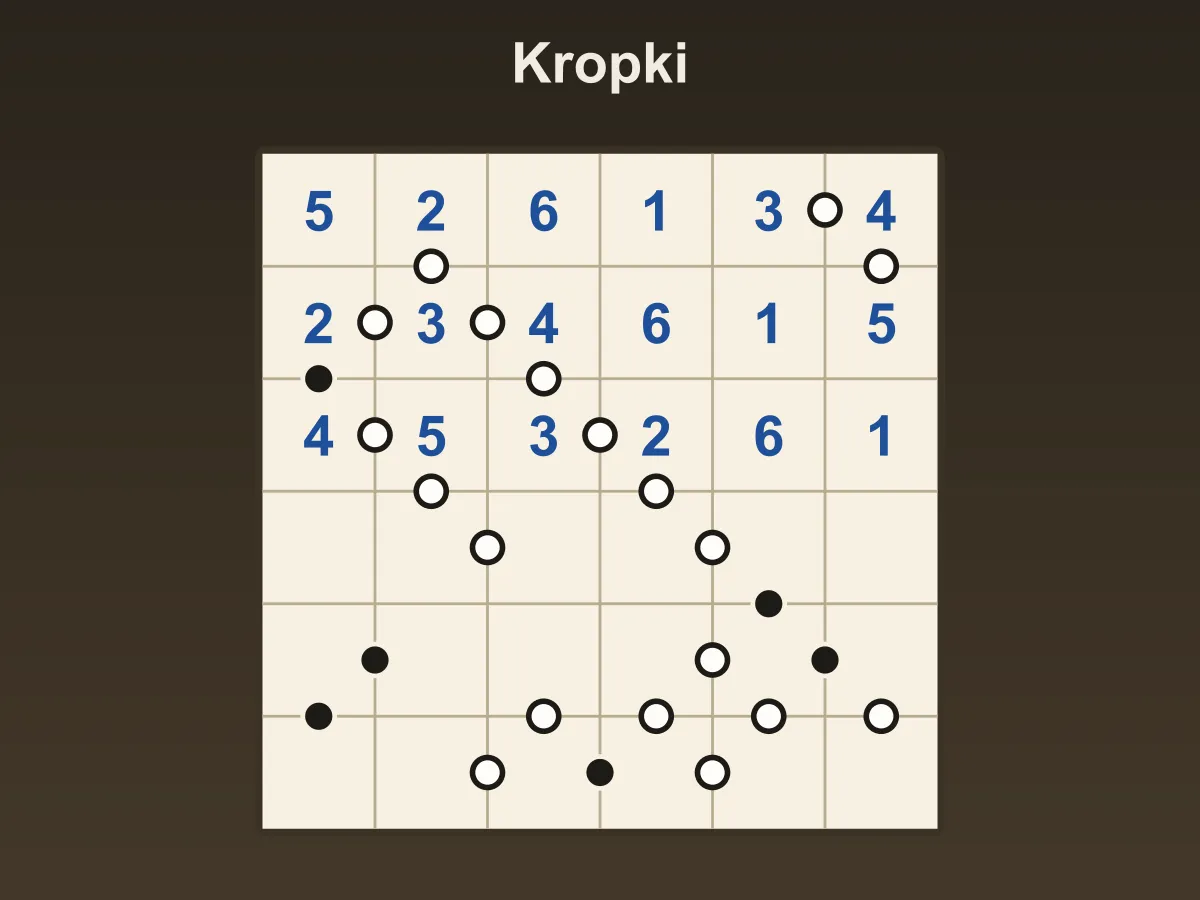
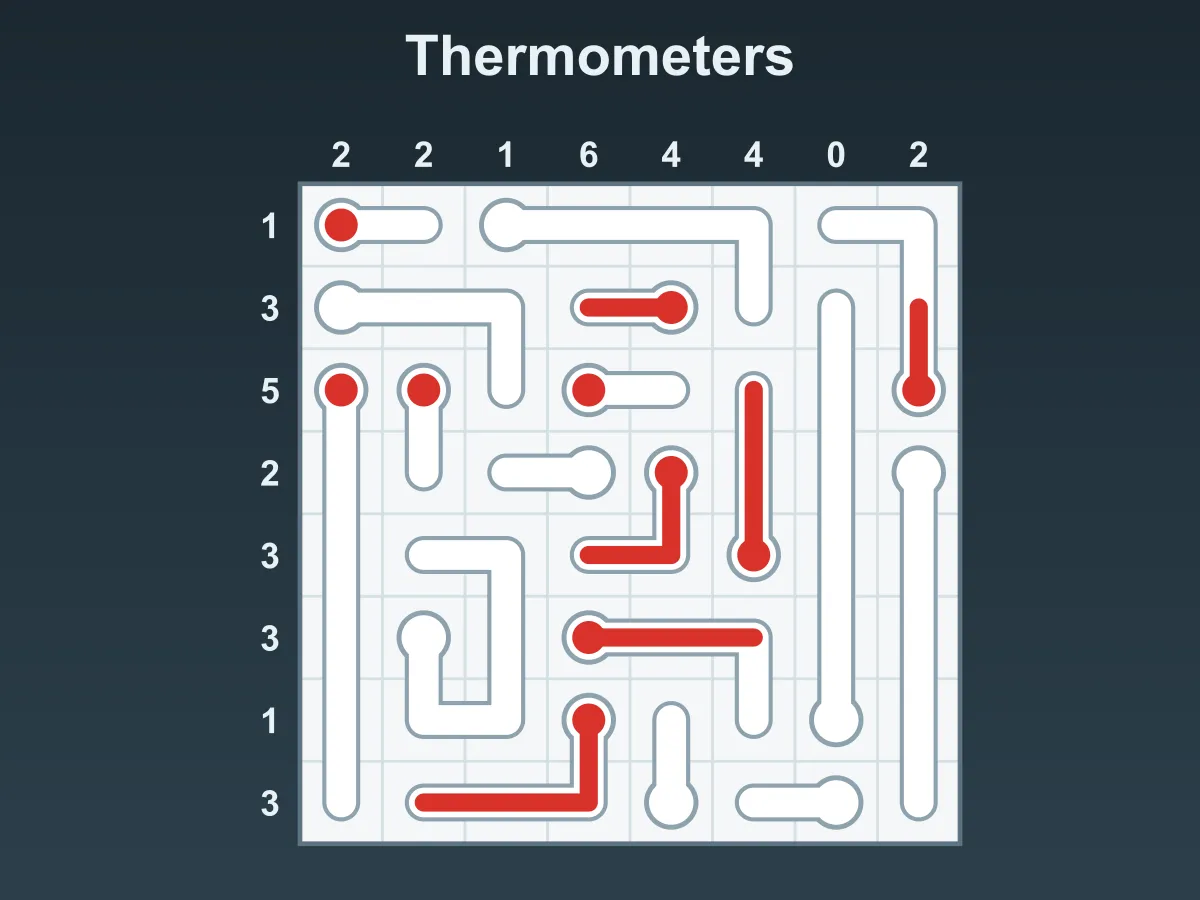


Shakashaka is a free online triangle logic puzzle from Japan, played in your browser with no download and no account. The grid holds a few black squares, some of them numbered. Your job is to put black triangles — half a square, cut corner to corner — into some of the white squares, so that every area left white is a rectangle. A rectangle may stand upright or lean at 45° like a diamond, and the white half of a triangle square belongs to the area it touches. A number counts the triangles in the squares directly above, below, left and right of it. Tap near a corner of a square to put a triangle with its right angle in that corner, tap the same corner again to take it off, and tap the middle to dot a square you know stays white. A red ring marks any corner point that can no longer close into a rectangle, and a number turns red when it has too many triangles or too few squares left. Every board is built by the game itself and proved to have exactly one answer before you see it. Eight levels grow from a 6×6 to a 10×10: the first three need only the corner and number rules, and from level 4 every board needs at least one "what if". Solve one and each white rectangle fills with its own quilt colour.
How to play Shakashaka
- The grid has white squares and a few black ones. Some black squares hold a number.
- Put black triangles into white squares. A triangle fills half the square, cut from corner to corner, and there are four ways to turn it. A square holds one triangle at most, and black squares never take one.
- When you are done, every area left white must be a rectangle or a square. It may stand upright or lean at 45° like a diamond. The white half of a triangle square is part of the area it touches.
- A number counts the triangles in the squares directly above, below, left and right of it. Squares touching it only at a corner do not count. A black square with no number can have any number of triangles beside it.
- Tap near a corner of a square to put a triangle with its right angle in that corner. Tap the same corner again to take it off. Tap the middle of a square to dot it: a note that it stays white. Right-click also dots.
- Drag from an empty square to dot every square you cross. Drag from a dot to wipe dots, or from a triangle to wipe triangles.
- On a keyboard, arrow keys move. Q, E, Z and C put a triangle in the top-left, top-right, bottom-left and bottom-right corner (7, 9, 1 and 3 on a number pad work too). S or a full stop dots, Backspace clears, and Space or Enter steps a square through every mark.
- A red ring on a grid point means the white around it can no longer close into a rectangle corner or a straight side. A number turns red when it already has too many triangles or can no longer reach its count, and green once it has exactly its count and every square beside it is decided.
- The board is solved the moment every rule holds. You do not need to dot the white squares — undecided squares count as white.
- Undo steps back one change, Clear wipes the board, and New Puzzle deals a different board on the same level. The ? button settles one square, fixing a mistake first. Three per board.
Tips
- Start at the corners of the grid. In a corner square, the two triangles whose long side ends in the grid's corner leave a 45° white sliver there, so only white or one of the other two triangles fits.
- A 0 means none of the squares beside it takes a triangle, so dot them all. A number that equals the white squares beside it means every one of them takes a triangle.
- Think of each grid point as a corner. Going round it, every unbroken stretch of white must be a quarter turn (a rectangle's corner) or a half turn (a straight side), unless the point is white all the way round. A 45°, 135° or 270° stretch is always wrong.
- A triangle's long side never just stops. Where it ends at a grid point, the white beside it carries on into the next square, either straight on along another long side or round a right-angled corner. Follow the line to see where the tilted rectangle has to turn.
- Three white squares round a grid point with a black square in the fourth make an L, which is never allowed: one of those three must take a triangle.
- On the later levels, try a square in your head: give it a triangle, follow what that forces, and if a corner breaks somewhere, it was not that.
FAQ
Is Shakashaka free to play?
Yes. It runs in the browser with no download, no sign-up and nothing to buy. All eight levels are included and unlock as you solve them.
What are the rules of Shakashaka?
Put black triangles — half a square, cut corner to corner — into some of the white squares so that every area left white is a rectangle, either upright or tilted at 45°. A number on a black square counts the triangles in the squares directly above, below, left and right of it. Black squares never take a triangle.
Can the white areas be diamonds?
Yes. A rectangle may lean at 45°, and that is what makes Shakashaka different: triangles cut the corners off the squares so the white area becomes a diamond or a tilted rectangle. Squares and upright rectangles are allowed too, but never an L shape or anything with a notch.
Does every puzzle have exactly one answer?
Yes, and it is checked rather than assumed. Each board is built from a real answer, and a program that only ever makes forced moves has to be able to finish it before it is shown; a board it can finish that way has only one answer. The tests also confirm the boards with an exhaustive search that works a different way.
Will I ever have to guess?
No. On levels 1 to 3 every move follows from a single corner point or a single number. From level 4 on, each board needs at least one "what if": put a triangle in a square in your head, follow it, and watch a corner break.
How many levels are there?
Eight, from a 6×6 grid to a 10×10. Levels 1 to 3 need no "what if" at all. Level 4 needs one or two, level 5 one to three, level 6 four to twelve, level 7 three to seven on a bigger grid, and level 8 eight or more. New Puzzle deals a fresh board on any level you have reached.
How do I put a triangle in a square on a phone?
Tap near the corner where you want the triangle's right angle — the black half goes into that corner. Tap the same corner again to remove it, or the middle of the square to mark it white with a dot. On a phone held upright the board uses the full width of the screen.
What does a red ring on the board mean?
It marks a grid point where the white around it can no longer form a rectangle corner or a straight side, whatever goes in the undecided squares next to it — for example a thin white sliver left between two triangles. Change one of the triangles beside it.
What happens when I solve a board?
The grid lines fall away and every white rectangle is filled with its own fabric colour, so the finished board looks like a patchwork quilt. Then you can move on to the next level, replay the same board, or share your time.