


Home / Puzzle / Yajisan-Kazusan
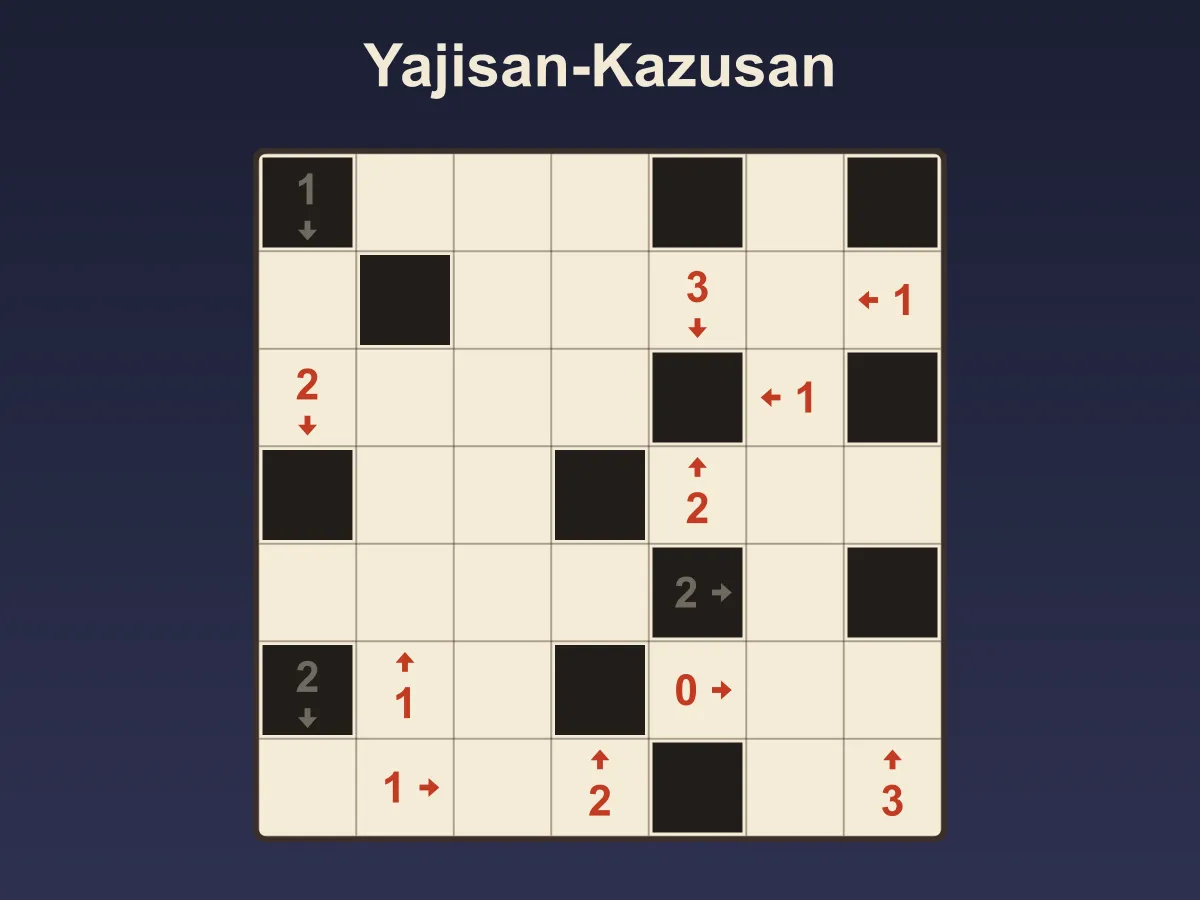
Yajisan-Kazusan is a free online arrow-and-number shading puzzle in the Japanese logic tradition, played in your browser with no download and no account. Some squares hold a clue: a number and an arrow. A clue on an open square tells the truth — exactly that many shaded squares lie in the direction of its arrow, all the way to the edge. But a clue square may itself be shaded, and a shaded clue says nothing at all, so any clue that cannot be true has to be shaded. Two more rules hold at once: shaded squares never share an edge, and all the open squares stay connected in one piece. That twist is what sets the puzzle apart: every board starts by catching a liar, often a number too big for its line, and the shading follows from there. Tap a square to shade it, tap again to dot it as open, or drag to paint several at once. Select a clue and its line lights up; a clue left open turns green once its line counts true, and red once your shading has ruled its number out. Every board is built by the game and proved to have exactly one answer before you see it. Nine levels grow from 6×6 to 10×10.
How to play Yajisan-Kazusan
- Some squares hold a clue: a number with an arrow. A clue on an open square counts the shaded squares in its arrow’s direction, all the way to the edge of the grid. Squares beside the line do not count.
- Any square may be shaded, clue squares included. A shaded clue says nothing — it may be true or false — so a clue that cannot be true must be shaded.
- Two shaded squares may never share an edge. Touching at a corner is fine.
- All the squares you leave open must form one connected area, joined edge to edge.
- Tap a square to shade it. Tap again to put a dot on it, a note that it stays open, and a third time to clear it. Right-click puts a dot on straight away.
- Drag across several squares to paint them all the same way. A drag only changes squares that looked like the one it started on, so it never overwrites something you decided.
- Tap or select a clue to light up the line it counts. A clue left open turns green once its line holds exactly its number, and red when your shading has already ruled its number out — or, once you have dotted the clue, when no way of finishing its line fits. Shade it, or change its line.
- On a keyboard, arrow keys move between squares, S shades, D or a full stop dots, Backspace clears, and Space or Enter cycles a square.
- The board is solved the moment every rule holds. You do not need to dot the open squares — undecided squares count as open.
- Undo steps back one change, Clear wipes the board, and New Puzzle deals a different board on the same level. The ? button settles one square, fixing a mistake first. Three per board.
Tips
- Start by hunting liars. Shaded squares never touch, so a line of squares can hold at most half of them, rounded up: two in a line of three or four, three in a line of five. A 3 whose arrow points at four squares or fewer can never be true — shade it.
- Every square beside a shaded square is open. Dot them as you go: a dotted clue is a clue that must tell the truth, and its line can then be counted.
- Once a clue is known to be open, count its line. A 0 makes its whole line open. A number equal to the most its line can hold often fixes the line outright: a 2 pointing at three squares shades both ends.
- Never shade the last way out of a pocket of open squares. Near an edge or a corner, a shaded square that would close a pocket off has to stay open instead.
- You never need to check a shaded clue — it says nothing. But every clue you leave open has to be exactly right, so a clue whose line already holds too many shaded squares must itself be shaded.
FAQ
Is Yajisan-Kazusan free to play?
Yes. Yajisan-Kazusan is completely free to play online in your browser, with no download, no account and no in-game purchases.
What are the rules of Yajisan-Kazusan?
Shade some squares. Shaded squares never share an edge, and all the open squares stay connected. A clue — a number and an arrow — on an open square counts exactly how many shaded squares lie in its arrow’s direction. A clue square may itself be shaded, and then its clue says nothing.
Can a clue be wrong?
Yes, and that is the heart of the puzzle. Only a clue on an open square has to be true. A clue that cannot be true must be shaded, which is how every board starts — often with a number too big for its line. Every board here shows at least one false clue. A shaded clue may also happen to be true; it simply does not count.
What does Yajisan-Kazusan mean?
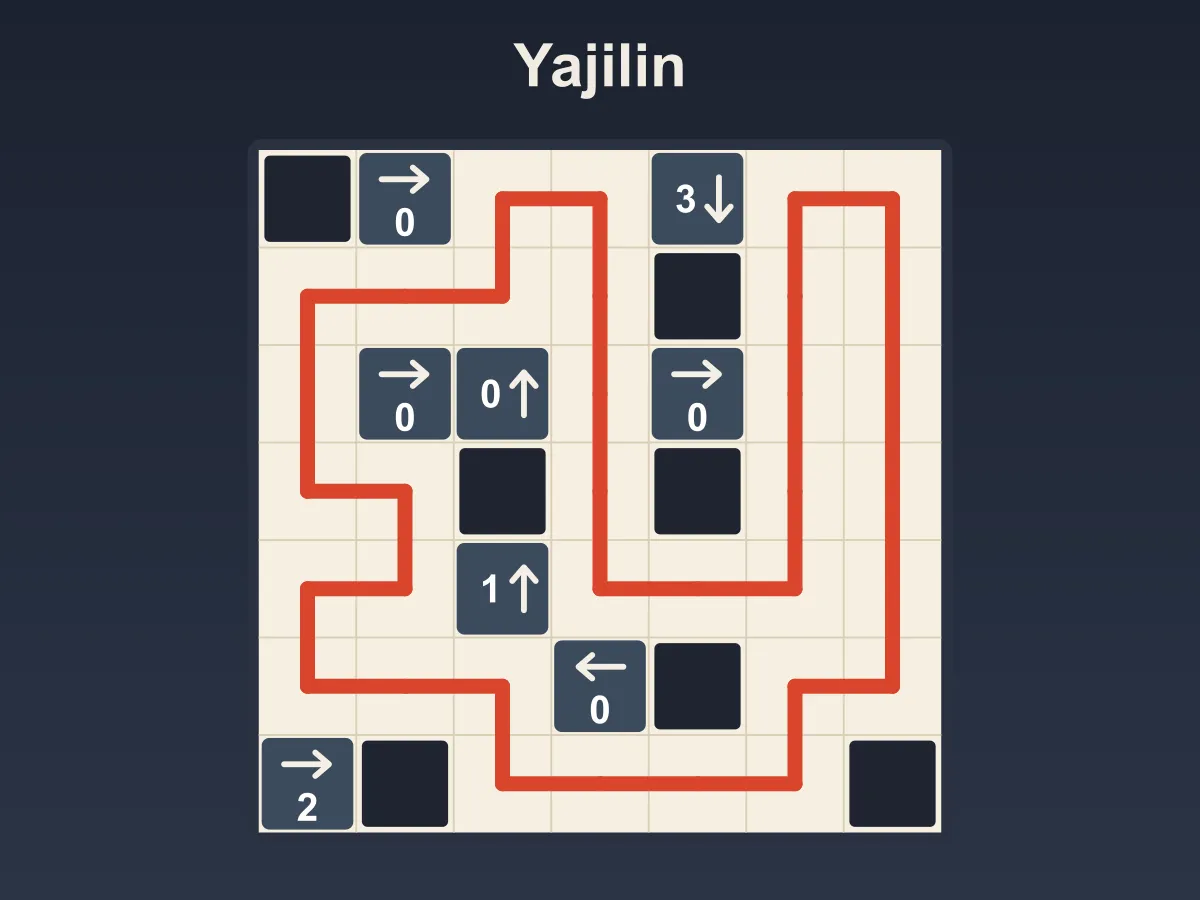
The Japanese name puts together yaji, arrow, and kazu, number — the two halves of every clue. It is a Japanese pencil puzzle that shares its arrow-and-number clue with Yajilin, a loop-drawing puzzle.
How is it different from Yajilin?
Yajilin uses the same arrow clues but asks you to shade squares and draw one loop through all the rest, and its clue squares are never shaded. Yajisan-Kazusan has no loop: the open squares only need to stay connected, and any clue may be shaded — false clues must be.
Does every puzzle have exactly one answer?
Yes. Every board is built by the game and, before you see it, solved by a logical solver that never guesses — a board it can finish has exactly one answer. The tests re-check the boards each level deals with a separate exhaustive search.
How many levels are there?
Nine, from a 6×6 to a 10×10. Levels 1 and 2 need only the clues’ lines and the no-touching rule. Levels 3 and 4 also lean on keeping the open squares in one piece. From level 5 every board needs at least one “what if” followed to a contradiction: level 5 needs one to three, level 6 two to five, level 7 four to nine, level 8 six to fourteen, and level 9 twelve to thirty. New Puzzle deals a fresh board at the same difficulty.
Do I have to dot the open squares?
No. Dots are notes for you; the board is solved as soon as the shaded squares are right, and undecided squares count as open. Dotting a clue square does tell the game you believe that clue, though, and it will then flag the clue red if its line can no longer count true.
Does Yajisan-Kazusan work on a phone?
Yes. Tap to shade and dot, drag to paint several squares, and the board fills the screen held upright; held sideways the frame grows so a 10×10 stays big enough to tap. It also plays with a mouse or entirely from the keyboard.