
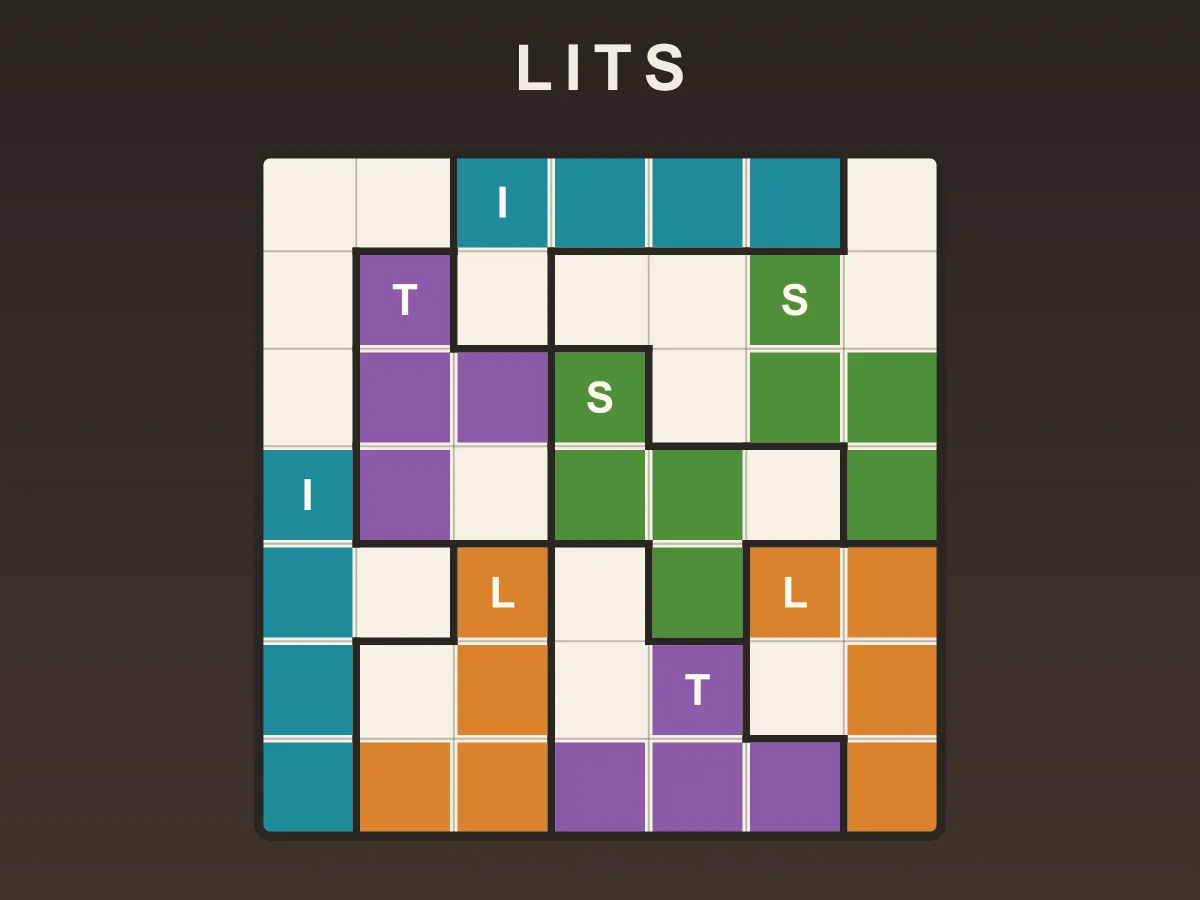



LITS is a free online shading logic puzzle, also known as Nuruomino. The grid is cut into outlined regions, and your job is to shade exactly one tetromino — four squares joined edge to edge — inside every region. Four rules hold at once. Every shaded square must join into one connected area. No 2×2 block may be all shaded, which is why the square O piece never appears and the puzzle is named after the four that are left: L, I, T and S. And two pieces of the same letter may never touch along an edge across a region border, where turned and mirrored pieces count as the same letter, so a J is an L and a Z is an S. Tap a square to shade it, tap again to mark it with a dot, and drag to paint several at once. When a region holds a real tetromino it turns the colour of its letter, so a same-letter clash is easy to spot, and a 2×2 or a cut-off piece turns red straight away. Every board has exactly one answer and can be solved without guessing. Eight levels run from a 6×6 to a 10×10, with eight boards on each. No download, no account.
How to play LITS
- The grid is cut into regions by thick lines. Shade exactly four squares in every region, joined edge to edge so they make one tetromino.
- The tetromino can be an L, an I, a T or an S, turned or mirrored any way. A J counts as an L and a Z counts as an S. The square O can never be used, because it is a 2×2 block.
- All the shaded squares on the board must join into one connected area, edge to edge. Touching at a corner does not join them.
- No 2×2 block of squares may be all shaded, even where it spans two or more regions.
- Two tetrominoes of the same letter may never share an edge across a region border. An L may touch a T, an I or an S, but never another L.
- Tap a square to shade it, tap again to put a dot on it as a note that it stays open, and tap a third time to clear it. Right-click dots a square straight away, and dragging paints several squares the same way.
- On a keyboard, the arrow keys move between squares, S shades, D or a full stop dots, Backspace clears, and Space or Enter cycles a square.
- A region holding a real tetromino turns the colour of its letter, with the letter on its first square. A 2×2 that is all shaded, two same-letter pieces that touch, shaded squares cut off from the rest, and a region that can no longer hold one tetromino all turn red.
- The board is solved the moment every rule holds. You do not need to dot the open squares. Undo steps back, Clear wipes the board, New Puzzle deals the next board on the level, and the ? button settles one square, three times per board.
Tips
- Start with the small regions. A region of exactly four squares is its own tetromino, and a region of five has only a few ways to hold one. Squares that every way uses are shaded; squares no way uses stay open.
- Watch for 2×2 blocks forming across a border. If three squares of a 2×2 are certain, the fourth is open, and any way of filling a region that would shade it is ruled out.
- Once you know a region holds, say, an L, no neighbouring region may put an L along its edge. The colours make this easy to check: two pieces of one colour must never touch.
- Every piece has to join the rest. A way of filling a region that would leave its piece walled off by open squares cannot be right, even if it fits its own region perfectly.
- When a neighbouring region would be left with no way to hold any tetromino, the placement that caused it is wrong. Checking what your choice leaves next door settles most of the middle levels.
- On the later levels, try a region in your head: place its piece one way, follow what that forces next door, and if a rule breaks, the piece lies another way.
FAQ
Is LITS free to play?
Yes. It runs in the browser with no download, no sign-up and nothing to buy. All eight levels are included and unlock as you solve them.
What are the rules of LITS?
Shade exactly one tetromino, four squares joined edge to edge, inside every outlined region. All shaded squares must form one connected area. No 2×2 block may be all shaded. And two tetrominoes of the same shape may not touch along an edge across a region border, counting turned and mirrored pieces as the same shape.
Why is it called LITS?
LITS is named after the four tetrominoes the puzzle uses: L, I, T and S. The fifth tetromino, the square O, can never appear because it would be a 2×2 block, which the rules forbid. In Japan the puzzle is also called Nuruomino.
Do a J and an L count as the same piece?
Yes. Turned and mirrored pieces count as the same letter, so a J is an L and a Z is an S. That matters for the rule that two pieces of the same letter may not touch: an L may not sit edge to edge with a J either.
Does every puzzle have exactly one answer?
Yes, and it is checked rather than assumed. Every board is grown square by square by a program that only keeps a change if a solver that never guesses can still finish the board, and a board it can finish that way has only one answer. The tests then run two exhaustive searches on all 64 boards, one of them written separately with none of the solver's rules, and each finds exactly one answer.
Will I ever have to guess?
No. On level 1 every region can be settled on its own, from what its own shape allows and the squares already certain around it. Levels 2 to 4 also need you to check what a choice leaves for the neighbouring regions and whether every piece can still join the rest. From level 5 each board needs at least one "what if": place a piece one way in your head, follow it, and watch a rule break.
How many levels are there?
Eight, from a 6×6 grid to a 10×10, with eight boards on each level. On level 5 each board needs one or two "what if" steps, on level 6 two to four, on level 7 four to eight, and on level 8 nine or more. New Puzzle deals the next board on any level you have reached.
What do the colours mean?
A region turns the colour of its letter once its shaded squares make a real L, I, T or S: amber for L, teal for I, plum for T and moss green for S. Two touching pieces of the same colour break the rules and turn red. Shading that is not yet a tetromino stays dark.
Does it work on a phone?
Yes. Tap to shade and slide a finger across squares to paint several at once. On a phone held upright the game uses a taller frame, so even the 10×10 boards span the full width of the screen.