





Home / Puzzle / Logic Grid Detective
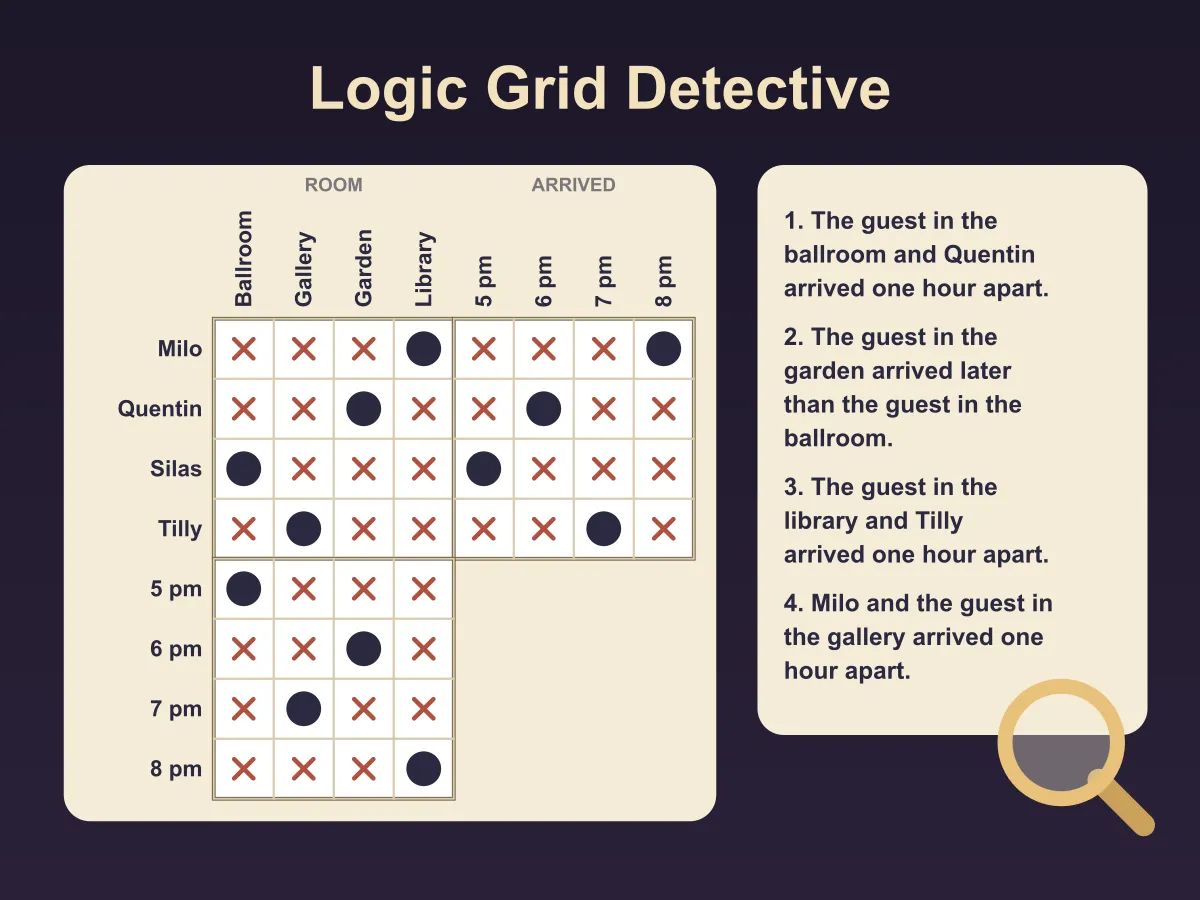
Logic Grid Detective is a free online logic grid puzzle — the classic "zebra" or Einstein-style riddle — dressed as a country-house mystery. Each case gives you a few guests, a few categories (the room each was in, the hour each arrived, what each carried, the colour of each coat) and a list of true clues. Every guest has exactly one of everything, and nobody shares. Work it out on the grid: tap a square once for ✗ (these two are not the same guest), twice for ● (they are). A ● crosses out the rest of its row and column for you, and a ✗ in one grid often decides a square in another. Clues range from the plain ("Ada was not in the attic") to the ones that need thought ("Of Basil and Clara, one was in the garden and the other arrived at 8 pm"). Every case is built by the game from a seed rather than copied from a book: the eight numbered cases are the same for everyone, New Case deals a different one at the same size, and each has exactly one answer and no clue it could do without. Eight cases grow from three guests and three categories to five of each; the later ones need a "what if" — suppose a match and watch the clues fall apart. Hints never lie. No download, no account.
How to play Logic Grid Detective
- Each case has a set of guests and two to four other categories — the room each guest was in, the hour each arrived, what each carried, the colour of each coat. Every guest has exactly one item from each category, and no two guests share one.
- Read the clues on the right (below the grid on a phone). Every clue is true, and together they allow exactly one answer.
- The grid pairs every category with every other. Each small square asks one question: are these two the same guest?
- Tap a square once for ✗ — not the same guest. Tap it again for ● — the same guest. A third tap clears it. On a computer, right-click puts a ✗ straight in.
- With Auto ✗ on, a ● greys out the rest of its row and column in that grid, since each guest has only one of each thing.
- Carry what you know between grids: if Ada was in the library and the library guest arrived at 7 pm, Ada arrived at 7 pm.
- Tap a clue to strike it through once you have used everything it says.
- The case closes when every ● in the top row of grids — the guests against each category — is right. The lower grids are your working space.
- Check shows any mark that is wrong, in red. The ? button gives a hint: it removes a wrong mark first, and otherwise places the next thing you could work out and lights up the clue it comes from. Five hints per case.
- On a keyboard, the arrow keys move around the grid, X places a ✗, O places a ●, Backspace clears, and Space or Enter cycles the square.
- When the whole grid is too small to tap comfortably, it shows one grid at a time: pick the categories for the side and the top with the chips above it.
- New Case deals a different case at the same size. Replay Case clears the grid and starts the same one again.
Tips
- Start with the plain clues — "was", "was not", "had", "did not have". Each one is a ● or a ✗ you can place straight away.
- An "either … or" clue crosses out everything else in that row. Only two squares are left, and one of them is the answer.
- Order clues work in two directions. If Basil arrived later than Clara, Basil cannot have been first and Clara cannot have been last.
- "Exactly one hour before" is stronger than "earlier than": it also rules out any pair of hours that are not neighbours.
- When a row in any grid has only one square left that is not ✗, that square is a ●.
- Use the lower grids. The top row closes the case, but "the guest with the map wore the red coat" belongs in the Carried/Coat grid, and it will pay off later.
- On the later cases, pick one square and ask what would happen if it were a ●. Follow the clues from there; if something breaks — two guests in one room, a row with nowhere left — that square is a ✗.
- If you are stuck, re-read the clues you have not struck through. The one you skipped is usually the one that moves.
FAQ
Is Logic Grid Detective free to play?
Yes. It runs in the browser with no download, no sign-up and nothing to buy. All eight cases are included and unlock as you solve them, and New Case gives you as many fresh ones as you like.
What is a logic grid puzzle?
A deduction puzzle where a set of people (here, the guests at a house) each have one item from several categories, and a list of clues pins down who has what. You solve it on a grid that pairs every category with every other, marking each square ✗ (not the same person) or ● (the same) until only one answer is left.
Is this the Einstein riddle or the zebra puzzle?
It is the same kind of puzzle. The famous "zebra puzzle", often called Einstein's riddle, has five houses in a row, each with five attributes. The last two cases here are built on the same idea: five guests, five of everything, and one category — the arrival time — in order, so clues can say who came earlier, later or an hour apart. The cases are generated by the game rather than taken from a puzzle book, and New Case deals a different one whenever you like.
Does every case have exactly one answer?
Yes, and it is checked rather than assumed. Each case is built from an answer, and its clues are chosen until they allow nothing else; the tests confirm it with an exhaustive search, and on the smaller cases by trying every possible arrangement.
Are there clues I do not need?
No. After a case is built, clues are taken away one by one for as long as the case can still be solved without them. What is left is a set where every clue matters — take any one away and the case either has more than one answer or can no longer be finished the way its level promises.
Will I ever have to guess?
Never blindly. Cases 1, 2, 3, 5 and 7 can be finished by reading the clues and the grid alone. Cases 4, 6 and 8 each need a few "what if"s: suppose one square is a ●, follow the clues, and when something breaks you know it is a ✗. You never have to suppose two things at once.
How do the order clues work?
The guests arrived one hour apart, earliest first in the Arrived columns. "Earlier than" and "later than" say only which came first. "Exactly one hour before" or "two hours after" fixes the gap. "Arrived one hour apart" means they were next to each other in the order, without saying which came first.
Do I have to fill in every grid?
No. The case closes when the top row of grids — every guest against every other category — has its ● in the right places. The grids below are working space for connecting two categories that do not involve a guest, like which room the map was found in.
Can the hint give me a wrong answer?
No. If one of your marks is wrong, the hint takes it off first. Otherwise it places the next square that can be worked out from what is already on the grid — and when that comes from a clue, the clue lights up so you can see why.
Does it work on a phone?
Yes. Tapping is the whole input. When the full grid would be too small for a finger, the game shows one grid at a time, larger, with chips to pick which two categories it compares; the clues sit underneath and scroll.