
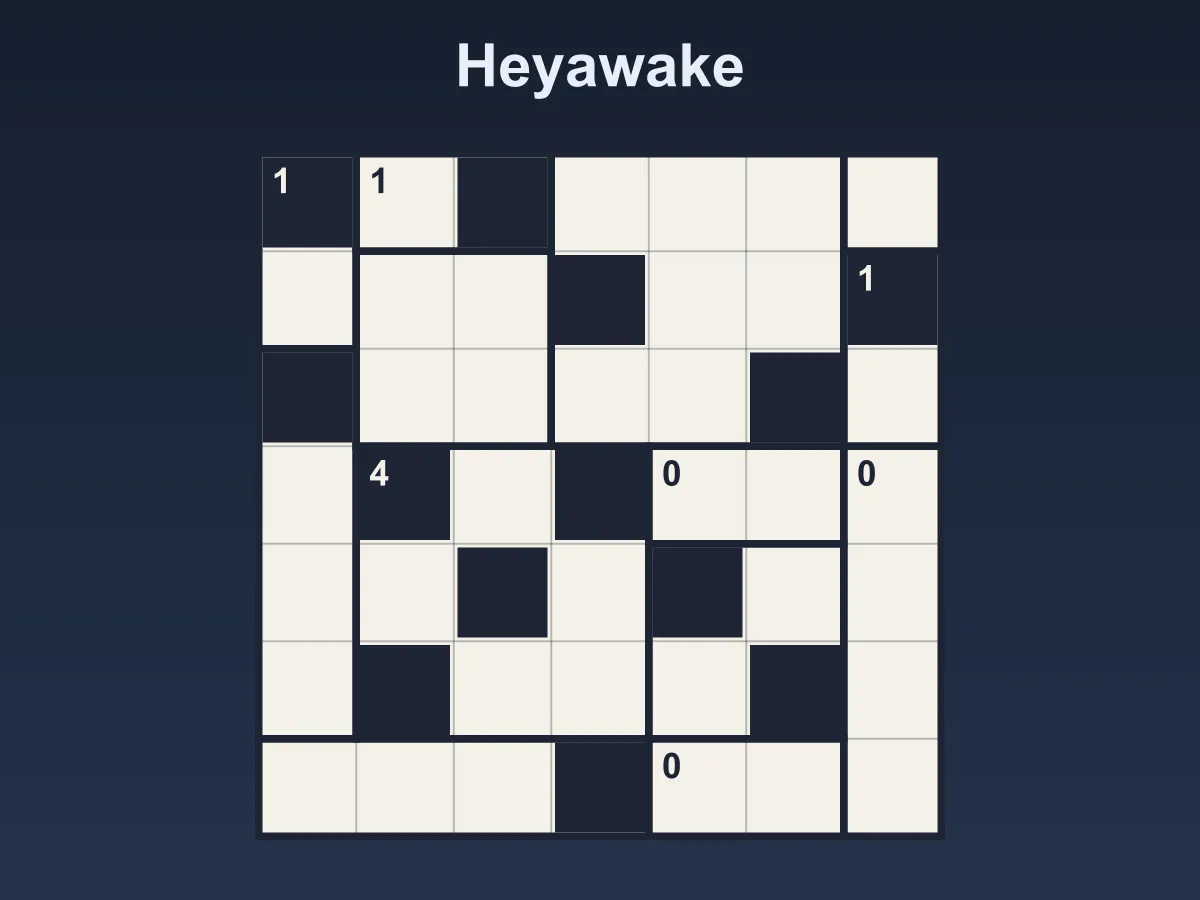


Heyawake is a free online room-shading logic puzzle. The grid is divided into rectangular rooms, and some rooms carry a number: exactly that many of the room's squares must be shaded. Four rules hold at once. A numbered room holds exactly its number of shaded squares, while a room with no number can hold any count. Shaded squares never share an edge, though they may touch at a corner. All the open squares must stay connected in one piece. And no straight line of open squares, along a row or a column, may run from one room through a second and on into a third — the rule the puzzle is named for, since heyawake is Japanese for "divided rooms". Tap a square to shade it, tap again to mark it with a dot as definitely open, and drag across squares to paint several at once. Two shaded squares that touch, a room that can no longer reach its number, an open line crossing two walls and an open patch that has been walled off all turn red straight away. Every board is built by the game itself, and before you see it, it is proved to have exactly one answer and to be solvable without guessing. Eight levels grow from a 6×6 to a 10×10: the first two need only the room counts, the spacing rule and the two-wall rule, levels 3 and 4 also lean on keeping the open squares in one piece, and from level 5 every board needs at least one "what if" followed through to a contradiction. No download, no account.
How to play Heyawake
- The grid is cut into rooms by thick walls. A number in a room's top-left corner says exactly how many of that room's squares are shaded. A room with no number may hold any number of shaded squares, including none.
- Two shaded squares may never share an edge. Touching at a corner is fine.
- All the squares you leave open must form one connected area, joined edge to edge. A shaded square can never be part of a ring that walls some open squares off.
- No straight line of open squares may cross two room walls. Walking along a row or a column over open squares only, you may pass from one room into the next, but never on into a third — so somewhere along that stretch there has to be a shaded square.
- Tap a square to shade it. Tap again to put a dot on it, a note that it stays open, and a third time to clear it. Right-click puts a dot on straight away.
- Drag across several squares to paint them all the same way. A drag only changes squares that looked like the one it started on, so it never overwrites something you decided.
- On a keyboard, arrow keys move between squares, S shades, D or a full stop dots, Backspace clears, and Space or Enter cycles a square.
- Two shaded squares that touch, a room that can no longer reach its number, a dotted line that runs through three rooms, and dotted squares walled off from the rest all turn red.
- The board is solved the moment every rule holds. You do not need to dot the open squares — undecided squares count as open.
- Undo steps back one change, Clear wipes the board, and New Puzzle deals a different board on the same level. The ? button settles one square, fixing a mistake first. Three per board.
Tips
- Start with rooms whose number leaves no choice. A 0 makes the whole room open. A room of two squares side by side can hold at most one shaded square, and a 2 in a row of three squares can only be the two ends.
- Every square next to a shaded square is open. Dot them as you go: dots are what the other rules work from.
- Look along the rows and columns for stretches that run from the last square before one wall to the first square after the next. Each such stretch needs a shaded square. When only one square of it is still undecided, shade it.
- Watch the corners and edges. A shaded square beside the edge, with another shaded square diagonally next to it, can box a corner square in. If that would happen, the square must stay open.
- A square that holds the open area together — the only link between two groups of open squares — can never be shaded.
- On the later levels, try a square in your head: shade it, follow what it forces, and if a room or a line breaks, it was open.
FAQ
Is Heyawake free to play?
Yes. It runs in the browser with no download, no sign-up and nothing to buy. All eight levels are included and unlock as you solve them.
What are the rules of Heyawake?
Shade squares so that each numbered room holds exactly that many shaded squares. Shaded squares never share an edge. All open squares form one connected area. And no straight line of open squares in a row or column may pass through three rooms, which means crossing two room walls. Rooms with no number can hold any count.
What does Heyawake mean?
Heyawake is Japanese for "divided rooms". The name comes from the rule that makes the puzzle unusual: an open line may reach into the next room but never through it into a third, so the rooms have to be divided by shaded squares.
Does every puzzle have exactly one answer?
Yes, and it is checked rather than assumed. Each board is built from a real answer, and a program that only ever makes forced moves has to be able to finish it before it is shown; a board it can finish that way has only one answer. The tests then run an exhaustive search on every level, and on levels 1 to 7 a second one written separately that uses none of that program's rules at all; each finds exactly one answer.
Will I ever have to guess?
No. On levels 1 and 2 every move follows from the room numbers, the spacing rule and the two-wall rule. Levels 3 and 4 also need the rule that the open squares stay in one piece. From level 5 on, each board needs at least one "what if": shade a square in your head, follow it, and watch a rule break.
How many levels are there?
Eight, from a 6×6 grid to a 10×10. The reasoning gets harder as the grids grow: level 5 needs one to four "what if" steps, level 6 three to eight, level 7 five to twelve, and level 8 fifteen or more. New Puzzle deals a fresh board on any level you have reached.
Why do some rooms have no number?
Because the puzzle does not need it. The game numbers every room from its answer and then takes numbers away for as long as the board stays solvable by logic, so the numbers left are the ones the puzzle needs. An unnumbered room can hold any count of shaded squares, and the other rules decide it.
What do the dots mean?
They are notes for you: a dot marks a square you know stays open. The game never requires them — undecided squares count as open when it checks your answer — but dotted squares are what it uses to spot a line that crosses two walls or an open patch that has been cut off.
Does it work on a phone?
Yes. Tap to shade and slide a finger across squares to paint several at once. On a phone held upright the game uses a taller frame, so the board spans the full width of the screen.