
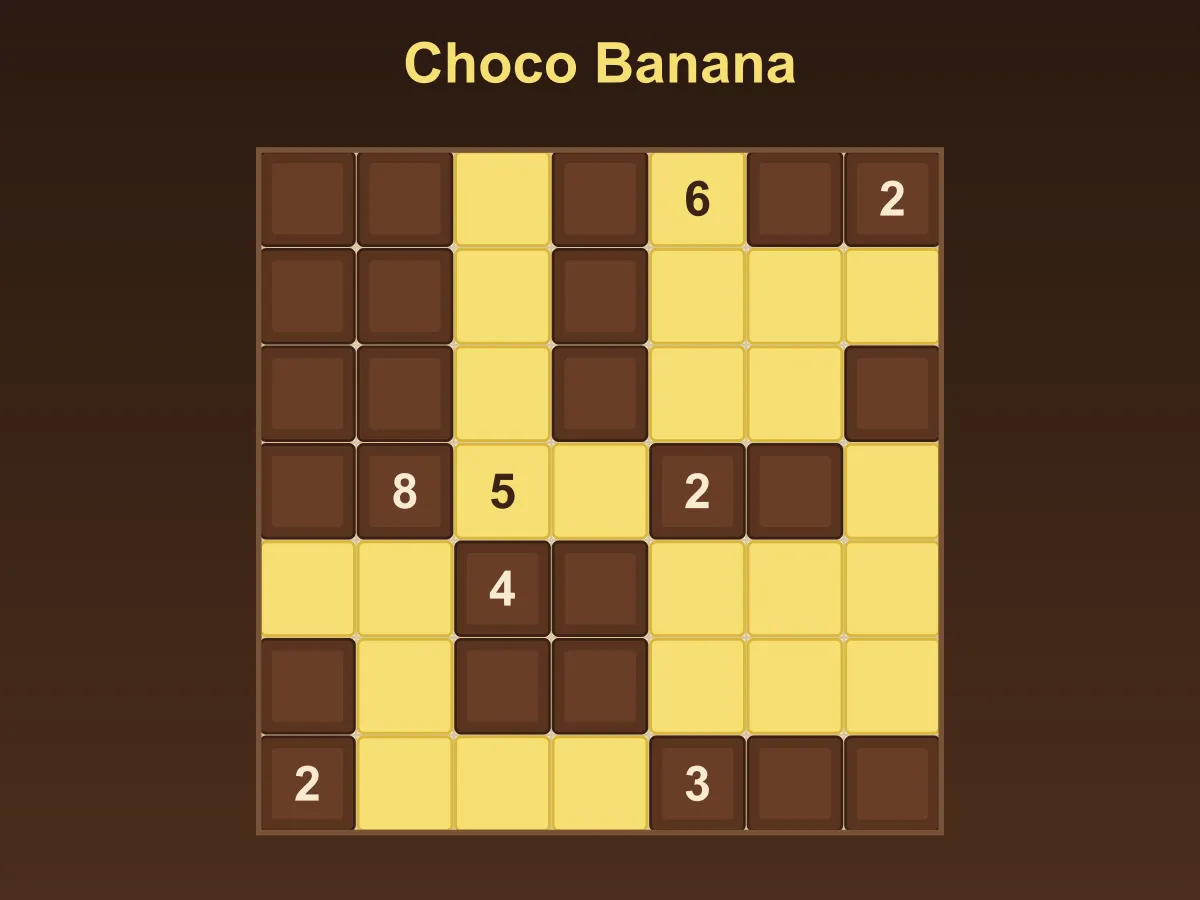


Choco Banana is a free online shading logic puzzle. Every square of the grid ends up chocolate (shaded) or banana (unshaded), and squares of the same kind joined side by side form one area. Every chocolate area must be a rectangle, every banana area must be any shape except a rectangle, and a number tells you how many squares are in the area it sits in. Tap a square for chocolate, again for banana, once more to empty it, or drag to fill several. A red frame marks an area that already breaks a rule. Every board is generated by the game, has exactly one answer, and is proved solvable by reasoning alone before you see it. Eight levels run from a 5×5 grid to a 10×10. No download, no account.
How to play Choco Banana
- Every square of the grid must end up chocolate (shaded) or banana (unshaded). Squares of the same kind that touch along a side belong to the same area; touching only at a corner does not join them.
- Every chocolate area must be a rectangle — a square counts. Every banana area must be any shape except a rectangle, so a banana area always has at least three squares.
- A number is the size of the area it sits in, whether that area is chocolate or banana. An area may hold several equal numbers, or none at all.
- Tap a square to make it chocolate, tap again for banana, and once more to empty it; a right-click goes round the other way. Drag across the board to fill every square you pass with what the first one turned to.
- On a keyboard, the arrow keys move a cursor, C or 1 makes a square chocolate, B or 2 banana, Enter or Space cycles it, and Backspace empties it.
- A red frame marks an area that already breaks a rule whatever you add later: two different numbers, more squares than its number, a banana square inside a chocolate area's rectangle, or an area that is closed off at the wrong size or shape.
- The board is solved the moment every square is filled and every rule holds. Undo steps back one change, Clear empties the board, and New Puzzle deals another board on the same level.
- The ? button settles one square: a square filled against the answer is turned the right way first, otherwise it fills the next square the reasoning reaches. Three per board.
Tips
- A 1 or a 2 is always chocolate: a banana area of one or two squares would be a rectangle, which bananas may never be.
- Chocolate fills its own corners. If three squares of a 2×2 block are chocolate, the fourth is too, because the area must become a rectangle; and two chocolate squares on a diagonal with a banana beside them mean the square across from that banana is banana.
- List the rectangles a chocolate number could still be. A square inside every one of them is chocolate, and a square that borders every one of them is banana.
- An area that has reached its number is finished: every empty square beside it is the other kind. A banana area that is still a rectangle, or a number still short, with only one way out, must grow through it.
- On the last three levels, try one square in your head. If making it chocolate leads to an area that cannot become a rectangle or a number that cannot be met, it is banana.
FAQ
Is Choco Banana free to play?
Yes. It runs in the browser with no download, no sign-up and nothing to buy. All eight levels are included and unlock as you solve them, and New Puzzle deals more boards on any level you have reached.
What are the rules of Choco Banana?
Shade some squares of the grid. Squares of the same kind joined side by side form an area. Every shaded (chocolate) area must be a rectangle, every unshaded (banana) area must not be a rectangle, and every number gives the size of the area that contains it, shaded or not.
Why is a 1 or a 2 always chocolate?
An area of one square is a square, and an area of two squares is a 1×2 strip — both are rectangles. Banana areas may never be rectangles, so a banana area needs at least three squares, and any number below three must sit in chocolate.
Does every puzzle have exactly one answer?
Yes, and it is checked rather than assumed. Each board is built from a real shading, and a program that only makes forced deductions — no guessing — must finish it before it is shown; a board it can finish that way has only one answer. The tests also run a separate search that tries every shading and finds exactly one answer on every board up to 8×8; on the 9×9 and 10×10 levels some boards take that search minutes, so it checks those it finishes.
Will I ever have to guess?
No. Levels 1 and 2 need only the shapes themselves: rectangles filling their corners, finished areas closing off, and areas with one way out. Levels 3 to 5 also need fitting — listing every rectangle a chocolate number could still fill. Levels 6 to 8 each need "what if" steps: one or two on level 6, two to five on level 7, and four or more on level 8.
How is Choco Banana different from Shikaku?
In Shikaku the whole grid is cut into rectangles, each holding exactly one number. In Choco Banana only the shaded areas are rectangles; the unshaded areas must be any other shape, and an area may hold several equal numbers or none.
Where does Choco Banana come from?
It is a pencil puzzle from the Japanese publisher Nikoli: published research on the puzzle traces its first appearance to the magazine Puzzle Communication Nikoli, issue 176. It shares its name with the chocolate-dipped banana sold at Japanese summer festivals. Who designed it is not recorded in the sources we could check.
How many levels are there?
Eight, from a 5×5 grid to a 10×10. Each level's boards are built fresh from a seed, so Replay gives the same board again and New Puzzle a different one at the same difficulty.
Does Choco Banana work on a phone?
Yes. Tap to cycle a square through chocolate, banana and empty, or drag with a finger to fill. On a phone held upright the board fills the screen's width; held sideways, the buttons move beside it.