
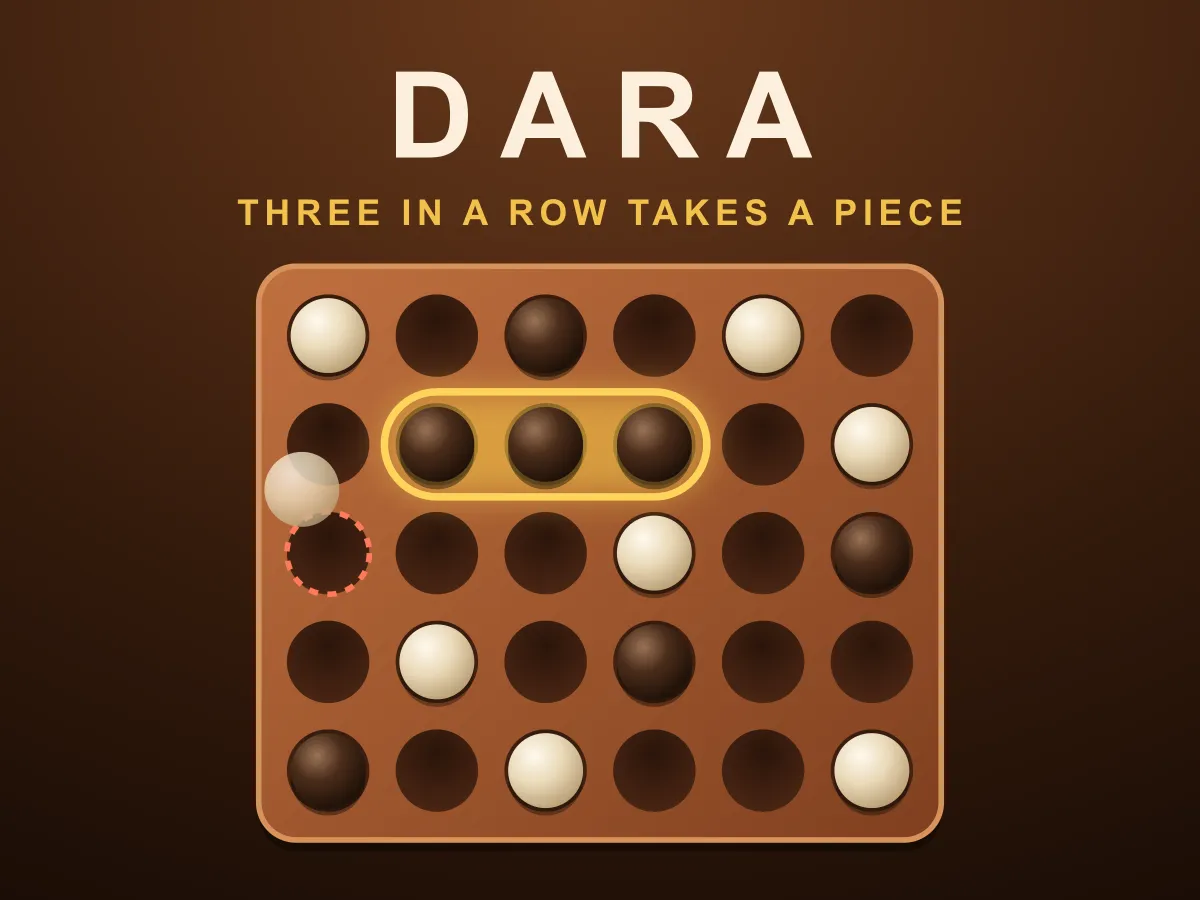



Dara is the West African strategy game of three in a row, played in Nigeria, Niger and Burkina Faso — free to play online against the computer with no download and no sign-up. Each side drops twelve pieces into five rows of six holes, never making three in a row while dropping. Then the pieces step one hole across or down, and every line of exactly three you make takes one enemy piece. Cut the other side down to two pieces to win. Five computer opponents, from a Novice that misses lines to a Master that reads five moves ahead, plus hints, undo and saved games.
How to play Dara
- You and the computer each have twelve pieces and the board has five rows of six holes. Black moves first: you play Black in your first game, and the colours swap every game after that.
- Drop phase: take turns tapping an empty hole to drop a piece, until all 24 pieces are on the board. A drop may never make three of your pieces in a row, across or down — those holes are crossed out.
- Move phase: tap one of your pieces, then a glowing hole next to it to step there — one hole across or down, never diagonally. You can also drag a piece, or tap an empty hole that only one of your pieces can reach.
- A step that makes exactly three of your pieces in a row, across or down, captures: the enemy pieces you may take glow red, and you tap the one you want. A piece standing in a row of three of its own is safe unless every enemy piece is. Four or more in a row is never allowed.
- Win by cutting the computer down to two pieces — it can never make a row again — or by leaving it with no step to make on its turn.
- The same position coming round a third time is a draw, and so is 30 steps each with no capture. Beat an opponent to unlock the next one; Hint shows the Master’s choice of move and Undo takes back your last move.
Tips
- Drop with the stepping phase in mind. Two pieces in a row with an empty hole beside them, and a third piece one step from that hole, is a line ready to close the moment the stepping starts.
- Whoever steps first after the drop often closes the first line, so as White, spend your last drops filling the holes Black is aiming at.
- A line can be opened and closed again: step a piece out of your row of three and back in, and it captures every time it closes. Guard the hole it steps out of, or the computer will do the same to you.
- Take the piece that hurts most: the one about to close a line of its own, or the one blocking the hole you want next.
- Count before you step. A step that makes four in a row is illegal, and a step that empties a hole beside your own pair can hand the computer the line instead.
FAQ
Is Dara free to play online?
Yes. Dara is free to play in your browser with no download, no account and no in-game purchases.
How do you win at Dara?
Capture enemy pieces by making rows of exactly three until your opponent has only two pieces left — two pieces can never make a row, so that side has lost. You also win if your opponent has no legal step on their turn.
Can you make three in a row while dropping the pieces?
Not here. This version follows the rule played in Niger: a drop that would make three of your pieces in a row across or down is not allowed at all, and those holes are crossed out on the board. In some places a row made during the drop is allowed but simply captures nothing. If a side ever has no legal drop it passes, and if neither side can drop the pieces still in hand stay out of the game.
Does four in a row count in Dara?
No. Only a row of exactly three captures, and a step or drop that would make four or more in a row is not allowed. Rows count across and down only — diagonals never count. A step that makes two rows of three at once still takes just one piece.
Which enemy piece can you take?
Any enemy piece that is not itself standing in a row of three. If every enemy piece is in a row of three, you may take any of them. The pieces you can take glow red, and you tap the one you want.
Who moves first in Dara?
Black drops first, and after a full drop Black also steps first. You play Black in your first game and the colours swap every game. Stepping first matters between careful players: in 200 games of the Expert playing itself from random openings, Black won 129 and White won 47, with 24 draws.
How strong is the computer?
Each pairing of levels was measured over 400 computer-against-computer games (200 openings, each played with the colours swapped). The Novice scores 57% against a beginner who only takes rows one move away; after that every level outscores the one below it — the Apprentice 86% against the Novice, the Player 95% against the Apprentice, the Expert 76% against the Player, and the Master, which looks five moves ahead, 63% against the Expert, winning 243 games to 140 with 17 draws.
Can Dara end in a draw?
Yes, though it is rare. Here a game is drawn when the same position comes round a third time, or after 30 steps each with no capture.
Where does Dara come from?
Dara is played in West Africa, in Nigeria, Niger and Burkina Faso. The Zarma of Niger call it dili, and Hausa players in Niger and Nigeria call it doki, meaning horse. Traditionally the board is thirty holes scooped into sand, played with nuts against short sticks.
How is Dara different from Nine Men’s Morris or tic-tac-toe?
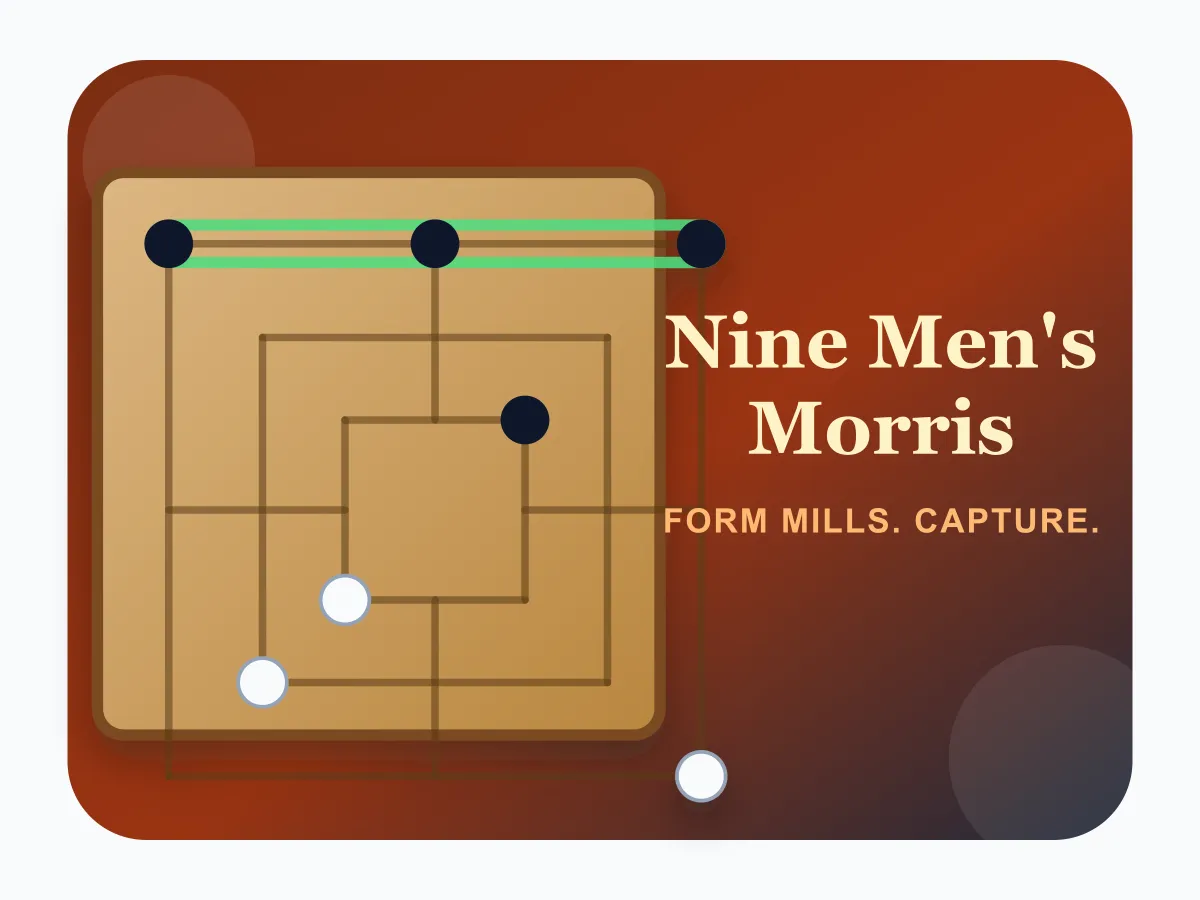
Like Nine Men’s Morris, Dara captures by making rows of three — but on an open grid of 30 holes, where rows run only across and down and must be exactly three long. Unlike tic-tac-toe, a row does not end the game: it takes one piece, and the game goes on until one side is down to two.
Does Dara work on phones?
Yes. Tap to drop and step, or drag a piece with your finger; on an upright phone the board sits above the controls. A keyboard works too: the arrow keys move around the board and Enter plays, H asks for a hint, U takes back a move, Escape cancels a step and N starts a new game.