
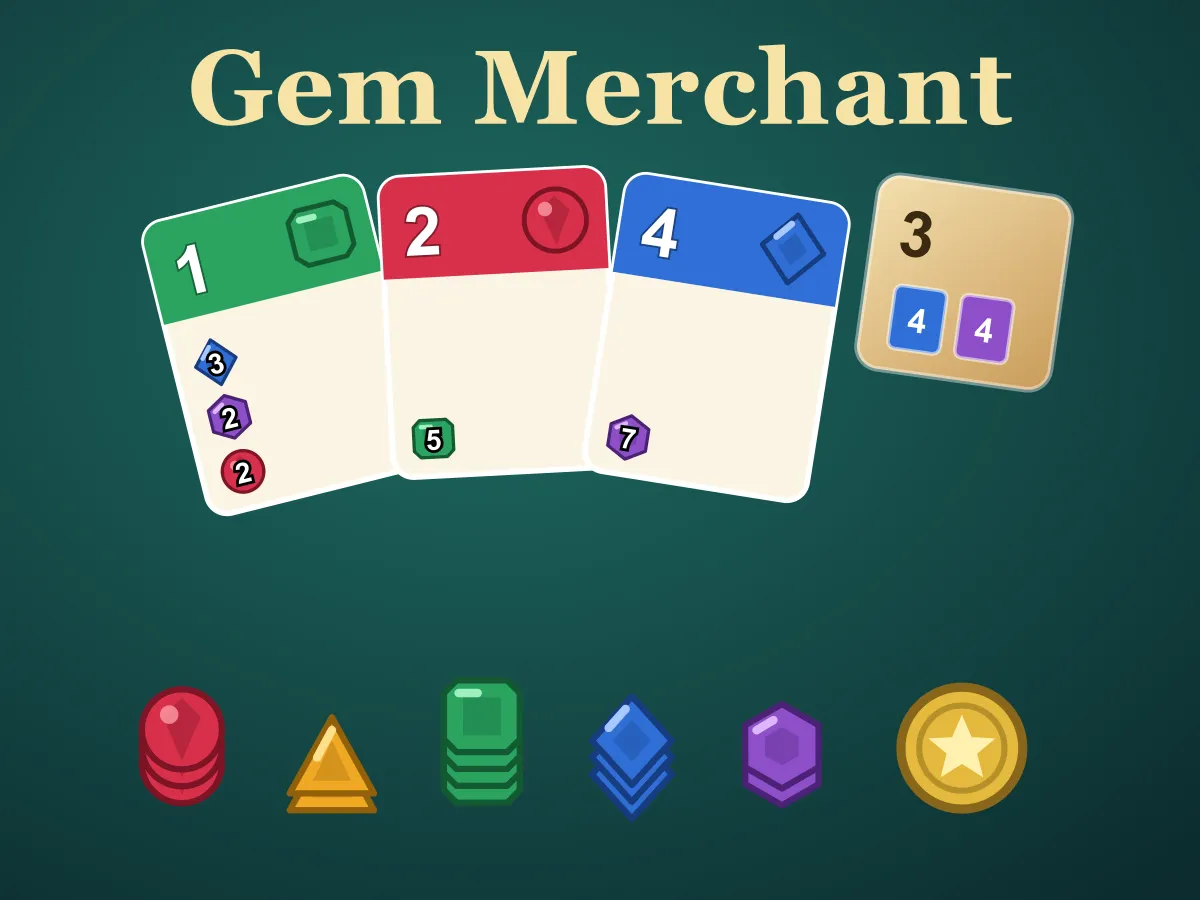



Gem Merchant is a free online gem-trading card game, an engine builder you play against the computer at six tables, from one easy rival up to a full table of four. The market shows twelve cards in three tiers, and each one costs gems — ruby, topaz, emerald, sapphire and amethyst, each with its own shape as well as its own colour. On your turn you do one thing: take three gems of different colours, take two of one colour from a full pile, reserve a card and take a gold wild, or buy a card. Every card you buy is a permanent discount of one gem in its colour, so the cheap cards of the first tier pay for the points of the third. Patrons wait at the top of the market and visit, for three points, the first merchant to own the cards they ask for. When someone reaches 15 points the round is played out, so everyone has had the same number of turns, and the most points wins. The deck is the game's own: 85 cards cut from a few cost patterns turned through all five colours, so no colour is cheaper than another. The computer merchants get sharper table by table — a novice who buys whatever shines, a trader who plans, and a master who looks a round ahead and reserves the card you need.
How to play Gem Merchant
- Press Play and pick a table. The first seats you with one beginner; each table you win opens the next, up to a table of four.
- The market shows four cards from each of three tiers, with patrons above them. A card shows its points in the top corner, the colour it gives in the top right, and its price in gems at the bottom.
- On your turn do exactly one thing. Take three gems of different colours: tap them in the supply, or press 1 to 5, then Take or Enter.
- Or take two gems of one colour: tap the same gem twice. You can only do this when that pile still has four or more.
- Or reserve a card: tap it, then Reserve. It goes to your hand, nobody else can buy it, and you take a gold, which pays for any colour. You can hold three reserved cards, and you can also reserve the top card of a deck without seeing it.
- Or buy a card from the market or from your reserve: tap it, then Buy. Every card you own takes one gem of its colour off every price, for good, so a card that costs three emeralds costs only one if you own two emerald cards. A green ring shows the cards you can afford.
- You can hold ten gems at most. If a take would leave you with more, the game asks which gems to give back.
- A patron visits, for 3 points, at the end of your turn as soon as you own the cards she asks for — four each of two colours, or three each of three. She visits only once, and only one merchant.
- When anyone reaches 15 points, the round is finished so everyone has had the same number of turns. The most points wins; a tie goes to whoever bought fewer cards.
- Win for one star. Finish far enough ahead of the best rival for two and three: the result card says how far. Hint (or H) suggests a move, and you can replay the same deal or ask for a new one.
Tips
- Buy cheap cards early, even ones worth no points. Each one is a discount for the rest of the game, and a few of the right colours make a three-point card cost half its printed price.
- Look at the patrons first and lean your early buys towards their colours. A patron is 3 points that cost no gems at all.
- Before you take gems, pick the card you are saving for and take what it is missing. Three gems you do not need are a turn spent for nothing.
- Taking two of one colour is the fastest way to finish a card that needs a lot of a single colour — but only while the pile has four.
- Reserve a card when a rival is one turn from buying it and it would win them the game or a patron, or when the gold is the gem you are short of.
- Keep an eye on the gem limit. Ten gems and nothing to buy means your next take costs you gems you already had.
- Late in the game, count points. The round is always played out, so reaching 15 first is not enough if the merchants after you can pass you before it ends.
FAQ
Is Gem Merchant free to play?
Yes. It runs in your browser for free, with no download, no install and no account.
Does Gem Merchant work on a phone?
Yes. Held upright the table stacks into one column with the rivals at the top and your gems at the bottom; held sideways it lays out like the desktop. It plays by touch, mouse or keyboard (1 to 5 for gems, Enter, Escape, H for a hint).
How do you win Gem Merchant?
Have the most points when the game ends. Points come from the higher-tier cards and from patrons, who visit for 3 points when you own the cards they ask for. The game ends at the end of the round in which someone reaches 15, so everyone has had the same number of turns; a tie on points goes to whoever bought fewer cards.
What does a card discount do?
Every card you buy counts as one gem of its colour towards every later purchase, for the rest of the game. Own three sapphire cards and a card that costs five sapphires costs you two. That is why cheap cards with no points are worth buying early: they make the expensive ones affordable.
What is gold for?
Gold pays for a gem of any colour. You cannot take it from the supply; you get one each time you reserve a card, while any are left. Reserving also keeps that card away from everyone else until you buy it.
How good are the computer merchants?
There are three. The novice mostly buys the card worth the most points that it can afford, and otherwise grabs gems at random. The trader weighs every move by how close it brings its best cards and patrons; played on the same deals with seats swapped, it beats the novice about four games in five. The master looks a round ahead at what each rival could do next and reserves the card that would win them the game; on the same deals it beats the trader about three games in four.
How hard are the tables?
Played on the first 100 deals of each table, a stand-in that plans like the trader wins 86 of them at the first table, 51 at the second and 20 at the last, a table of four masters. The master itself wins 94 at the first table and 40 at the last. The star targets come from the same games: two stars at the master's typical winning lead, three at a lead only its best fifth of wins reach.
Does going first help?
Not measurably. You always move first, but the last round is played out so every merchant gets the same number of turns. With identical computer merchants in every seat, over 400 deals each, every seat won within six points of its fair share at tables of two, three and four.
How long does a game take?
Between computer players most games end around round 25 to 30, which is five to ten minutes for you at a table of two — a little longer at a table of four, where you wait for three rivals each round.
Are the cards copied from a published game?
No. Gem Merchant's 85 cards and 20 patrons are its own: each tier is a few cost patterns, each turned through all five colours, so every colour has exactly the same cards. Strong computer players were measured buying every pattern.