
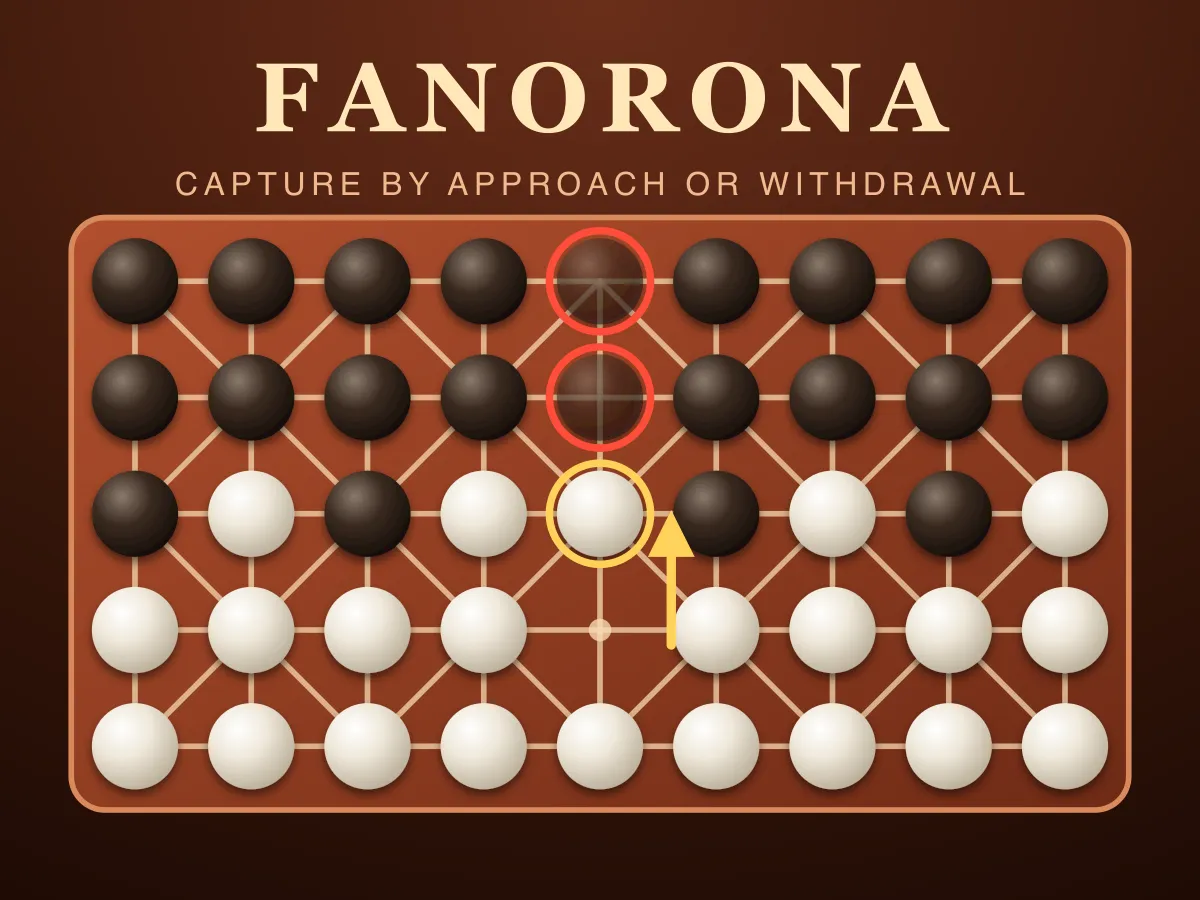
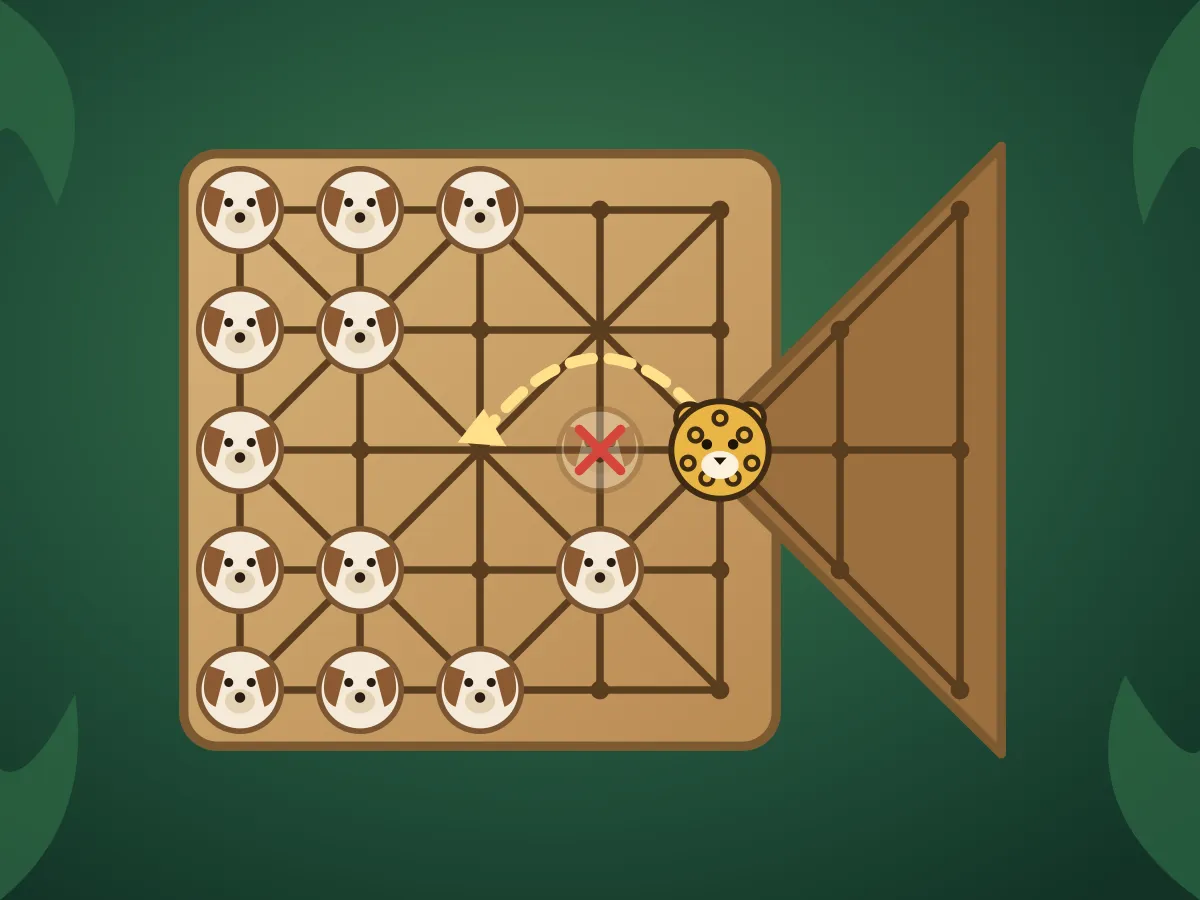




Fanorona is the traditional strategy board game of Madagascar, free to play online here against the computer with no download and no sign-up. Twenty-two stones a side fill the 9×5 board except the centre point. You capture in a way few board games do: step up to an enemy stone along a line (approach) or step directly away from one (withdrawal), and that stone goes — along with every enemy stone lined up behind it. Captures are compulsory and can chain, so one piece can zig-zag across the board taking a row at a time. Play five computer opponents, from a Novice that grabs what it sees to a Master that reads five turns ahead, with hints, undo and saved games.
How to play Fanorona
- Each side has 22 stones filling the board except the centre point. White moves first: you play White in your first game, and the colours swap every game after that. Your side is always drawn at the bottom.
- On your turn, move one stone one step along a line to an empty point. Straight lines join every point; the diagonals only run through the points they are drawn through.
- Capture by approach: step up so you stop next to an enemy stone on the line you moved along. That stone is taken, and so is every enemy stone directly behind it until a gap or one of your own stones.
- Capture by withdrawal: step directly away from an enemy stone next to you. It is taken, with the unbroken line of enemy stones behind it. If one step could do either, choose Approach or Withdraw (or tap a stone in the line you want).
- Capturing is compulsory: if any of your stones can capture, you must capture. After a capture the same stone may capture again, but never in the same direction twice in a row and never back onto a point it has already stood on this turn. You may stop whenever you like with End turn.
- White's very first turn is a single capture with no chain. Take every enemy stone to win; a side left with no legal step loses. The same position coming round a third time, or 25 moves each without a capture, is a draw.
- Beat an opponent to unlock the next one. Hint shows the Master's choice of turn; Undo takes back your last turn and the computer's reply.
Tips
- Before you capture, look at where your stone ends up. A stone that stops in a line of your own pieces with an empty point beyond them invites the other side to approach and take the whole row.
- Count both ways. The same step often captures forwards by approach and backwards by withdrawal — pick the line that leaves you safer, not just the longer one.
- Plan chains. Each capture must change direction, so a stone that can turn a corner onto a second line can take two rows in one turn.
- Strong points matter: the points where diagonals cross let a stone move in eight directions instead of four, so a stone there can capture along more lines and is harder to trap.
- Near the end, hunt with two stones together. A lone stone can slip between single attackers, but two working on neighbouring lines leave it nowhere to step.
FAQ
Is Fanorona free to play online?
Yes. Fanorona is free to play in your browser with no download, no account and no in-game purchases.
How do you capture in Fanorona?
By moving, never by jumping. Approach: step so you stop next to an enemy stone on the line you moved along. Withdrawal: step directly away from an enemy stone next to you. Either way that stone is captured along with every enemy stone lined up directly behind it, up to the first empty point or one of your own stones.
Do you have to capture in Fanorona?
Yes. If any of your stones can capture, your turn must be a capture — a plain step (a "paika") is only allowed when nothing can capture. Carrying on with a chain after the first capture is optional: you may stop whenever you like.
What are the rules for a capture chain?
Only the stone that just captured may carry on, and every further step must capture too. It may not move in the same direction twice in a row, and it may not return to a point it has already stood on this turn. Here the very first turn of the game is limited to a single capture — a common opening rule that keeps White from sweeping a wing on move one.
Can Fanorona end in a draw?
Yes. Here a game is drawn when the same position comes round a third time with the same side to move, or after 25 moves each without a capture. Computer analysis has shown that Fanorona is a draw when both sides play perfectly, and strong players do draw: the Master and the Expert drew 48 of their 200 measured games.
Who moves first, and does it matter?
White always moves first, and you get White every other game. Moving first is not a clear edge here: in 200 games of the Player against itself from random two-turn openings, White won 64 and Black won 107, with 29 draws.
How strong is the computer?
Each pairing of levels was measured over 200 computer-against-computer games (100 random openings, each played with the colours swapped). The Novice beats a random mover 83% of the time; after that every level outscores the one below it — the Apprentice 99% against the Novice, the Player 89% against the Apprentice, the Expert 87% against the Player, and the Master, which reads five turns ahead, 83% against the Expert, winning 142 games to 10 with 48 draws.
Does Fanorona work on phones?
Yes. Tap a stone and then a glowing point, or drag the stone; the board fits an upright phone and fills a sideways one. A keyboard works too: the arrow keys move around the board, Enter plays, A and W choose approach or withdrawal, E ends a chain, H asks for a hint, U takes back a turn and N starts a new game.
Where does Fanorona come from?
Fanorona is the traditional board game of Madagascar, where it is still widely played. This is Fanoron-tsivy, the full 9×5 game; smaller boards (Fanoron-telo on 3×3 and Fanoron-dimy on 5×5) are played there too. A well-known Malagasy legend says a king chose his heir by which son reached him first — and the elder lost the crown because he stayed to finish a difficult game of Fanorona.