








Home / Simulation / Moon Sweeper
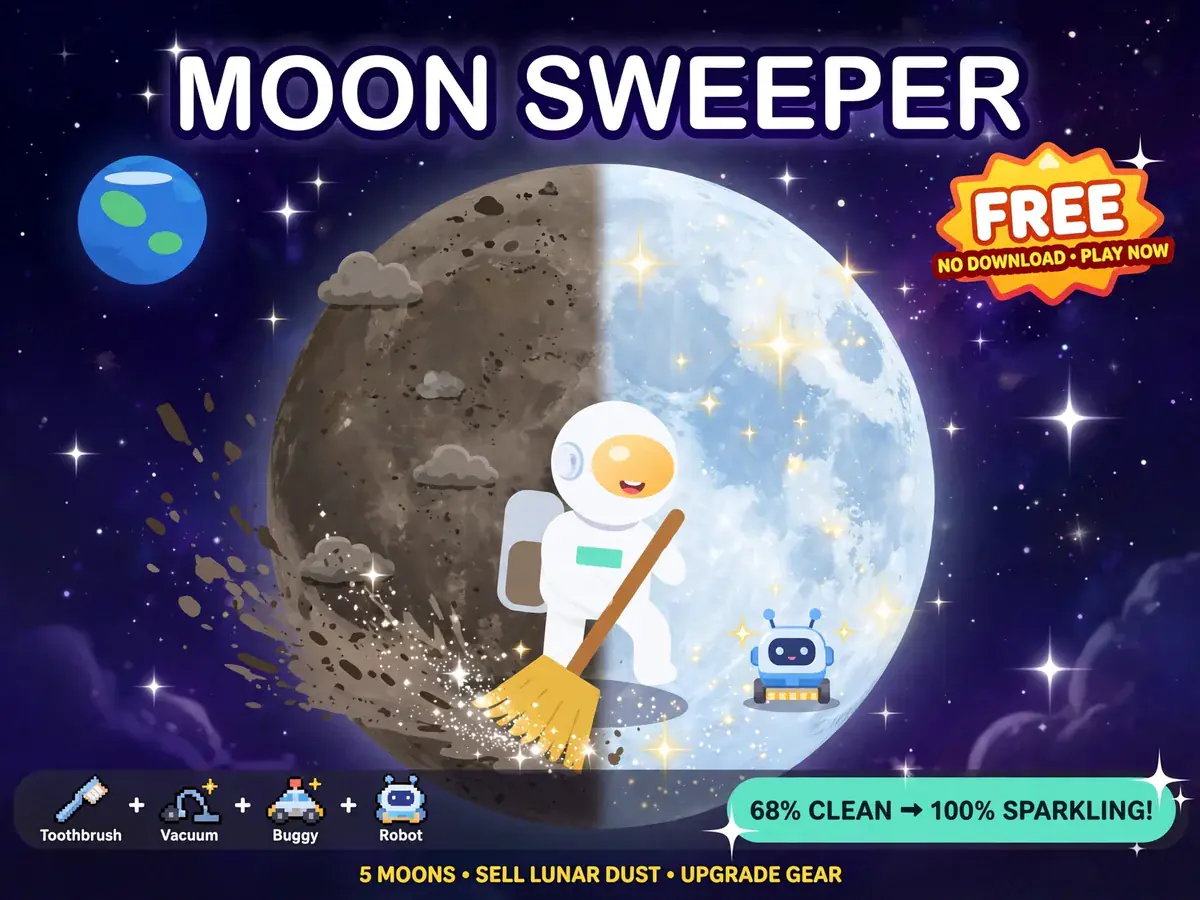
Moon Sweeper is a free clean-the-moon game you can play online in your browser — no download, no account, and it works on phones, tablets and computers. You are the astronaut sent to sweep the moon clean, one cell at a time, starting with nothing but a toothbrush. Tap a dusty cell to walk there and scrub it; the dust goes into your bag, and stepping back onto the lander sells it for credits. Every day runs on one tank of oxygen, and walking, sweeping and the long trip home all spend it. At night you spend the credits in the lander’s shop: a broom that sweeps a 3×3 patch, a vacuum that lifts two layers off a whole row, bigger bags, a moon buggy, a bigger oxygen tank, docks you build on the far side of the moon and a sweeper robot. Here is the catch that makes it a game: the only money on the moon is the dust itself, so you cannot buy everything — a smart buying order beats a lucky one. There are five moons to clean, from 8×8 to 11×11 cells — Pebble Moon to Harvest Moon — each with a day limit and day marks for the stars, and a before-and-after picture of the moon when you finish. If you enjoy the slow, satisfying climb of a power washing game — a dirty surface, a small tool and a clean percentage that only goes up — Moon Sweeper is that cleaning game on a grid, with an oxygen bar and a shop standing between you and a spotless moon.
How to play Moon Sweeper
- Pick a moon. You start on Pebble Moon, a small 8×8 moon; cleaning one unlocks the next, up to the 11×11 Harvest Moon. Each moon shows how many days you have and the day marks for three and two stars.
- Your lander sits on the bottom rim. Tap any dusty cell: the astronaut walks there along the shortest path and sweeps it with the tool in hand. Each step costs 2 oxygen and each sweep costs the tool’s oxygen (1 for the toothbrush). Tap the cell you are standing on to sweep it again. On a keyboard, the arrow keys walk one cell and Space sweeps.
- Dark, thick patches hold more layers of dust — up to six on the deepest craters. A toothbrush lifts one layer from one cell, so a deep cell takes several sweeps. Hover or press on a cell to see how much dust a sweep there would lift and how much oxygen the trip costs.
- Swept dust goes into your bag, which holds 10 to start. When it is full, walk back onto the lander (or a dock you built) and the dust sells automatically: 1 credit per dust. Buried moon gems pay 10 credits when you clear the cell they hide under — watch for a cyan glint through the last layer.
- Watch the oxygen bar. The white mark on it is what the walk home costs from where you stand. If the oxygen runs out away from a dock, the rescue drone tows you home and your bag spills: that dust settles back onto the moon. End day walks you home first if you can make it.
- At night the lander’s shop opens. Spend your credits on the Broom (3×3 patch), the Dust Vacuum (two layers off a whole row), the Dust Sack, Big Hopper and Cargo Pod (20, 40 and 80 dust), the Moon Buggy (1 oxygen a step), the Big Tank (90 oxygen a day), the Dock Kit and Second Dock Kit (a selling dock wherever you build one) and the Sweeper Robot (15 dust near the lander every morning).
- Owned tools appear as buttons under the meters, so you can switch back to the toothbrush for a single speck. Use Build dock while standing on a clean cell to put a selling dock there; docks shorten every later walk home.
- Clean the last speck before the day limit and the moon is spotless: you get one to three stars by the day you finished and a before-and-after picture of the moon. Miss the limit and the supply ship leaves — the card tells you what to try next time.
Tips
- Buy something on the first night you can. The moon only ever pays out its own dust, so an upgrade bought on night two works for the whole run while the same upgrade on night eight barely pays for itself. Keeping the credits and buying nothing never cleans a moon in time.
- Match the bag to the tool. A broom fills a 10-dust bag in one or two sweeps, and then the walk home is most of your day; the Dust Sack or a Dock Kit soon after the broom is what makes the broom pay.
- Build your first dock far from the lander, on the side with the most dust left. Every trip from there on is shorter, and you can start the next morning from that dock instead of the rim.
- Plan each trip so the bag is full when you reach a dock, and never let the oxygen fall below the white home mark. A tow costs the whole bag, and that dust lands back on the cells you already swept.
- The Sweeper Robot is a luxury, not a first buy: saving for it before anything else costs several days on every moon. Tools, bags and docks pay back faster; the robot is for when they are done.
- The best order changes with the moon. On small Pebble Moon the broom comes first; on the deep, dusty Harvest Moon the Dust Vacuum is worth buying early, because two layers off a whole row empties the deepest patches fast.
FAQ
Is Moon Sweeper free to play?
Yes. Moon Sweeper is free to play online in your browser with no download, no account and no in-game purchases. Credits come only from the moon itself: the dust you sell and the gems you dig up.
Is Moon Sweeper the same game as Moon Sweepers on Steam?
No — they are two different games about the same job. Moon Sweepers by DragDrop Games is a paid PC game on Steam with online co-op for up to 16 players. Moon Sweeper on this page is a free single-player browser game with the same toothbrush-to-robot cleaning loop, played on a grid of moon cells with one tank of oxygen a day. It is not made by or connected to DragDrop Games, and it runs on phones and computers with no download.
Is there a free version of Moon Sweepers?
Moon Sweepers is sold on Steam as a paid game. Moon Sweeper is a separate free game built around the same idea — sweep lunar dust, sell it and upgrade your tools from a toothbrush to a robot — and it costs nothing to play here in your browser, on a phone or a computer.
What is the game where you clean the moon with a toothbrush?
The one in the viral clips is Moon Sweepers, a paid co-op game on Steam. Moon Sweeper, on this page, starts the same way and is free in your browser: your astronaut lands on a moon buried in dust with a toothbrush as the only tool. Every cell you scrub fills your bag with dust you sell at the lander, and the credits buy a broom, a vacuum, a buggy and eventually a robot — until the whole moon is clean.
Do I need Steam or a download to play Moon Sweeper?
No. Moon Sweeper runs entirely in this browser tab — open the page and press Play. There is no Steam account, no installer and no app; the same page works on Windows, Mac, Chromebook, Android and iPhone.
How do you play Moon Sweeper?
Tap a dusty cell and your astronaut walks there and sweeps it. The dust goes into your bag; walk back onto the lander or a dock to sell it for credits. Each day you have one tank of oxygen for walking and sweeping, and at night you spend the credits on bigger tools, bags, a buggy, a tank, docks and a robot. Clean the whole moon before the day limit.
What happens if I run out of oxygen?
If your oxygen runs out while you are away from a dock, a rescue drone tows you back to the lander and your bag spills — the dust in it settles back onto the nearest swept cells, so you lose that progress as well as the credits. The white mark on the oxygen bar shows what the walk home costs, and End day walks you home first whenever you have enough oxygen.
What should I buy first in Moon Sweeper?
Something cheap and useful on the first night you can afford it: the Broom (3×3 sweeps) or the Dust Sack (a 20-dust bag), then a Dock Kit and the Moon Buggy to cut the walk home. The total money in a run is fixed by the dust on the moon, so early upgrades pay back the most. Playing a moon without buying anything never finishes in time, and saving for the Sweeper Robot before anything else costs several days.
How do stars work?
Each moon, from Pebble Moon to Harvest Moon, has a day limit and two day marks. Finish by the first mark for three stars, by the second for two, and before the limit for one. The marks were set by playing every moon with a strong buying order and with a cheapest-first order, so three stars needs a plan, not just speed.
How many moons are there?
Five: Pebble Moon (8×8), Silver Moon (10×10), Crater Moon (10×10 with deep craters), Rocky Moon (11×11 with boulders in the way) and Harvest Moon (11×11 and the dustiest). Cleaning one unlocks the next, and each moon keeps your best stars and days.
Can I play Moon Sweeper on my phone?
Yes. Everything works with taps: tap a cell to walk and sweep, or press, slide your finger to aim and lift to choose the cell under it. The game fits an upright phone screen and a phone on its side. On a computer you can also use the arrow keys, Space to sweep, H to go home, B to build a dock, E to end the day and 1–3 to switch tools.
Is my progress saved?
Yes, in this browser. The run you are playing is saved after every move, so you can close the page and continue from the moon picker, and every moon remembers your best stars and fewest days. Clearing your browser data removes them.
Is Moon Sweeper multiplayer?
No. It is a single-player game: one astronaut, one moon at a time, and nothing to wait for.
Is Moon Sweeper like PowerWash Simulator?
It shares the satisfying part of a power washing game — a dirty surface, a small tool and a clean percentage that only goes up — but the game around it is different. Power washing is about spraying grime off freely against a clock. Moon Sweeper is a grid of dust layers on a round moon with an economy around it: oxygen for each day, a bag that has to be carried home, and a shop where every credit comes from the dust you swept. Watching the clean percentage climb is the reward; deciding what to buy and when to walk home is the game.
Is Moon Sweeper like Minesweeper?
Only in the name and the grid. There are no mines and no numbers to work out: thick dust shows as darker patches, and hovering or pressing on a cell tells you how much a sweep there would lift. The puzzle is planning — your oxygen, your bag space and the order you buy upgrades in. Think of it as a cleaning game on a Minesweeper-shaped board.