
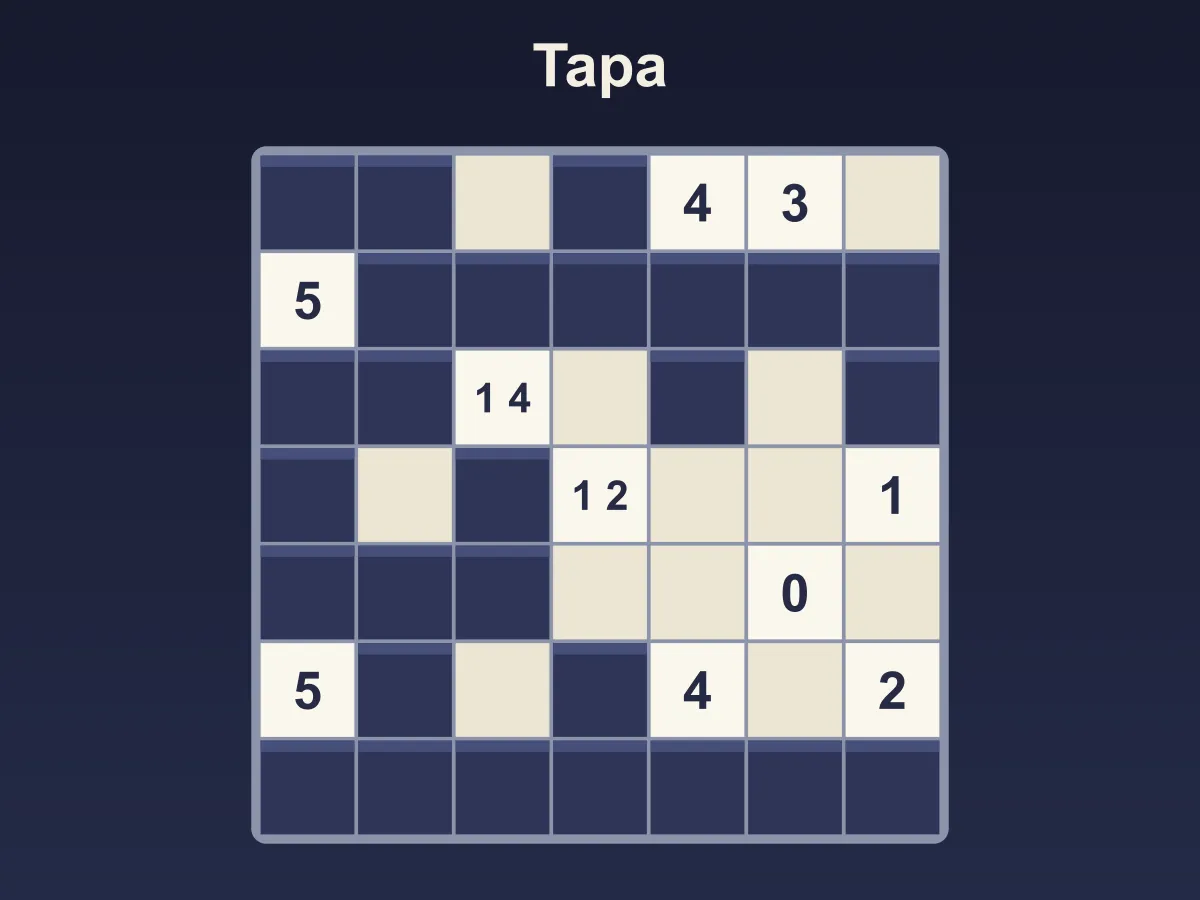
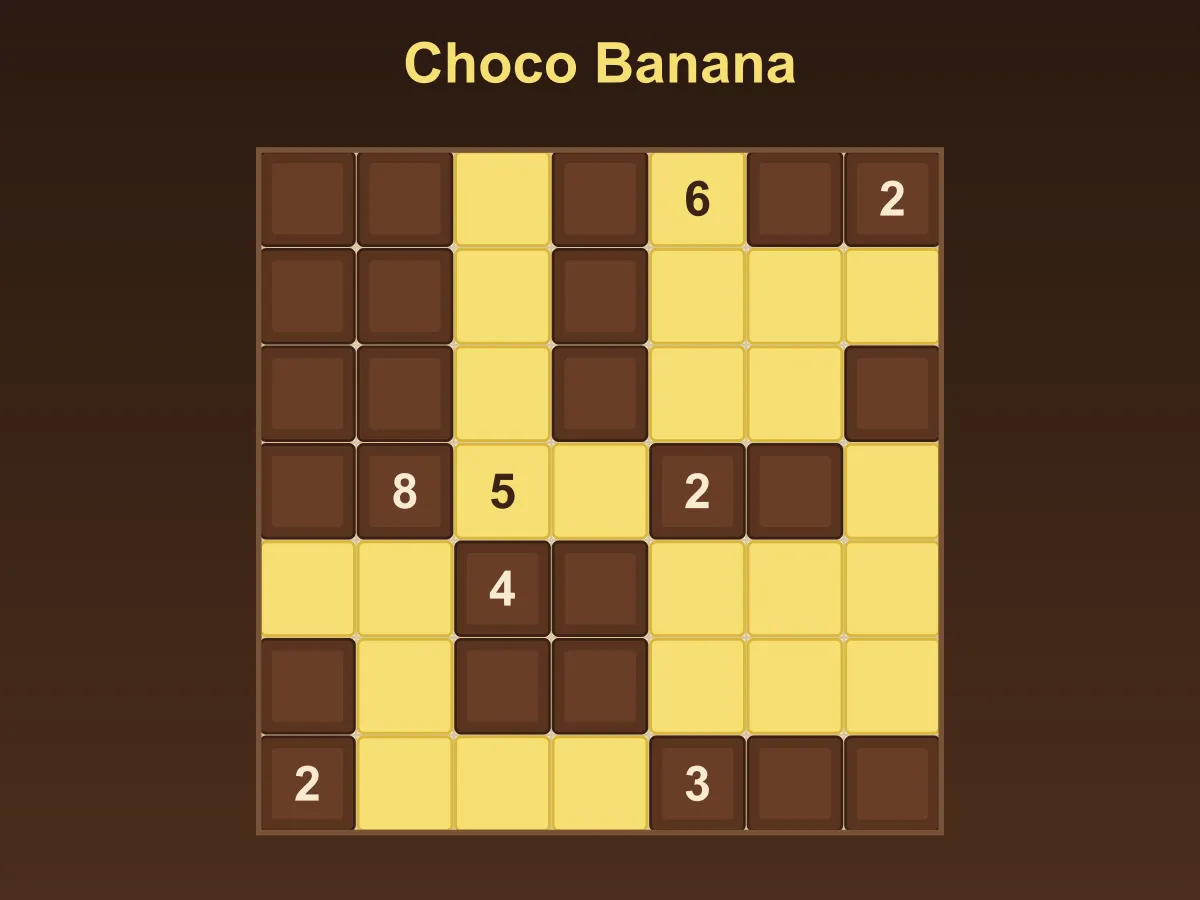



Tapa is a free online logic puzzle, invented by the Turkish puzzle author Serkan Yürekli and now a favourite at puzzle championships. The grid holds a handful of clue squares, and you shade the others to build a wall. Each clue describes the ring of eight squares around it: every number is the length of one unbroken run of shaded squares in that ring, diagonals included. A clue of 3 means one run of three; a clue of 1 1 2 means three separate runs, of one, one and two, in any order around the ring. Clue squares are never shaded, every shaded square must join the rest of the wall side to side so it forms a single piece, and no 2×2 block may be completely shaded. Tap a square to shade it, tap again to mark it with a dot as open, and drag to paint a whole stretch at once; on a computer the right button places dots. Once a clue already shows its numbers, tap it and every undecided square around it is dotted. Mistakes appear as you make them: a full 2×2, a clue that can no longer be met, a piece of wall sealed off from the rest. Every board is generated fresh, has exactly one answer, and is proved solvable without guessing before you see it. Eight levels grow from 6×6 to 12×12, and the later ones need a "what if" followed through to a contradiction. No download, no account.
How to play Tapa
- Shade squares to build a wall. Every shaded square must connect to the rest of the wall through a side, so the whole wall is one piece.
- A clue square looks at the eight squares around it, corners included. Each of its numbers is the length of one unbroken run of shaded squares in that ring.
- Several numbers mean several runs, each separated by at least one open square. The order of the numbers says nothing about where the runs sit.
- A 0 means none of the squares around the clue is shaded. Clue squares themselves are never shaded.
- No 2×2 block of squares may be completely shaded, anywhere on the board.
- Tap an undecided square once to shade it, again to mark it with a dot (open, no wall here), and a third time to clear it.
- Press on a square and drag across others to paint the same change onto every square in the same state along the way. On a computer the right button places or removes dots.
- When a clue already shows its numbers, tap it to dot every square around it that is still undecided.
- Red means a rule is already broken: a fully shaded 2×2, a clue its ring can no longer satisfy, or part of the wall sealed off from the rest by open squares.
- On a keyboard, arrow keys move the highlight, S shades, D or . places a dot, Backspace clears, and Space or Enter cycles the square.
- The board is solved when the shaded squares match every clue, form one connected wall, and contain no 2×2 block. Dots are notes and are never required.
- Undo steps back one change, Clear wipes the board, New Puzzle builds a different board on the same level, and the ? button fixes one square, three times per board.
Tips
- Start with the extremes. A 0 dots its whole ring, and a 7 shades all but one square of it.
- A clue with several numbers needs a gap between every pair of runs. On a clue like 1 1 1 1 the four runs must alternate with four gaps, which fixes a lot.
- Clues on the edge or in a corner have only five or three neighbours, so a big number there leaves almost no choice.
- Every time three squares of a 2×2 are shaded, dot the fourth straight away.
- Look for an open pocket the wall must pass around. If dotting a square would split the wall into two parts, that square has to be shaded.
- A stretch of undecided squares that the wall can no longer reach, because dots and clues surround it, is all open.
- Two neighbouring clues share squares in their rings. Work out which runs of one clue fit beside the runs of the other before shading either.
- On the later levels, pick a square and ask what would happen if it were shaded. If that leads to a 2×2, a broken clue or a split wall, it must be open.
FAQ
Is Tapa free to play?
Yes. It runs in the browser with no download, no sign-up and nothing to buy. All eight levels are included and unlock as you solve them.
What are the rules of Tapa?
Shade squares so that every clue shows the runs of shaded squares in the eight squares around it, clue squares stay unshaded, all shaded squares connect into one wall through their sides, and no 2×2 block is ever completely shaded.
What does a clue like 1 3 mean?
Among the eight squares around the clue there are exactly two runs of shaded squares: one of length one and one of length three, with open squares between them. The order the numbers are written in does not tell you which run comes first around the ring.
Do diagonal squares count?
For the clues, yes: a clue looks at all eight surrounding squares, corners included, and a run can turn a corner of the ring. For the wall, no: shaded squares only count as connected when they share a side.
Does every puzzle have exactly one answer?
Yes, and it is checked rather than assumed. Each board starts from a real wall with a clue on every open square, and clues are taken away only while a program that makes nothing but forced moves can still finish it; a board it finishes has one answer. The tests confirm that with an exhaustive search as well.
Will I ever have to guess?
No. A board only ships if it can be finished by deduction alone. The first two levels need nothing but the clues and the 2×2 rule, the next two also need you to keep the wall in one piece, and the last four need at least one "what if" followed through until it breaks a rule.
How many levels are there?
Eight, from a 6×6 grid to a 12×12. The board grows, and the kind of reasoning each level needs gets harder too, so later levels are not just longer. New Puzzle gives you a fresh board on any level you have reached.
Who invented Tapa?
Tapa was created by the Turkish puzzle author Serkan Yürekli and has since become a regular at puzzle championships. It is a genre name, like Sudoku or Kakuro, and many publishers print their own Tapa puzzles.
Does it work on a phone?
Yes. Tapping is the whole input, dragging to paint works with a finger, and on a phone held upright the frame grows taller so even the 12×12 board keeps squares large enough to tap.