
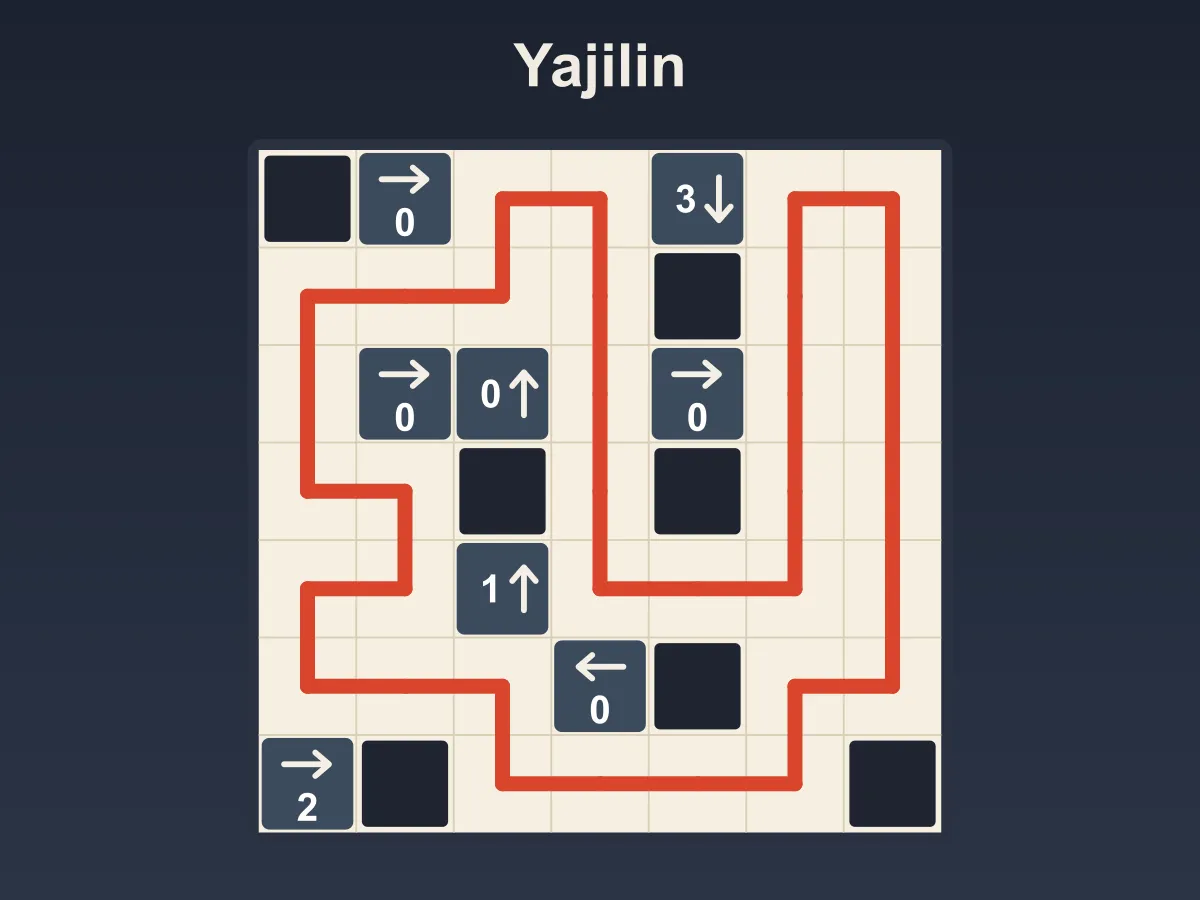




Yajilin, also called Arrow Ring, is a free online arrow-and-loop logic puzzle. Some squares hold a clue: a number and an arrow. The number says how many shaded squares lie in the arrow's direction, all the way to the edge of the grid. Your job is to shade squares so every clue counts right — never two shaded squares side by side — and then draw a single closed loop that passes through every square that is neither a clue nor shaded, visiting each exactly once, with no branches and no crossings. The two halves feed each other: a square the loop cannot reach has to be shaded, and a shaded square rules its neighbours onto the loop. Tap a square to shade it, tap again to put a dot on it as a note that it belongs to the loop, and drag from square to square to draw the line. A clue that can no longer come right, two shaded squares that touch, or a branch in the line turns red at once. Every board is built by the game itself rather than copied from a book, and every one has exactly one answer and is proved solvable without guessing before you see it — including a check that no second loop could run through the same squares. Eight levels grow from a 6×6 to a 10×10, and from level 6 each board needs at least one "what if" followed through to a contradiction. No download, no account.
How to play Yajilin
- A clue square shows a number and an arrow. The number is how many shaded squares lie in that direction, counted all the way to the edge of the grid.
- Shade squares so every clue counts right. Two shaded squares may never share an edge; touching at a corner is fine.
- Then draw one closed loop through every square that is neither a clue nor shaded. The loop goes from square to square across edges, visits each of those squares exactly once, and never branches or crosses itself.
- Clue squares are never shaded and the loop never enters them.
- Tap a square to shade it. Tap again to swap the shading for a dot — a note that the square is on the loop — and a third time to clear it. Right-click puts a dot on straight away.
- Drag from square to square to draw the loop. Dragging back over a line you drew rubs it out. Shading a square takes any lines off it.
- On a keyboard, arrow keys move the cursor, Space or Enter shades and dots, a full stop toggles a dot, and Shift with an arrow draws or rubs out a line from the cursor.
- Two shaded squares that touch, a clue with too many shaded squares (or with its whole row settled and the wrong count), and a square with three lines all turn red.
- The board is solved the moment every clue counts right and the loop runs through every other square.
- Undo steps back one change, Clear wipes the board, and New Puzzle deals a different board on the same level.
- The ? button settles one fact of the answer, correcting a mistake first. Three per board.
Tips
- Start with the clues that leave no choice. A clue of 0 puts every square in its arrow's direction on the loop, other clue squares apart, and a clue that needs as many squares as that direction has left shades them all.
- A square you know is on the loop — a neighbour of a shaded square, say — with only two ways out must use both, so its two lines are already known.
- A square with fewer than two ways out cannot be on the loop at all, so it must be shaded.
- Count the room. Four open squares in a row can hold at most two shaded ones, because shaded squares never touch. A 3 pointing at five open squares in a row can only go first, third and fifth.
- Every square next to a shaded square is on the loop. Put a dot on them as you go so you can see the loop's path forming.
- Never close a small loop. If joining two ends of the line would shut it while some square is still left outside, those two ends must not meet.
- On the later levels, try a square in your head: shade it, follow what that forces, and if a clue or a square breaks, it was not shaded.
FAQ
Is Yajilin free to play?
Yes. It runs in the browser with no download, no sign-up and nothing to buy. All eight levels are included and unlock as you solve them.
What are the rules of Yajilin?
Each clue square counts the shaded squares in its arrow's direction, all the way to the edge. Shade squares so every clue is right, with no two shaded squares sharing an edge. Then every square that is neither a clue nor shaded must be on one closed loop that visits each of them once, turning only at square centres and never branching or crossing.
Is Yajilin the same as Arrow Ring?
Yes. It is one Japanese logic puzzle under two names: Yajilin, and Arrow Ring in some English puzzle books. The rules here are the classic ones, with nothing added.
Does every puzzle have exactly one answer?
Yes, and it is checked rather than assumed. Each board is built from a real answer, and a program that only ever makes forced moves has to be able to finish it before it is shown; a board it can finish that way has only one answer. The game also checks that no second loop could run through exactly the same squares, and the tests confirm every level with an exhaustive search as well.
Will I ever have to guess?
No. On levels 1 and 2 every move is direct — a square with only two ways out, a clue already met, a clue that needs every square it has left. Levels 3 to 5 each need at least one spacing step: shaded squares never touch, so a row of open squares can only hold so many. From level 6 on, each board needs at least one "what if": shade a square in your head, follow it, and see a rule break.
How many levels are there?
Eight, from a 6×6 grid to a 10×10. The grids grow and the reasoning gets harder: in testing over twenty boards a level, the typical board needed about three "what if" steps on level 6 and about eight on level 8. New Puzzle deals a fresh board on any level you have reached.
Why do so many clues say 0?
Because a 0 is a strong clue: every square the arrow points across, up to the edge, is on the loop, other clue squares apart. The generator keeps turning clues into shaded squares for as long as the board stays solvable by logic, so the clues that remain are the ones the puzzle needs. A 10×10 board ends up with fifteen to twenty clues.
What do the dots mean?
They are notes for you. A dot marks a square you know is on the loop but have not drawn through yet. The game never checks them, so use them however helps.
Does it work on a phone?
Yes. Tap to shade, and slide a finger from square to square to draw the loop. On a phone held upright the game uses a taller frame, so even the 10×10 board keeps squares large enough to tap accurately.