





Tiddlywinks is the classic flicking game, free to play online against the computer with no download and no sign-up. Drag back from one of your winks like a squidger and let go: it hops across the felt mat in an arc, and if it drops into the pot you shoot again. Land on an enemy wink and you squop it, so it cannot be played. After twelve turns each, or the moment a side pots all six, tiddlies decide it. Five computer opponents, two-game matches, hints, and it plays on phones and desktops.
How to play Tiddlywinks
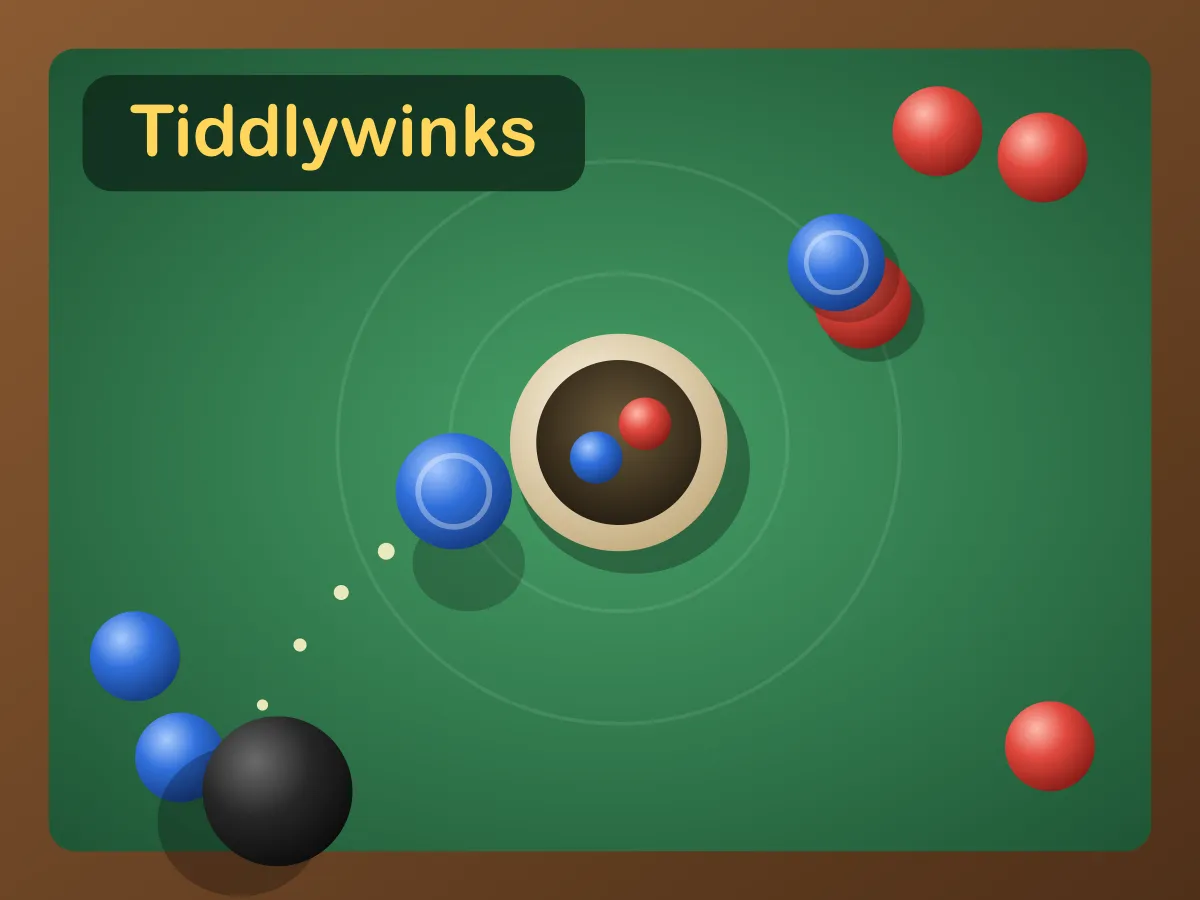
- You have six blue winks in the bottom-left corner of the mat and the computer has six red winks in the top-right. The pot stands in the middle, and you shoot first in the first game.
- Press on one of your winks and drag back, the way a squidger presses its edge, then let go: the wink hops off the opposite way, further the further you pulled. You can also tap the mat where you want the wink to land and press Flick, or aim with the arrow keys and press Space.
- A dotted arc shows the flight and a ring shows where most of your flicks would come down — no flick is perfect, and yours wobble about as much as the Expert’s do. The ring turns gold when the pot is inside it.
- Pot a wink and you shoot again; any other shot ends your turn. A wink that clips the rim rattles back out, and one that flies off the mat is put back just inside the edge.
- Land on another wink and you squop it: a squopped wink cannot be played by its owner until the wink on top moves away, and it scores nothing while it is covered.
- The game ends when a side pots all six winks (a pot-out) or after twelve turns each. Count tiddlies: 3 for each potted wink, 1 for each free wink on the mat, 0 for a squopped one. A match is two games — you shoot first in one, the computer in the other — and the higher total wins and unlocks the next opponent.
Tips
- The faint rings round the pot are 15, 25 and 35 units out. Measured over 1,000 flicks with your hand, a wink aimed at the pot from the inner ring went in every time, from the outer ring 887 times, and from 45 units — about where the front of your corner starts — 723 times. A miss costs the turn, so creep closer when the pot is not worth the risk.
- Do not stop hard against the pot. From 12 units a wink has to climb so steeply that only 804 of those 1,000 flicks dropped in; the rest banged into the side.
- A red wink waiting beside the pot is a pot the computer is about to take. Squop it and it is stuck — and your wink on top is still yours to play later.
- Mind where you leave your own winks: a blue wink parked near the pot is just as tempting for the computer to squop.
- In the last turns a squop is worth as much as a pot is to your opponent: it turns their free wink from 1 tiddly into nothing, and they get no time to dig it out.
- Stuck? Hint picks a shot — pot, squop or creep closer — with your hand’s wobble taken into account, and aims it for you.
FAQ
Is Tiddlywinks free to play online?
Yes. Tiddlywinks is free to play in your browser with no download, no account and no in-game purchases. It works on phones, tablets and desktops, and your progress through the five opponents is saved on your device.
How do you play tiddlywinks?
Each side flicks small discs called winks by pressing a larger disc, the squidger, on their edge so they jump. The aim is to get your winks into a pot in the middle of the mat. Potting a wink earns another shot, and landing on an opponent’s wink — a squop — stops them playing it. Here you flick by dragging back from a wink and letting go.
How is tiddlywinks scored?
With tiddlies, as in the English Tiddlywinks Association game: 3 for every wink in the pot, 1 for every wink still on the mat and not squopped, and nothing for a squopped wink. This version simplifies the tournament game for two players and one colour each: the game ends when a side pots all six winks or after twelve turns each, and the side with more tiddlies wins. A match adds up two games.
What does squop mean in tiddlywinks?
A wink is squopped when another wink lands on top of it, even partly. Its owner cannot play it until the covering wink moves away, and it scores no tiddlies while it is covered. The wink on top can still be played by its own side, which is why squopping a rival wink next to the pot is often worth more than going for the pot yourself.
Why is a match two games?
Because the side that shoots second also takes the last turn, with a free squop nobody can answer. In 400 games between two Player-level computer opponents, the side shooting second won 244 and the side shooting first 120, with 36 draws. Two games, one each way round, cancel that out, and the higher total of tiddlies takes the match.
How strong is the computer?
All five opponents choose their shots the same way; what changes is how steady their hand is, and each was measured over 200 two-game matches against the one below. The Novice won every match against a player flicking at random, but only about half against one that simply aims every wink at the pot. The Apprentice won 73% of matches against the Novice, the Player 76% against the Apprentice, the Expert 78% against the Player and the Master 75% against the Expert — and 93% against the Player.
Is my flick as steady as the computer’s?
Your flicks wobble exactly as much as the Expert’s: the Novice, Apprentice and Player have shakier hands than you, the Expert has the same, and the Master is steadier. Every flick, yours and the computer’s, wanders a little from its aim — the ring on the mat shows how far most of yours land from the aim.
How is this different from carrom or cornhole?
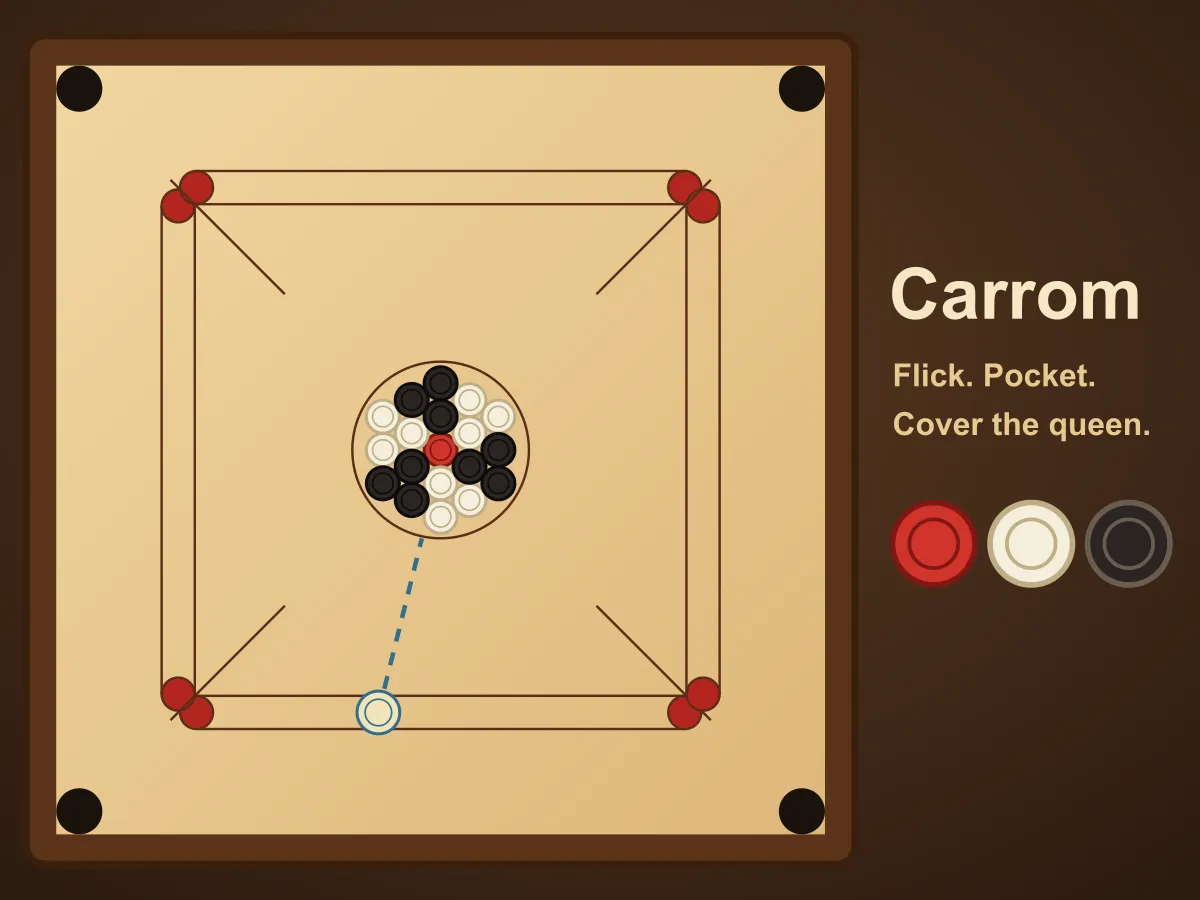
Carrom slides flat discs across a smooth board with a striker into corner pockets, and Cornhole Toss throws bean bags at a board with a hole. In tiddlywinks the winks jump through the air off a squidger, land in a single pot in the middle, and can land on top of each other — squopping, which neither of the others has.