
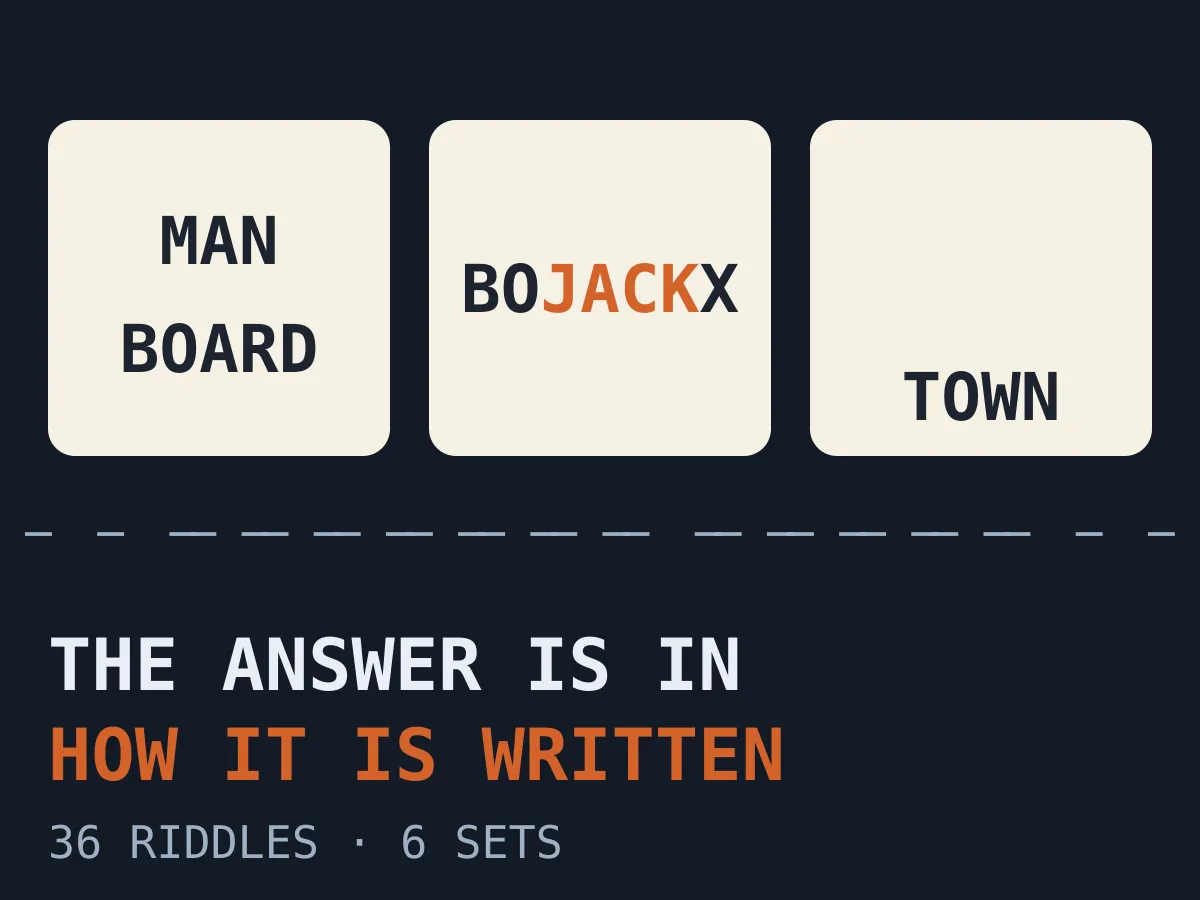





Rebus Riddles is a free online word puzzle game that runs in your browser with no download and no account. A rebus is a phrase drawn rather than written: MAN sitting above BOARD is “man overboard”, and the joke only works because one word is physically over the other. That is the whole game — read the arrangement, not the words. Thirty-six riddles across six sets use the traditional moves: a word above another, a word tucked inside another, letters stretched apart or squashed together, a word turned backwards, a word shrunk or blown up, the same word repeated so you have to count it, and a word sitting high or low on the card for no reason except that the height is the clue. Every riddle starts at five points and each letter you reveal costs one, down to a floor of one — so a hint is a price rather than a failure, and there is a separate clue that costs nothing at all if you would rather have a nudge than a letter. The puzzles are written for this game rather than lifted from a list, and every one has to earn its place: the set is checked to make sure no card simply spells out its own answer, no hint gives it away, and every riddle actually does something to its text rather than just sitting there. Type the phrase, in any capitalisation you like, with or without the apostrophes.
How to play Rebus Riddles
- Each card is a phrase drawn with layout instead of written out. What matters is where the words sit, not what they say.
- MAN written above BOARD is “man overboard”. That is the whole idea, and every other riddle is a version of it.
- Watch for a word inside another word, letters pushed apart or squashed together, a word written backwards, and a word much bigger or smaller than it should be.
- Count anything that is repeated. Three of a thing usually means the word “three”, and six of a thing usually means “six”.
- Where a word sits on the card can be the entire clue. The same word high up and low down are two different riddles.
- Type the answer in the box. Capitals, spaces, hyphens and apostrophes are all ignored, so you never lose a riddle on punctuation.
- A riddle is worth five points. Each letter you reveal costs one, down to a minimum of one — so taking help is a price, not a failure.
- The clue button is free. It nudges you towards the idea without giving you any of the letters.
- Give up if you are stuck and it will tell you the answer and move on.
- Solve every riddle in a set to unlock the next. Progress is kept in your own browser.
Tips
- Read the card out loud describing the layout: “stand, with an I under it”. The description is usually most of the answer.
- If a word is repeated, count before anything else. The number is nearly always part of the phrase.
- Check the size of the text. Something enormous or tiny is telling you a word like big, much, long or shrinking.
- When a word is inside another, the answer almost always contains “in” — and often “in the”.
- Take the free clue before spending a letter. It costs nothing and often turns the card into something obvious.
- A word that seems to be sitting oddly high or low on the card is doing that deliberately.
FAQ
Is Rebus Riddles free to play?
Yes. It runs in your browser with no download, no plugin, no sign-up and nothing to buy. The first set is open straight away and the rest unlock by solving.
What is a rebus?
A phrase drawn with arrangement rather than spelled out. The classic is MAN written above BOARD for “man overboard” — you read the layout, not the words. They are also called dingbats, and the moves are old folk puzzles rather than anyone’s property.
Do I have to type the punctuation?
No. Capitals, spaces, hyphens and apostrophes are all ignored when your answer is checked, so “mans best friend” counts exactly the same as “man’s best friend”. A rebus is not a spelling test.
What is the difference between a clue and a letter?
The clue is free and points you at the idea. A letter costs a point off what the riddle is worth and reveals the next one from the front. A riddle starts at five and never falls below one, so help always leaves you something.
Are these taken from somewhere?
No. The moves are traditional — a word over a word, a word inside a word — but these particular riddles are written for this game. The set is also checked automatically: no card may simply spell out its own answer, no hint may contain it, and every riddle has to do something to its text rather than just sit there.
How do the sets get harder?
The early sets use one move per card and phrases you will have heard. Later ones combine two ideas on one card, and the answer sits further from the picture — the arrangement tells you the shape of the phrase rather than the phrase itself.
Can I play on a phone?
Yes. The cards scale to the screen and the answer box is a normal text field, so the phone keyboard works as it does everywhere else.