
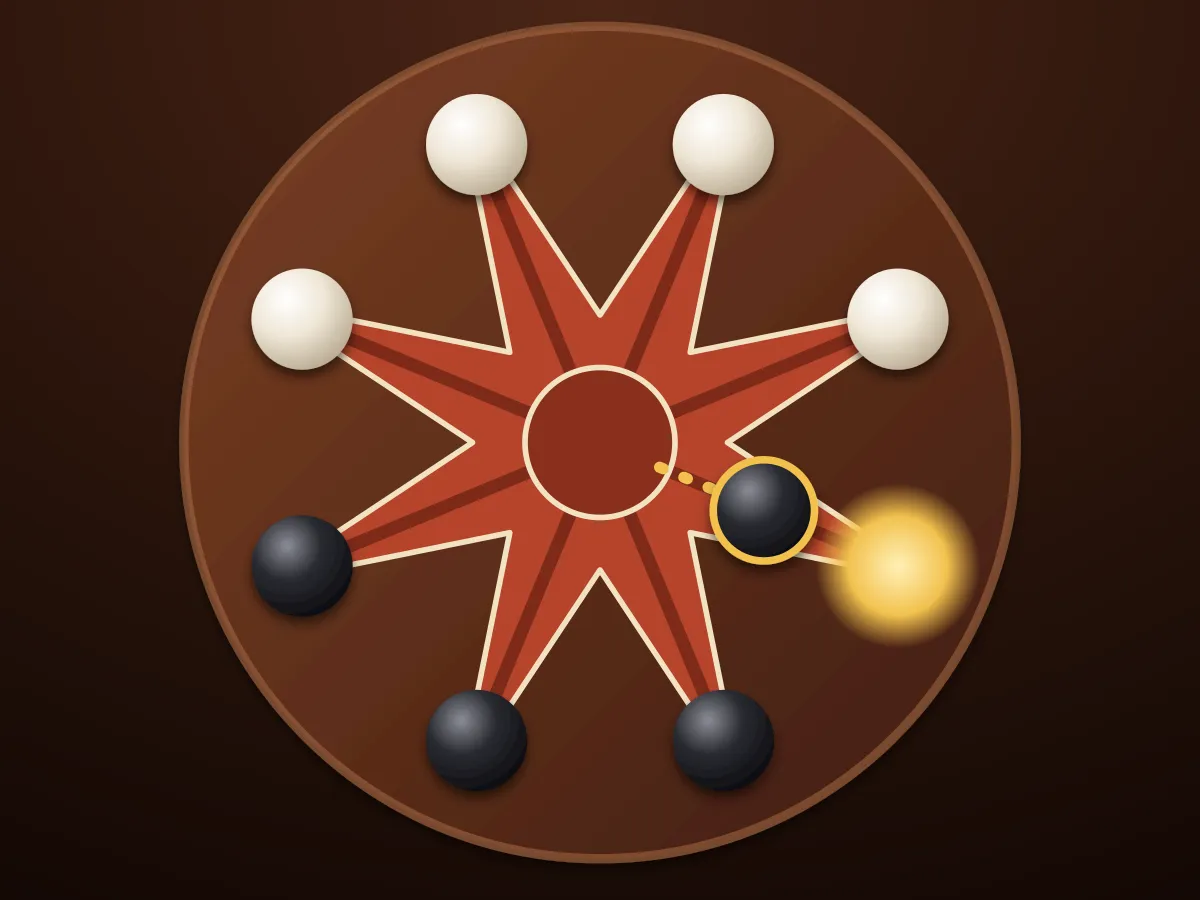


Mū Tōrere (mu torere) is the traditional two-player strategy game of the Māori of Aotearoa New Zealand, free to play online against the computer with no download and no sign-up. Four counters each sit on the points of an eight-armed star with the centre empty, and every turn you slide one counter into the single empty point. A counter may only enter the centre when an enemy stands beside it, and whoever cannot move loses. The rules take a minute; the traps take longer. Play four-game matches against five opponents, from a Novice to a Master that plays the solved game perfectly, with a coach that colours every move by where it leads.
How to play Mū Tōrere
- Each side has four counters on the eight points (kewai) of the star, Black on the lower four and White on the upper four. The centre (the pūtahi) starts empty, and Black moves first.
- Eight counters on nine points leave exactly one point empty. On your turn, slide one of your counters into it: round the star from a neighbouring kewai, out from the pūtahi to the empty kewai, or from a kewai into the pūtahi.
- A counter may move into the pūtahi only if an enemy counter stands on a kewai right next to it. That is why only the two end counters can move at the start.
- If it is your turn and none of your counters can reach the empty point, you are blocked and you lose. Block the computer to win.
- The same position coming round a third time with the same player to move is a draw, and so is 20 moves each with nobody blocked.
- A match is four games and you swap colours every game, so you move first twice. A win scores 1 and a draw ½; win the match to unlock the next opponent. Hint shows the solved game's best move, Coach colours your moves gold (wins), green (holds) or red (loses), and Undo takes a move back.
Tips
- While one of your counters sits in the pūtahi you cannot be blocked: it can always step out to the empty kewai. Every block happens to the side that does not hold the centre.
- You are only ever blocked with the empty point on a kewai whose two neighbours are enemy counters while the enemy also holds the pūtahi. Watch for that shape forming round the gap.
- Before stepping into the pūtahi, look at the kewai you are leaving: it becomes the gap, and your opponent chooses who fills it.
- No forced block anywhere on the board takes more than five moves, counting both players — so a careful look three of your own moves ahead sees every trap.
- Turn the Coach on to learn: it shows which of your moves keep the game level and which lose against perfect play. Then turn it off and try to hold the Master.
FAQ
Is Mū Tōrere free to play online?
Yes. Mū Tōrere is free to play in your browser with no download, no account and no in-game purchases.
How do you win at Mū Tōrere?
Leave your opponent with no legal move. There is always exactly one empty point, and a player is blocked when the gap is on a kewai between two of the opponent’s counters while the opponent also holds the pūtahi. The player who cannot move loses.
When can a counter move into the centre?
Only when an enemy counter stands on a kewai right next to it. A counter between two of its own side cannot enter the pūtahi. This game applies that rule all game long; some descriptions apply it only to each player’s first two moves. Under either version the starting position is a draw with best play.
Can Mū Tōrere end in a draw?
Yes, and with perfect play it always does. The game is small enough to solve completely: 1,180 positions can be reached from the start, and with best play 208 of them are won for the player to move, 128 lost and 844 drawn — the start among the draws. Here a game is drawn when the same position comes round a third time with the same player to move, or after 20 moves each with nobody blocked.
Can you beat the Master?
No. The Master plays from the solved game, so it never moves from a level position into a lost one — a test checks every reachable position. It is still dangerous: in a level position it picks the move that leaves you the most losing replies. The best result against it is a drawn match, four draws in a row, which the game counts as holding the Master.
How strong is the computer?
Each pairing was measured over 400 computer-against-computer games, 200 seeds played with the colours swapped, a draw counting a half. The Novice, which only sees a block it can make on the spot, scores 67% against random moves; the Apprentice scores 74% against the Novice, the Player scores 58% against the Apprentice and the Expert scores 55% against the Player. The Master scores 58% against the Expert, winning 66 games and drawing 334 without a loss.
Who moves first, and does it matter?
Black always moves first. In a match you play Black in games one and three and White in games two and four. Moving first is an edge between fallible players: in 400 games of the Apprentice playing itself, Black won 110 and White 46, with 244 draws. Between perfect players it makes no difference — the Master drew all 400 games against itself.
Does Mū Tōrere work on phones?
Yes. Tap a glowing counter to slide it, or drag it onto the empty point; on an upright phone the board sits above the controls. A keyboard works too: the arrow keys walk round the star to the centre and Enter moves, H asks for a hint, C turns the coach on or off, U takes back a move and N starts a new match.
Where does Mū Tōrere come from?
It is a traditional game of the Māori of Aotearoa New Zealand, played on an eight-pointed star with four counters a side. The mathematician Marcia Ascher published an analysis of it in Mathematics Magazine in 1987. This version is an independent recreation of the traditional rules.