
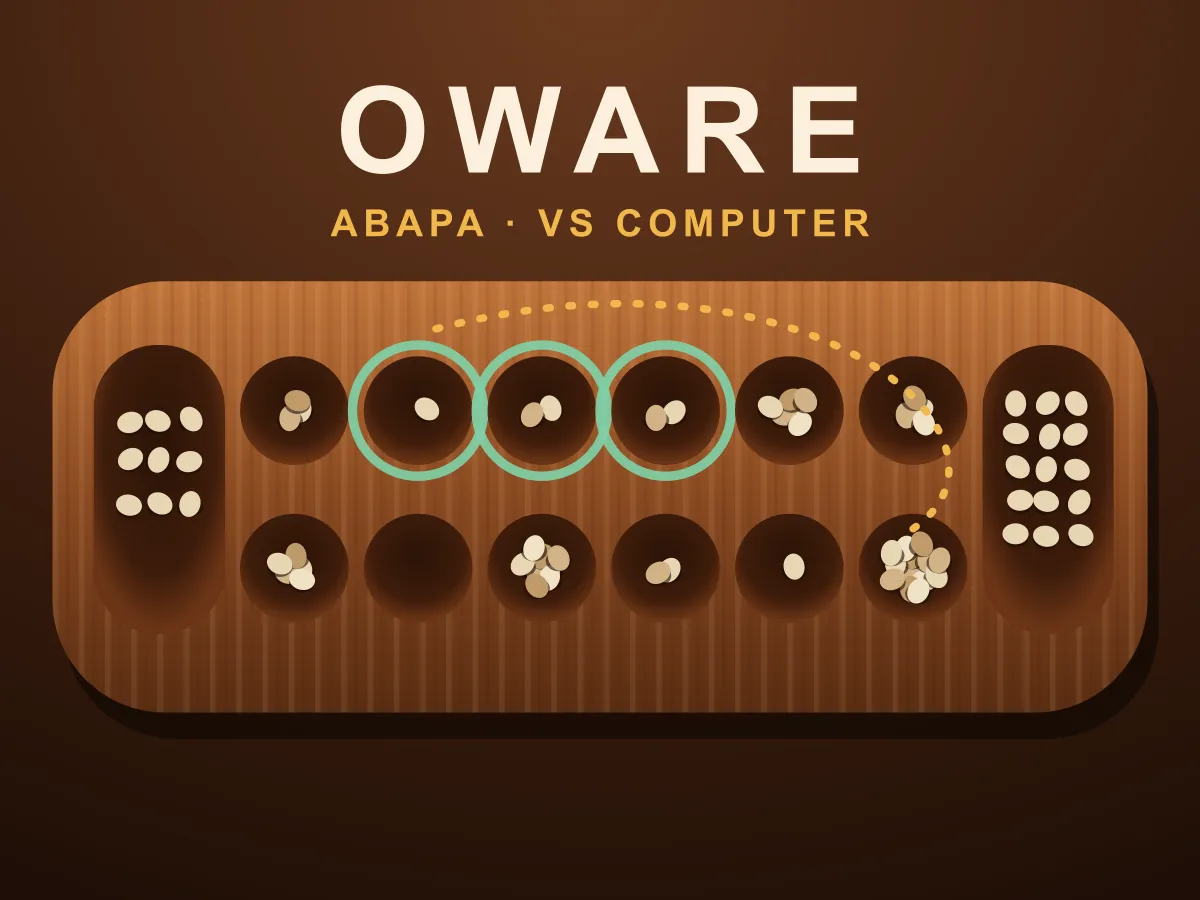


Oware is the national mancala game of Ghana, free to play online here against the computer with no download and no sign-up. This version follows Oware Abapa, the ruleset used in tournaments: 48 seeds in two rows of six houses, four to a house. Pick one of your houses and its seeds are sown one at a time, counter-clockwise, round the board. If the last seed lands in one of your opponent's houses and makes it exactly two or three, you capture those seeds — and the house before it too, if that one is also two or three, chaining backwards along their row. Two rules make Abapa a game of foresight rather than plunder: a move that would capture every seed your opponent has is allowed but takes nothing, and if your opponent has no seeds at all you must play a move that gives them some. First to 25 seeds wins; 24 each is a draw. Hover a house to see where its last seed will land and what it would capture, ask for a hint from the strongest player, take moves back, and climb a ladder of five computer opponents whose strength was measured over hundreds of games rather than guessed.
How to play Oware
- The board has two rows of six houses with four seeds in each. Your houses are the bottom row; the computer's are the top row. Seeds you capture go in your tray — at the right-hand end of the board, or below it on an upright phone.
- On your turn, tap one of your houses that has seeds in it. All of its seeds are picked up and sown one per house, counter-clockwise: along your row to the right, then back along the computer's row to the left.
- A house with twelve or more seeds sows right round the board. It skips the house it was emptied from, so that house always ends the move empty.
- If your last seed lands in one of the computer's houses and brings it to exactly two or three seeds, you capture them. Then look at the house before it: if that is also on the computer's side with two or three, capture it too, and keep going back until a house breaks the chain.
- A move that would capture every seed the computer has left is called a grand slam. You may play it, but it captures nothing and the seeds stay on the board.
- If the computer has no seeds at all, you must play a house that sows into its row. If none of your houses can reach, the game ends and you keep every seed on your side. The same rule applies to the computer when your row is bare.
- The first player to capture 25 of the 48 seeds wins; 24 each is a draw. If the same position comes round a third time, the game stops and each side keeps the seeds in its own houses.
Tips
- Hover over or tab to one of your houses before you play: the house where its last seed will land is ringed, and any houses it would capture glow green.
- Houses holding one or two seeds are the computer's targets — one more seed makes them two or three. Count how far each of its houses reaches before you leave a small house sitting in range.
- Build up one big house on your side. Twelve or more seeds lap the board and drop a seed into every opposing house on the way, which can turn a whole row of ones and twos into a chain capture.
- Captures chain backwards, so the best targets are runs of ones and twos on the opponent's side next to each other. A last seed at the right-hand end of such a run can take three or four houses at once.
- Do not starve your opponent by accident. If their row runs dry you are forced to feed them, and the forced move is often the one that hands them a capture.
- Late in the game, with few seeds left, keep seeds on your own side: if the game ends because nobody can feed or a position repeats, the seeds in your houses count for you.
- Start against the Novice to learn how captures look, then use Hint against stronger players — it asks the Master what it would play, and tells you when a position is already won or lost by force.
FAQ
Is Oware free to play online?
Yes. This Oware game is free in your browser with no download and no account. Your unlocked opponents and an unfinished game are kept in your own browser, so you can close the tab and carry on later.
Can I play Oware on my phone?
Yes. Tap a house to sow it, exactly as with a mouse. On an upright phone the board turns so the two capture trays sit above and below the houses, which keeps every house large enough to tap.
What rules does this Oware use?
Oware Abapa, the version used in tournaments and described in Wikipedia's Oware article: four seeds in each of twelve houses, counter-clockwise sowing that skips the starting house on a lap of twelve or more, captures of two or three that chain backwards along the opponent's row, a grand slam that captures nothing, the obligation to feed an opponent with no seeds, and 25 seeds to win. Abapa players agree to stop an endless cycle; here the game stops by itself the third time the same position comes round, and each side keeps the seeds in its own houses.
How is Oware different from Mancala (Kalah)?
Kalah, the version on this site's Mancala page, has a store at each end that you sow into, gives you an extra turn when your last seed lands in your store, and captures by landing in an empty house of your own. Oware has no stores on the board and no extra turns: you capture on the opponent's side by making a house two or three, captures chain backwards, and you are obliged to keep your opponent supplied with seeds. Oware games are longer and more about reading which houses are in reach.
How do you win at Oware?
Capture 25 of the 48 seeds. Most games are won by leaving the opponent no safe move — every one of their houses either empty or holding one or two seeds within reach of your sowing — and by saving up a large house that can lap the board for a chain capture late in the game.
What is a grand slam in Oware?
A move that would capture every seed your opponent has left. Oware rulesets disagree about it: some make it illegal, some give the remaining seeds to the other player. This game follows Abapa: the move is legal, but it captures nothing and every seed stays on the board.
How strong is the computer?
There are five opponents, and their strength was measured in 400 computer-against-computer games per pairing, with the seats swapped, rather than guessed. The Novice scores 42% against a player who simply takes the biggest capture on offer, so a beginner can beat it. Each later opponent scores at least 73% against the one before it, and the Master, which looks nine moves ahead, wins 92% of its games against the Elder. Beat an opponent to unlock the next.
Who moves first?
You and the computer take turns: if you opened the last game, the computer opens the next. Moving first is worth surprisingly little in Oware. With the Elder playing both sides of 200 games, the side that moved first won 95 and the side that moved second won 88, with 17 draws.