
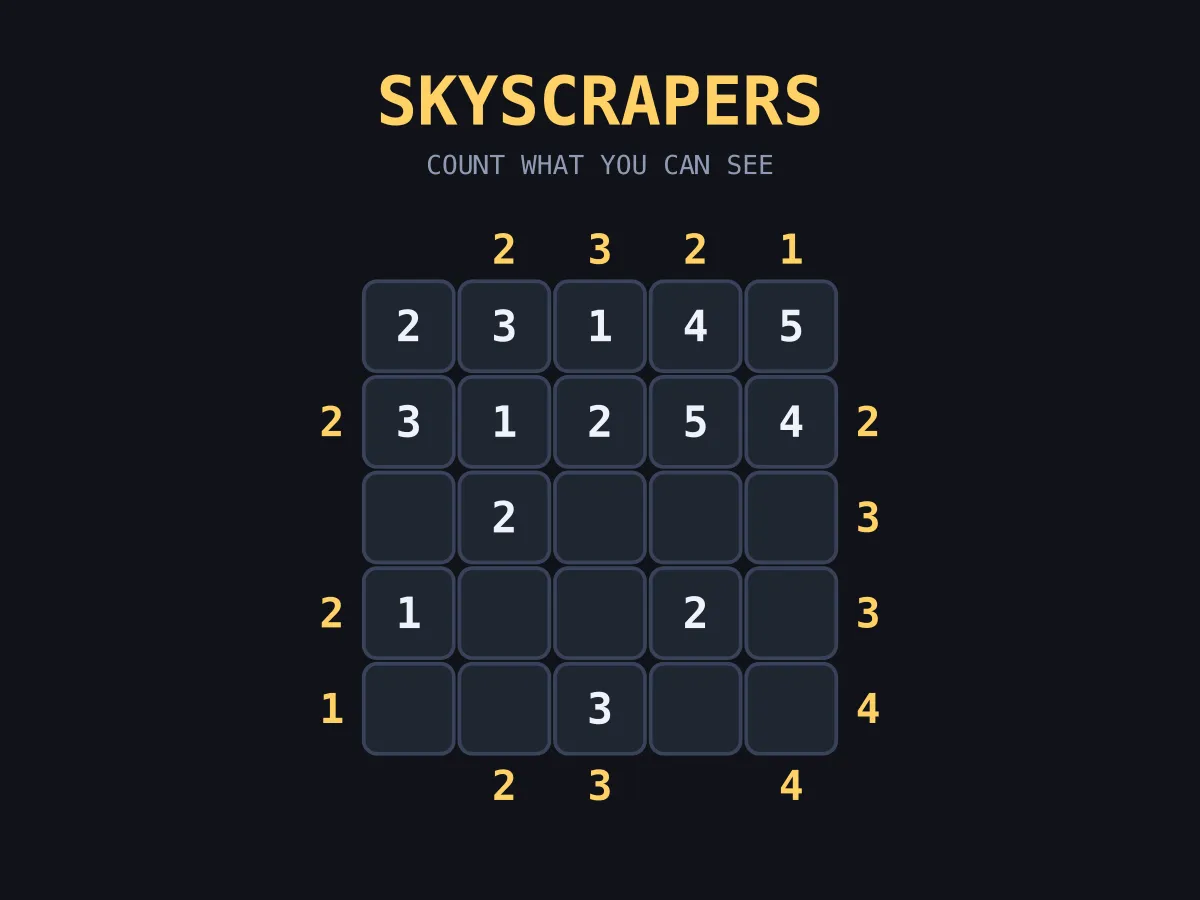





Skyscrapers is a free online logic puzzle played on an empty grid. Each row and each column holds every height from 1 up to the grid size exactly once, and the numbers around the border say how many buildings are visible looking down that line: a building is visible when nothing in front of it is as tall, so a taller one hides everything shorter behind it. A 1 means the nearest building is the tallest there is. A number equal to the grid size means the line climbs steadily from front to back. Everything between those two is where the puzzle lives. There is nothing to guess — every board is generated with exactly one answer, checked by an exhaustive solver before it reaches you, so a deduction you can justify is always available and a correct grid is never rejected. Eight levels run from a 4×4 with most of its clues to a 6×6 with barely half, and New Puzzle gives you another board of the same shape whenever you want one. No download, no account.
How to play Skyscrapers
- Tap a cell, then tap a height on the pad below to place it. Tap the backspace key on the pad to clear a cell.
- Every row and every column must hold each height exactly once, so a 5×5 grid uses the heights 1 to 5 in every line.
- A number on the border counts the buildings you can see looking along that line from where the number sits.
- A building is visible when every building in front of it is shorter. A taller one hides everything shorter behind it, however many there are.
- A clue of 1 means the tallest building in that line is the nearest one to the clue.
- A clue equal to the grid size means every building is visible, so that line rises steadily: 1, 2, 3 and so on away from the clue.
- The four clues that read through the cell you have selected are highlighted, so you can see which ones you are working against.
- A finished line whose count does not match its clue turns that clue red. An unfinished line is never marked wrong — it is just unfinished.
- A height that already appears twice in a row or column turns both cells red.
- Some border slots are blank. Those lines have no clue at all and have to be worked out from everything else.
- Undo steps back one placement at a time. New Puzzle gives you a different board of the same size.
- The ? button fills one cell from the answer, three times per board.
Tips
- Start with the 1s and the biggest clues. A clue of 1 pins the tallest building immediately, and a clue equal to the grid size pins the entire line.
- A clue of 2 on a 5×5 says the tallest building is somewhere in positions two to five, and nothing between the clue and it is taller than the first building. That is usually enough to place the 5.
- The tallest building can never be closer to a clue than one less than the clue itself, because everything in front of it is visible. That single rule eliminates more cells than any other.
- Work the pairs. Opposite clues read the same line from both ends, and a line with clues at both ends is far more constrained than one with a single clue.
- Blank border slots are information too: they tell you which lines you will have to finish from the rows and columns instead.
- Place the tallest height first in every line you can. It hides everything behind it, so it decides more of the counting than any other building.
- When a clue turns red, the line is complete and wrong — so at least one of those cells is wrong, and the other clue on the same line usually tells you which end.
- If a board feels arbitrary, it is not: every one is generated with exactly one answer and verified before you see it, so there is always a next step you can justify.
FAQ
Is Skyscrapers free to play?
Yes. It runs in the browser with no download, no sign-up and nothing to buy. All eight levels are included and unlock as you clear them.
How do the border numbers work?
Each one counts the buildings you can see looking along that line from where the number sits. A building is visible only when everything in front of it is shorter, so a tall building hides every shorter one behind it. A line reading 2, 4, 1, 3 shows two buildings from the left — the 2 and the 4 — because the 1 and the 3 are both hidden behind the 4.
Does every puzzle have exactly one answer?
Yes, and it is checked rather than assumed. Every board is run through an exhaustive solver during generation, and a clue is only removed if the puzzle still has a single answer afterwards. That is what makes a correct grid impossible to reject and a guess never necessary.
Why are some of the border slots empty?
Because the clue there was not needed. Generation starts with every clue filled in and takes them away one at a time, keeping a removal only when the puzzle still has one answer. A blank slot means the rest of the board already pins that line, and the harder levels have many more of them.
Is it the same as Sudoku?
It shares one rule — each height once per row and column — and adds a completely different one. There are no boxes and no given digits at all: the grid starts empty and everything you place comes from the visibility counts around the edge.
What do the red marks mean?
A red clue means that line is finished and the number of visible buildings does not match it. Red cells mean the same height appears twice in a row or column. Neither ever appears for an unfinished line, because an unfinished line is not wrong yet.
How many levels are there?
Eight: three on a 4×4, three on a 5×5 and two on a 6×6. Within each size the later levels give you fewer clues, which is the thing that actually makes them harder.
Can I get a different board on the same level?
Yes. New Puzzle generates another board of the same size and difficulty. Boards are seeded, so the same level always opens with the same one, and each New Puzzle reliably differs from the last.
Does it work on a phone?
Yes. Tap a cell, tap a height, and that is all the input there is. The board scales to the frame so the whole grid and its clue border stay on screen in portrait.