
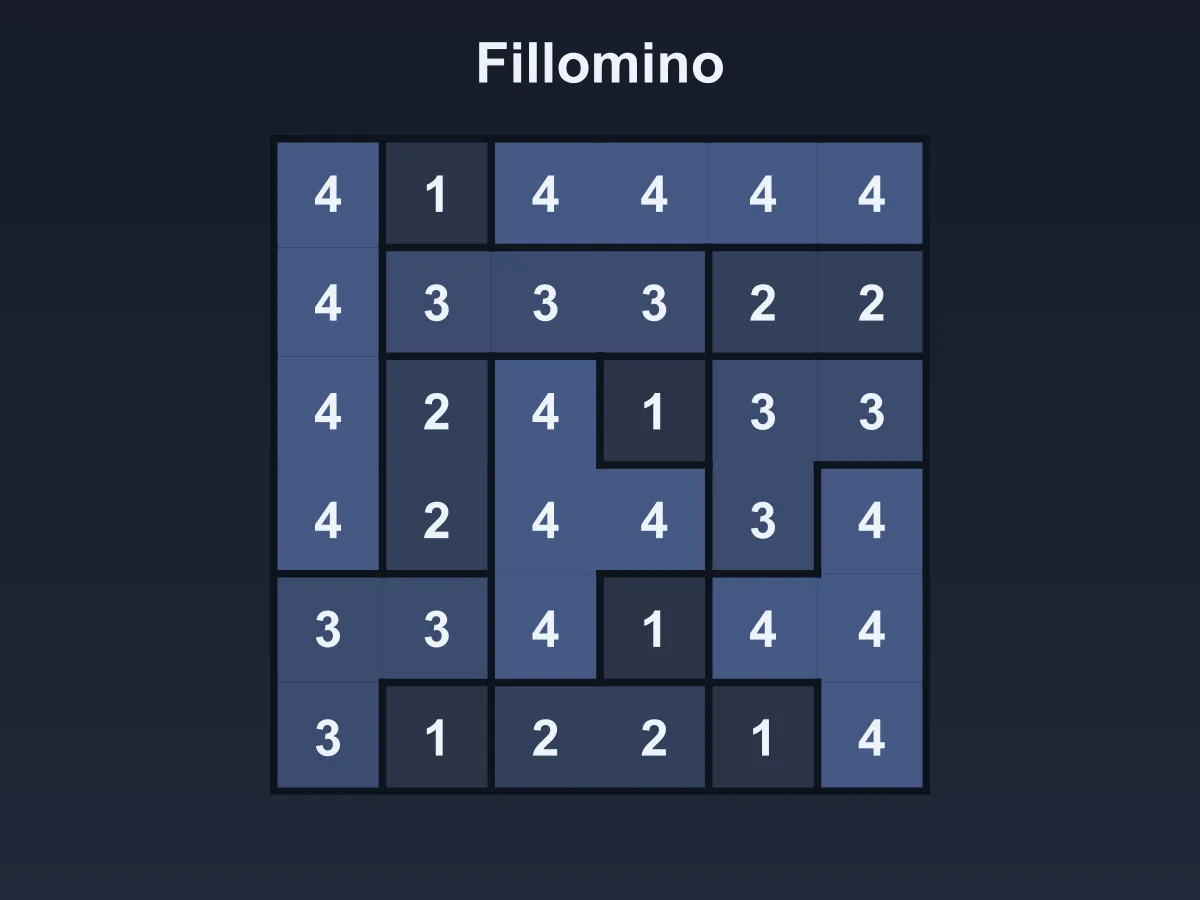




Fillomino is a free online logic puzzle about carving a grid into blocks. Every cell holds a number, and cells with the same number that touch edge to edge form a block — the rule is simply that the number has to be the size of the block it is in. A 3 must sit in a block of exactly three 3s; a 1 must sit alone. That one rule already carries the one people usually state separately, because two same-numbered blocks that touch would be a single, wrongly-numbered block. Some cells arrive filled in and the rest are yours, and the game draws the outline of every block as you build it, so you can see the shapes rather than re-reading a wall of digits. Every board is verified by an exhaustive solver to have exactly one answer before you see it, so a grid you can justify is never rejected. Eight levels grow from a 5×5 with blocks of up to four to an 8×8 with blocks of up to six. No download, no account.
How to play Fillomino
- Tap a blank cell to select it, then tap a number on the pad below to write it in. The backspace key on the pad clears a cell.
- Cells with the same number that touch edge to edge form one block. The number must equal how many cells are in that block.
- So a 1 sits alone, a 2 sits in a pair, a 3 in a block of three — any shape, as long as the cells are joined edge to edge.
- Two blocks with the same number can never touch. If they did they would be one bigger block, and then the number in it would be wrong.
- The given numbers are shaded darker and cannot be changed. Everything else is yours to fill.
- As soon as a block reaches its own number, its digits turn green — that block is finished and you can stop thinking about it.
- The outline of every block is drawn for you: the border between two cells disappears when they are in the same block.
- A block that has grown past its number, or one stuck below it with nowhere left to grow, turns red and the line under the board says how many cells are affected.
- A block that is simply still too small is never marked red. That is just an unfinished block.
- Arrow keys move the selected cell; number keys write, and Backspace clears.
- Undo steps back one entry. New Puzzle generates a different grid on the same level.
- The ? button fills one cell correctly — it fixes a wrong number first, and fills a blank otherwise. Three per grid.
Tips
- Start with the 1s. A 1 is a block on its own, so every cell touching it is definitely a different number — that is four cells decided from one clue.
- A given number with only one free cell beside it has no choice: its block has to grow that way. Those forced steps are where most boards open up.
- Two equal numbers that are diagonally next to each other usually have to be in the same block, because the alternative is two same-sized blocks touching somewhere.
- Count the space, not just the numbers. A 5 in a corner with only three free cells around it cannot be a 5, so one of those neighbours must belong to it from further away.
- Watch for cells that are boxed in. A blank surrounded by finished blocks can only be a 1 — nothing else fits.
- Work the completed blocks as hard as the clues. Once a block goes green it is a wall, and walls are what make the next block forced.
- When two blocks of the same number would end up touching, one of your numbers is wrong — usually the more recent one.
- If a grid feels arbitrary, it is not: every one is verified to have a single answer before you see it, so there is always a next cell you can justify.
FAQ
Is Fillomino free to play?
Yes. It runs in the browser with no download, no sign-up and nothing to buy. All eight levels are included and unlock as you clear them.
What is the rule of Fillomino?
Every number must be the size of the block it belongs to. A block is a group of cells with the same number joined edge to edge, so a 4 has to sit in a block of exactly four 4s and a 1 has to sit by itself. Shape does not matter — only how many cells are joined.
Can two blocks with the same number touch?
No, and you never have to check for it separately. If two same-numbered blocks touched they would be one larger block, and then the number in it would no longer match its size — so the single rule already rules it out.
Does every puzzle have exactly one answer?
Yes, and it is checked rather than assumed. Each grid is built by tiling the board with blocks, then removing given numbers one at a time and putting any removal back that would leave a second answer, using an exhaustive solver. That is what makes a correct grid impossible to reject and a guess never necessary.
What is the biggest number I can use?
It depends on the level: the early boards go up to 4 and the last one up to 6. The pad only ever offers the numbers that level uses, so you can never write one that is out of range.
Why has a block turned red?
Either it has more cells than its number allows, or it is smaller than its number with every surrounding cell already filled in, so it can never grow to size. A block that is simply still too small with room around it is not marked, because that is just unfinished work.
What do the green numbers mean?
That block has reached exactly its own number and is done. It is the most useful signal on the board: a finished block is a wall you can reason against, and it tells you which parts of the grid you no longer have to think about.
How many levels are there?
Eight, from a 5×5 with blocks of up to four to an 8×8 with blocks of up to six. Each level also hides more of the grid than the one before, which is what actually makes it harder.
Does it work on a phone?
Yes. Tap a cell, tap a number, and that is the whole input. The grid scales to the frame so the board and the number pad both stay on screen in portrait.