
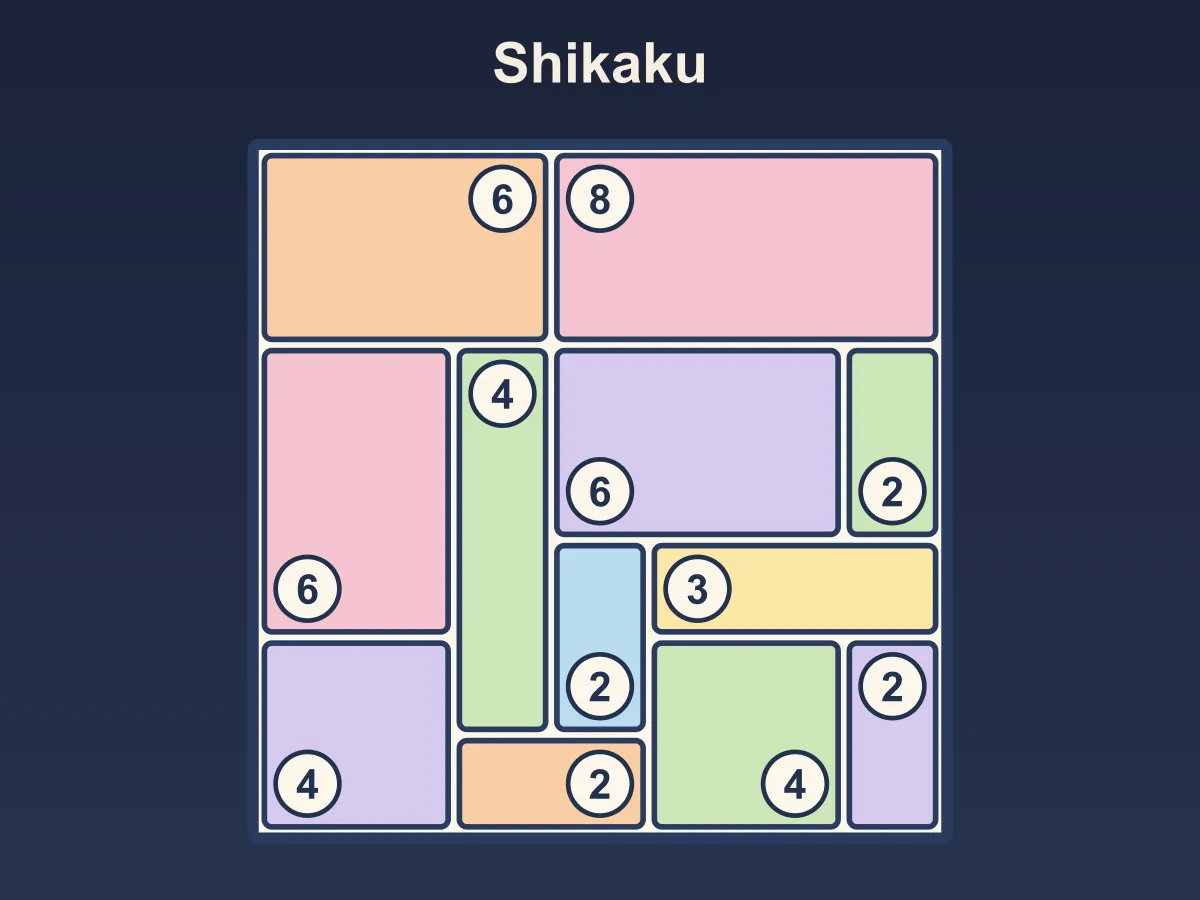



Shikaku is a free online logic puzzle, also printed as Rectangles or Divide by Box. The grid is scattered with numbers, and your job is to cut it into rectangles: every rectangle must hold exactly one number, the number is its area, and every square ends up in exactly one rectangle. A 6 can be a 2×3, a 3×2, a 1×6 or a 6×1, and working out which one — and where — is the whole puzzle. Drag from one corner to the opposite corner to draw a rectangle; while you drag, its size is shown and it turns green when it would be legal. Draw over an old rectangle to replace it, tap one to lift it off, and a rectangle that holds two numbers or the wrong area is marked in red straight away. Every grid is generated fresh, has exactly one answer, and is proved solvable without guessing before you see it. Eight levels grow from a 5×5 to a 12×12, and from level 5 on each grid needs at least one "what if" followed through to a contradiction. No download, no account.
How to play Shikaku
- Every square on the grid has to end up inside exactly one rectangle.
- Each rectangle holds exactly one number — never none, never two.
- The number is the rectangle's area: a 6 covers six squares, as 1×6, 2×3, 3×2 or 6×1.
- Press on a square and drag to the opposite corner to draw a rectangle. The size is shown as you drag, green when it would be legal and red once it is already too big.
- Drawing over rectangles you already placed replaces them, so fixing a corner is one drag.
- Tap a rectangle to lift it off the grid.
- A rectangle with no number, two numbers or the wrong area is marked in red.
- On a keyboard, arrow keys move the cursor, Enter or Space sets the first corner, and a second Enter draws the rectangle. Esc drops the corner, Backspace lifts the rectangle under the cursor.
- The grid is solved when every square is covered and every rectangle keeps the rules.
- Undo steps back one change, Clear wipes the grid, and New Puzzle cuts a different grid on the same level.
- The ? button draws one rectangle of the answer, fixing a wrong one first. Three per grid.
Tips
- Start with the numbers that have only one rectangle left — often one hemmed in by the edge and by other numbers.
- Look for squares only one number can reach. If a square sits where no other number's rectangle could stretch, it belongs to that one number.
- Prime numbers are lines. A 5 or a 7 can only be one square wide, so it runs straight across or straight down.
- When every rectangle a number could still make covers the same squares, those squares belong to that number whatever shape it takes, and no other number can use them.
- Big numbers are easier than they look: a 12 has few places a 3×4, 4×3, 2×6 or 6×2 fits without swallowing another number.
- Work the edges and corners first. A square in a corner can only be reached from two directions.
- On the later levels, try a rectangle in your head. If drawing it leaves another number with nowhere to go, or a square nobody can reach, that rectangle is wrong.
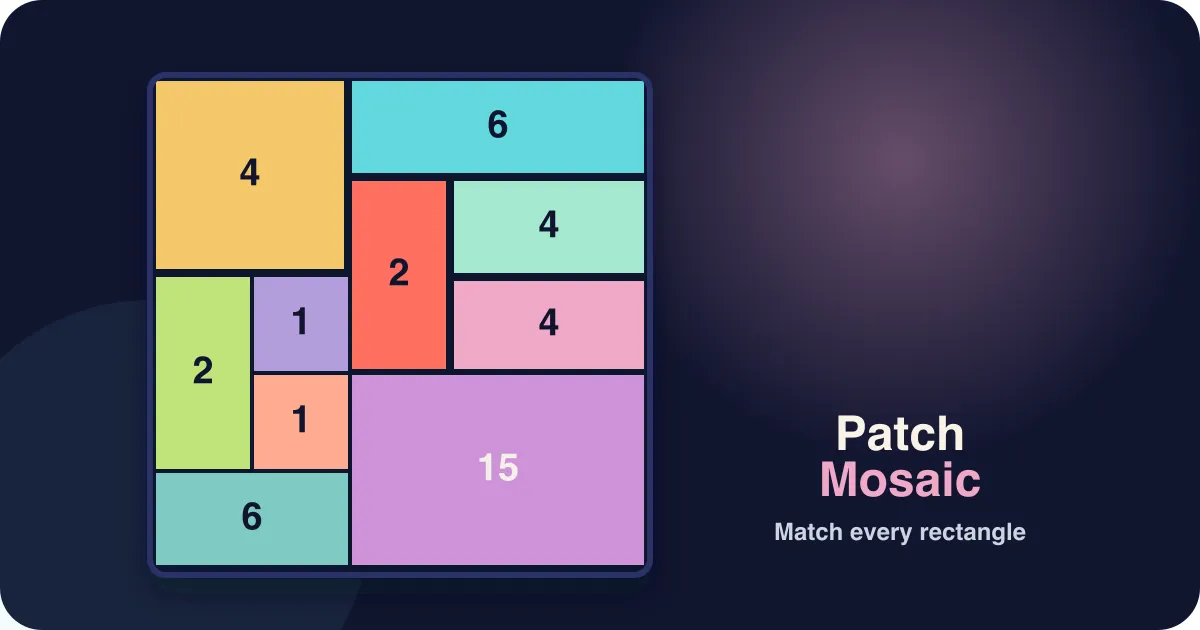
- Patch Mosaic, on this site, is a variant that adds a shape rule to every number. If you finish every level here, it is the natural next step.
FAQ
Is Shikaku free to play?
Yes. It runs in the browser with no download, no sign-up and nothing to buy. All eight levels are included and unlock as you solve them.
What are the rules of Shikaku?
Divide the grid into rectangles so that every square is in exactly one rectangle, every rectangle contains exactly one number, and that number equals the rectangle's area — the number of squares it covers. Squares count too, so a 4 can be a 2×2.
Does every puzzle have exactly one answer?
Yes, and it is checked rather than assumed. Each grid is built from a real cut into rectangles, then solved by a program that only ever makes forced moves; a grid it can finish that way has only one answer. The tests confirm that with an exhaustive search on every level as well.
Will I ever have to guess?
No. A grid only ships if it can be finished by deduction alone. On levels 1 and 2 every move is direct — a number with one rectangle left, or a square only one number can reach. Levels 3 and 4 need you to notice squares that every option of a number covers. From level 5 on, each grid needs at least one "what if": try a rectangle, follow it through, and see it break.
How many levels are there?
Eight, from a 5×5 grid to a 12×12. The grid grows, and the kind of reasoning each level needs gets harder too: in testing, the number of "what if" steps a grid needs rose from about one on level 5 to about four on level 8. New Puzzle cuts a fresh grid on any level you have reached.
Why is there never a 1 on the grid?
A 1 is a one-square rectangle that solves itself on sight, so the generator does not use them. The smallest number is 2, no more than a third of the rectangles are 2s, and no single rectangle covers more than a sixth of the grid.
Is this the same as Patch Mosaic?
No. This is classic Shikaku with nothing added: the number fixes the area and nothing else, so you have to work out the shape. Patch Mosaic, also on this site, is a variant where every number also carries a shape marker — square, tall or wide — which changes how the grids are solved.
How is Shikaku different from Choco Banana?
Both are about rectangles and numbers that give an area's size. In Shikaku the whole grid is cut into rectangles and each holds exactly one number. In Choco Banana, also on this site, you shade squares instead: only the shaded areas must be rectangles, the unshaded areas must be any shape except a rectangle, and an area may hold several equal numbers or none.
Does it work on a phone?
Yes. Drag with a finger from corner to corner and tap a rectangle to lift it. On a phone held upright the game uses a taller frame, so even the 12×12 grid keeps squares large enough to drag across accurately.