
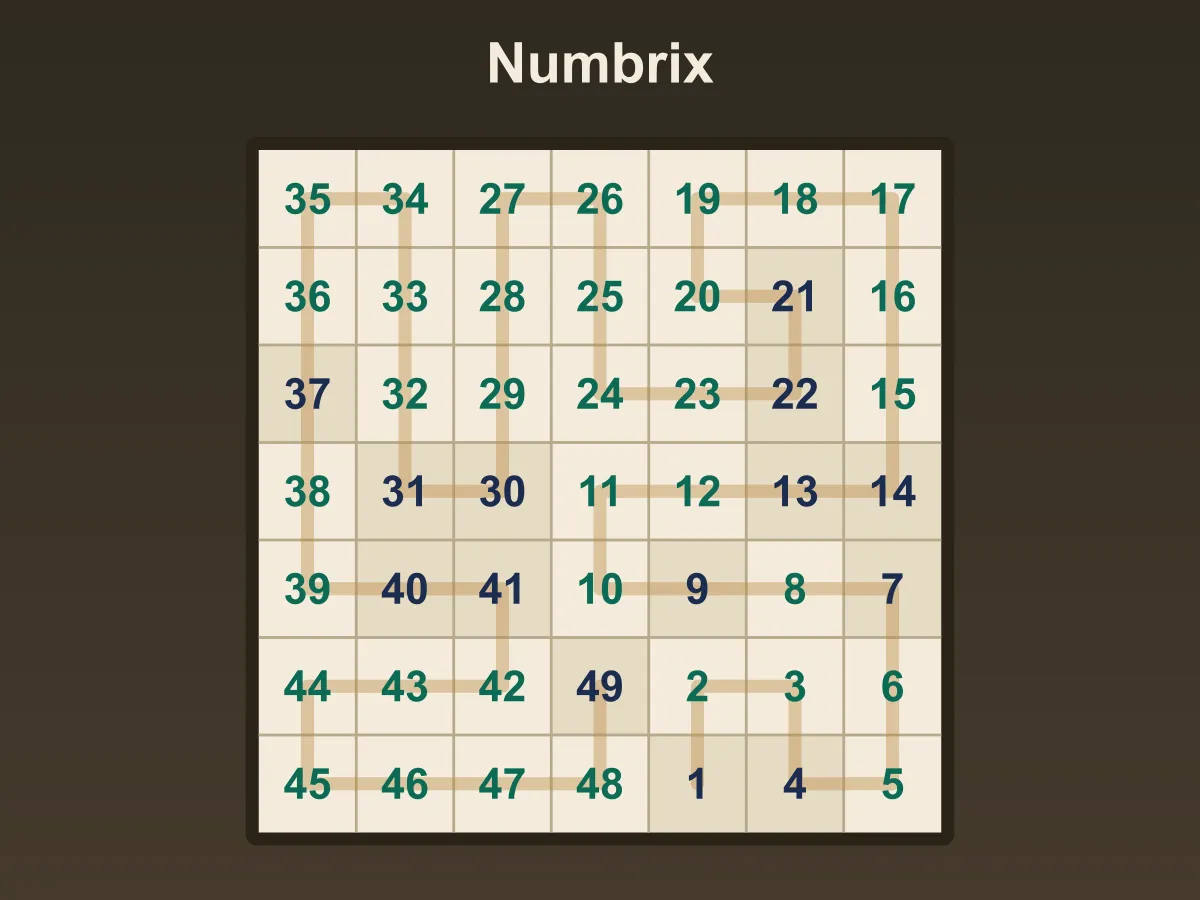
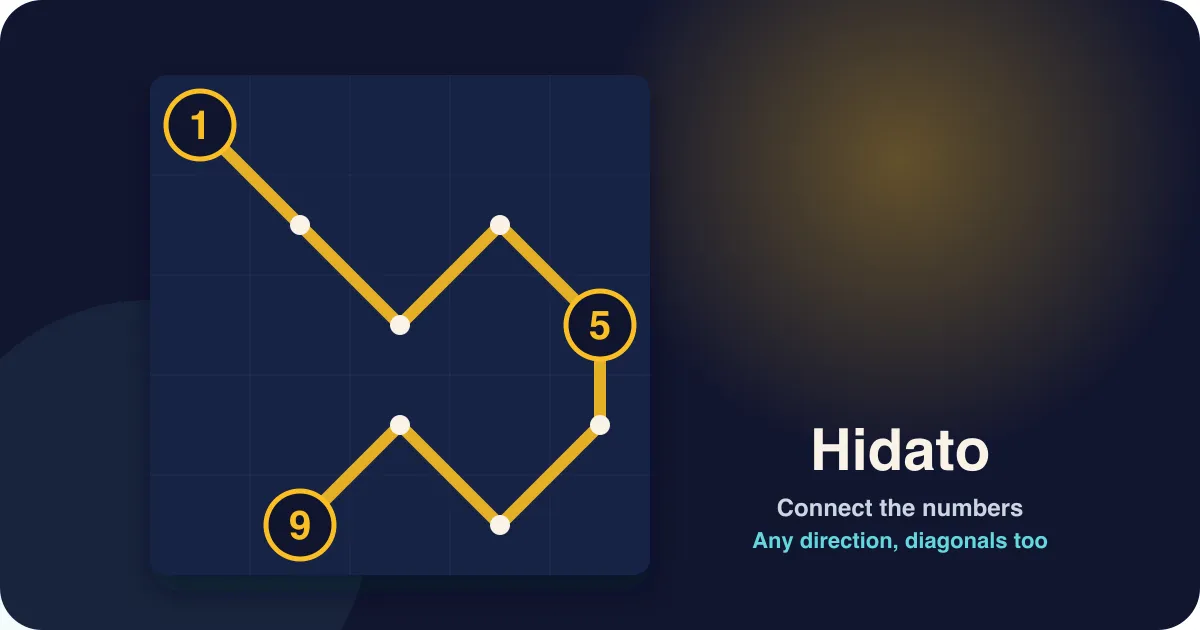

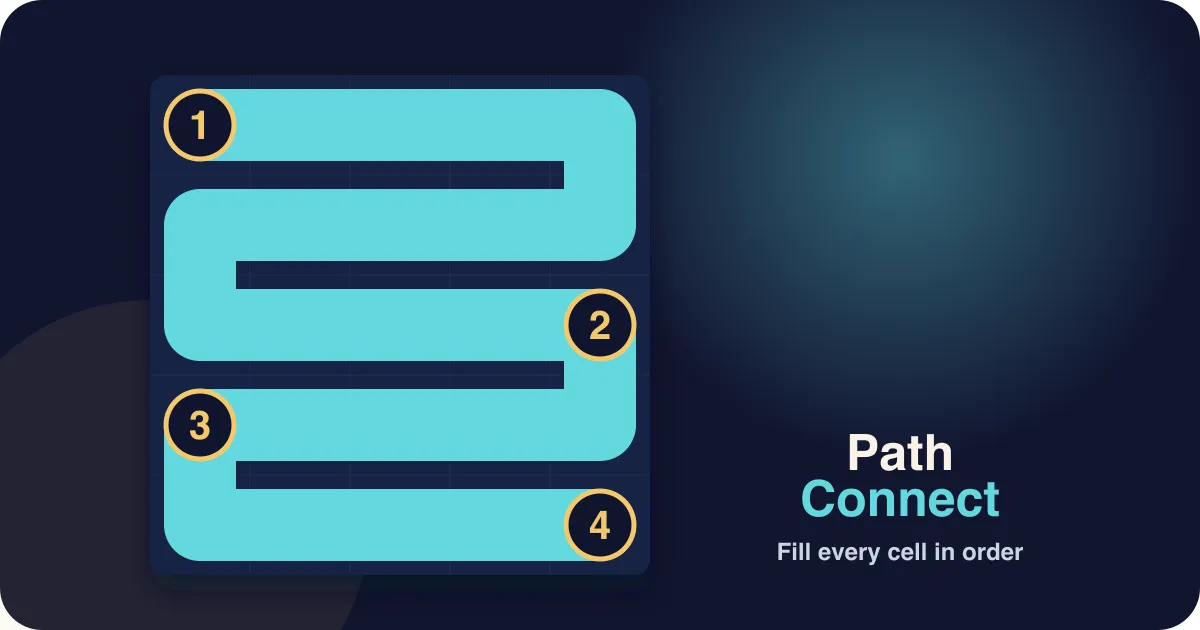


Numbrix is a free online number path puzzle you can play straight away in your browser, with no download and no account. A square grid comes with some of its numbers already printed; you fill in the rest so that 1, 2, 3 and every number up to the last square form one continuous chain, and each number sits in a square that shares an edge with the one before it. Diagonals never count — that is the whole difference between Numbrix and Hidato. Press a printed number and drag along the squares to run the chain out, or tap a square and type its number on the keypad. The two squares a number still has to reach are ringed as you go, a number that can no longer link up turns red at once, Undo takes a whole traced run back, and three hints per level reveal the next square along with the one-line reason you could have found it yourself. Eight levels climb from a gentle 5x5 warm-up to the 9x9 grid of 81 squares, and every board is stripped down by a solver that never guesses, so each one has exactly one answer and can be finished by reasoning alone.
How to play Numbrix
- Some numbers come already printed on the grid — always 1 and the highest number, plus a scatter in between. Your job is to write in all the rest.
- Consecutive numbers must sit in squares that share an edge — up, down, left or right. Diagonal neighbours do not count, which is what separates Numbrix from Hidato.
- Press a number already on the grid and drag across the empty squares beside it: each square you cross takes the next number in the run. Drag back over a square to rub it out again. Pulling out of the highest number runs the chain downwards instead.
- Or tap any empty square and type its number — one key at a time for two-digit numbers, Backspace to rub out, arrow keys to move around the grid.
- The squares the selected number still has to reach are ringed, and any number that can no longer link up turns red straight away, so a wrong turn shows itself before it spreads.
- Fill every square so the chain runs unbroken from 1 to the last number and the level is complete; finish it to unlock the next grid.
Tips
- Work the short gaps first. When two printed numbers are only two apart, the number between them has to sit in a square that touches both — and there is usually only one such square on the whole grid.
- Use the checkerboard. Every step changes colour, so if 1 sits on a light square then every odd number is on a light square and every even number is on a dark one. Half the grid is ruled out for a number before you look at anything else.
- Count the distance before you commit. To get from 32 to a printed 37 you have exactly five steps, so 33 can only go in a square that is within four steps of where 37 is printed. Corners and edges have fewer neighbours, so numbers forced into them are the easiest to pin down.
- Watch the sides and corners of the grid. A square with only two neighbours left has to be passed straight through, which fixes both of its links at once.
- If you get stuck, spend a hint rather than guessing: it fills the one square you could have proved next and tells you which rule proved it, so the next grid gets easier rather than just shorter.
FAQ
Is Numbrix free to play?
Yes. Every level is free, with no download, no account and no in-game purchases. Open the page and the first grid is ready.
Does Numbrix work on mobile?
Yes. The grid and the keypad are both built for touch — drag a finger along the squares to trace a run, or tap a square and type its number. Mouse and keyboard work the same way on desktop.
What is Numbrix?
Numbrix is a number path puzzle created by Marilyn vos Savant and printed in Parade magazine since 2008, usually on a 9x9 grid holding 1 to 81. A few numbers are printed and you write in the rest so the whole sequence forms a single chain of squares that share edges. This page is an independent version of that puzzle type, not affiliated with Parade or its publisher.
Is Numbrix the same as Hidato?
Almost, with one rule changed. Both ask you to fill a grid with one chain of consecutive numbers, but Hidato counts a diagonal step as a link and Numbrix does not — in Numbrix consecutive numbers have to share an edge. That single difference makes Numbrix tighter, because every square has at most four neighbours instead of eight.
Does every Numbrix puzzle have only one answer?
Yes. Each grid is built by taking numbers away from a finished chain one at a time, and a number only comes off while a solver that never guesses can still finish the grid without it. A solver that only ever writes a number it can prove has also proved there is nothing else the grid could be, and the shipped boards are checked a second time by an independent search that counts the answers.
Will I ever have to guess?
No. Every board can be finished by reasoning from the numbers in front of you. On the last level the reasoning sometimes takes the form of trying a number and watching the chain run into a dead end, which rules it out — still a proof rather than a coin flip.
How big are the grids and how many levels are there?
Eight levels: a 5x5 warm-up, two 6x6 grids, two 7x7 grids (the other size Parade has printed), an 8x8, and two 9x9 grids of 81 squares. Each rung prints a smaller share of the grid than the one before, from 44 percent of the squares down to under 19 percent.