
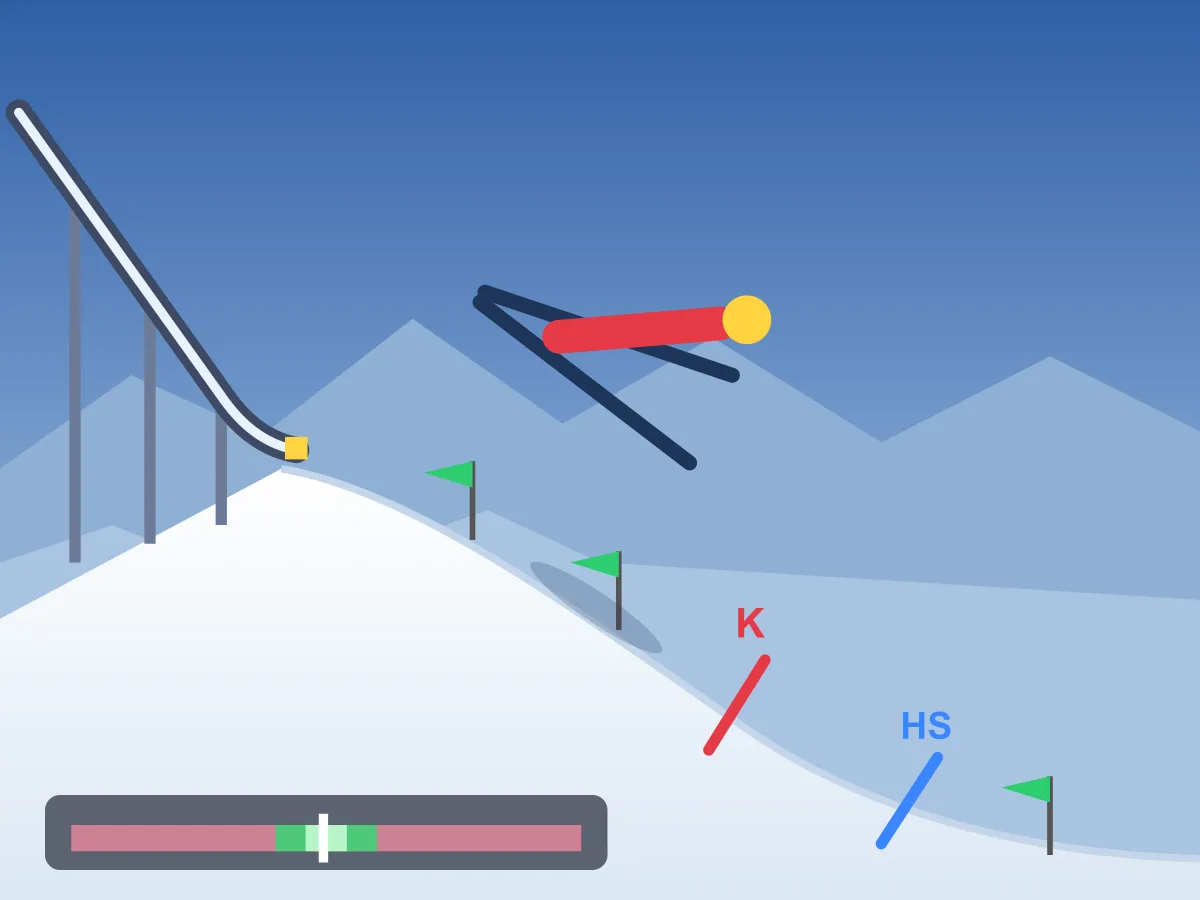








Ski Jump is a free online ski jumping game played on one button and two arrows. Hold Jump to push off and stay in the tuck, and keep the lean gauge in its green band as the ruts tip you. Let go of Jump as your skis reach the edge of the table: that is the spring, and early or late costs distance. In the air the body comes up sitting back and the wind keeps pushing it there, so lean forward into the band and hold it through the gusts. Press Jump again just before touchdown for a telemark. Distance points, five judges and a wind compensation make the score, and two rounds against the field decide the stars on eight hills from a village hill to a 240 m flying hill. No download, no sign-up.
How to play Ski Jump
- Press To the gate, then press and hold Jump (Space, or the Jump pad) to push off. The gate closes after eight seconds: wait that long and you are sent down standing up, which is the slowest way to the table.
- Keep holding Jump on the inrun: that is the tuck. Ruts in the track tip your body, so keep the marker on the lean gauge in its green band with ↑ (lean back) and ↓ (lean forward). Out of the band the air catches you and you reach the table slower.
- Let go of Jump as your skis reach the edge of the table, where the gauge says EDGE. That is the spring off the table. Let go early and you stand up on the table and lose speed as well as spring; late and you are already falling off the edge, and after a quarter of a second there is no spring at all.
- In the air your body comes off the table sitting back, and a steady drift keeps tipping it further back, more so in a headwind. Lean forward with ↓ into the green band and hold it there with small taps; gusts will knock you out of it. Too far back and you brake like a sail; too far forward and the lift goes and you drop.
- Press Jump again just before your skis touch the snow for a telemark landing — watch your shadow and the height readout above the gauge bar. Too late, or not at all, is a two-footed landing; past the hill size without a telemark you put a hand down; and touch down with the lean far out of the green and you fall, telemark or not.
- A jump scores distance points against the K-point (the red line), five judges’ style marks out of 20 with the best and worst dropped, and a wind compensation: points off for a helping headwind, points on for a tailwind. You jump last in each of two rounds, and the green line shows roughly how far you need to go to take the lead. Finish in the top half for one star, on the podium for two, and win for three; a star unlocks the next hill.
Tips
- Tap ↓ the moment you leave the table. The body comes up well out of the band, and every tenth of a second spent sitting back in the air is distance lost.
- Hold the lean with small taps, not long presses. One press of ↓ moves the gauge fast, and overshooting forward costs lift just as sitting back costs drag.
- Let go of Jump on the edge rather than guessing early. A release a few hundredths late still springs; one a tenth early has already stood you up on the table.
- Watch the flags along the landing hill: green streaming towards you is a headwind that carries you further, red is a tailwind. The wind compensation evens most of that out in the points.
- Press for the telemark when your shadow nearly meets your skis. A landing opened a long way up sits you up in the air, and the judges mark it down the earlier it is.
- A good first round is not the end of it: the final round counts just as much, and the green line to beat takes your first round into account.
- Losing a hill? Jump again for the same field to learn it, or draw a new field of rivals from the result card.
FAQ
Is this ski jump game free to play?
Yes. Ski Jump runs free in your browser with no download, no install and no account, on a computer, tablet or phone.
How do I jump further?
Three things carry the distance: speed at the table, which comes from holding the tuck with the lean in the green; the spring, which comes from letting go of Jump exactly at the edge; and the flight, which comes from keeping the lean in the green band all the way down. The flight matters most: a test jumper with a perfect take-off and a perfect telemark who never touched the lean earned no star on any hill after the first.
When exactly should I let go at the take-off?
As the skis reach the edge of the table, when the gauge says EDGE. The spring is full on the edge and falls away either side, faster when you are late: a few hundredths of a second off costs a little, a tenth costs a lot. Let go more than 0.45 seconds before the edge and you only stand up, and you can press Jump again to get back into the tuck.
What is a telemark and how do I land one?
The telemark is the classic ski jumping landing, one ski ahead of the other with the knees bent, and the judges reward it. Press Jump again just before touchdown — about a quarter of a second before is ideal. Too late, or not at all, is a two-footed landing that costs style marks; opening the landing far too early sits you up in the air, shortens the jump and is marked down too.
How is a jump scored?
Like real ski jumping, simplified. Distance points: a jump on the K-point is worth 60 points on a normal or large hill and 120 on a flying hill, and every metre past or short of it is worth 2.4, 2, 1.8 or 1.2 points depending on the size of the hill. Style: five judges give marks out of 20, the best and worst are dropped and the middle three count. Wind: a headwind helps you fly, so points come off for it, and a tailwind earns points back.
Who are the rivals, and how good are they?
Every rival is a jumper on the same hill in the same kind of wind, flying the same physics as you with its own reaction time and timing. Stronger hills bring stronger fields. Test jumpers measured the stars: one reacting in about 0.15 seconds with a timing spread of 20 milliseconds won at least nine competitions in ten on every hill; one at 0.25 seconds and 40 milliseconds won the first two hills at least seven times in ten but won fewer than one in five on the flying hills; one at 0.4 seconds finished in the top half on the first two hills at least six times in ten, and on the third about half the time.
How many hills are there?
Eight: a village hill, two normal hills, two large hills and three flying hills, the last with a 240 m hill size and twenty rivals. Each hill is at least as big as the one before and brings a larger, stronger field; the wind and its gusts change from hill to hill and are strongest on the World Final. A star on one hill unlocks the next.
What happens if I do nothing at all?
The gate closes after eight seconds and you are sent down standing up, with no spring off the table and no telemark. It scores lower than any jumper who steers the lean, and it never earns a star.
Can I play on my phone?
Yes. Three pads sit under the hill — Back, Jump and Forward. Hold Jump with one thumb and tap Back and Forward with the other; held sideways, the lean pads move to the left and Jump to the right.
Is it the same competition every time?
Jump again from the result card and it is the same field of rivals, with the same wind and the same gusts for every jump, so you can learn it. New field draws different rivals and new conditions. Your own jumps are always your own.