
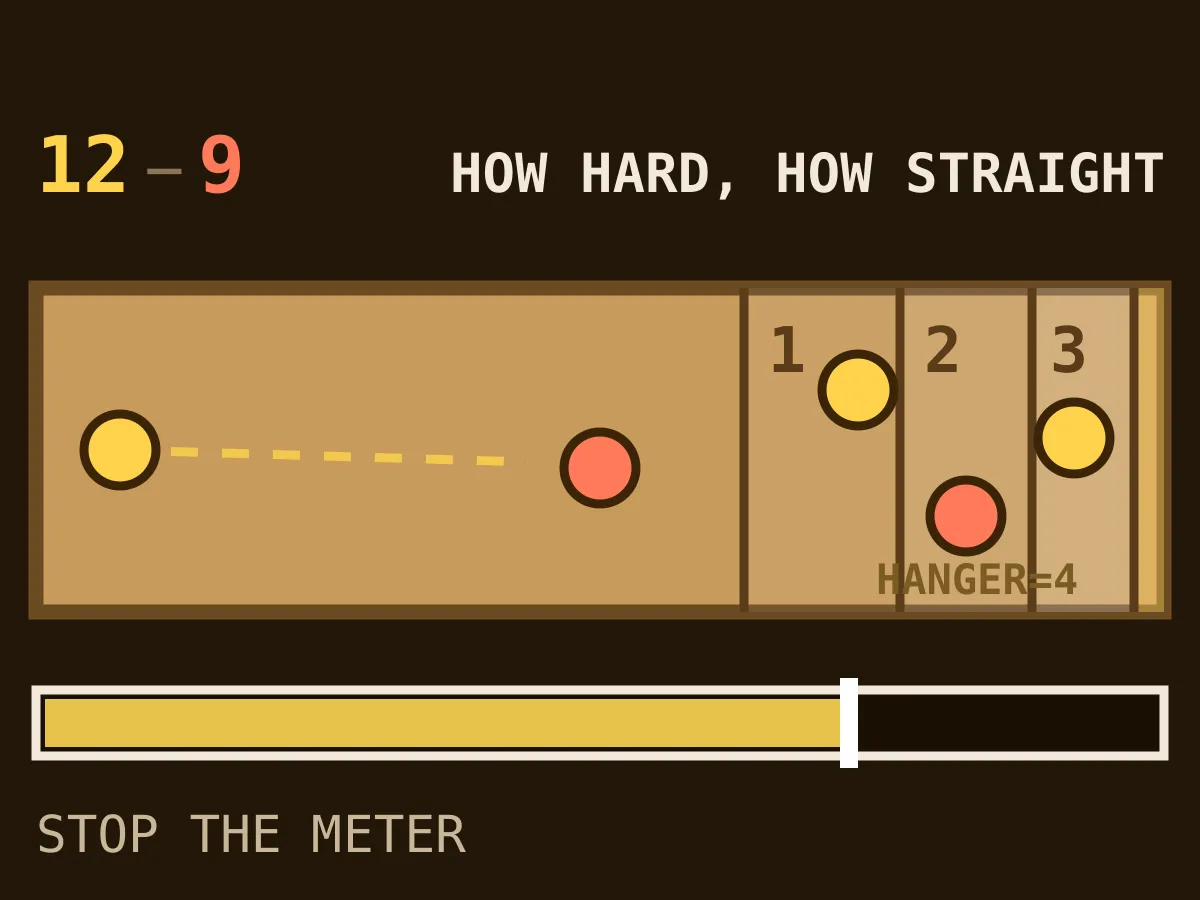


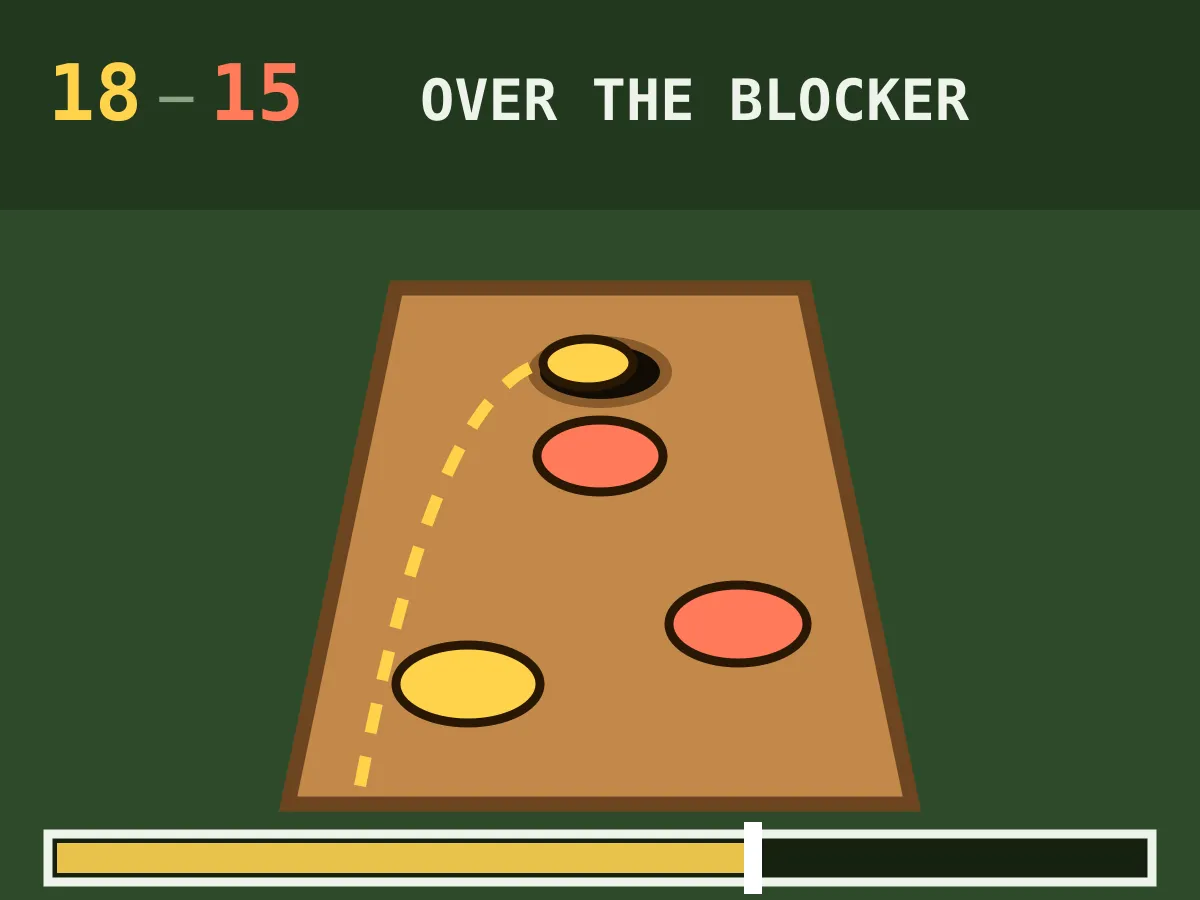


Shuffleboard is a free online table shuffleboard game that runs in your browser with no download and no account. It is the bar-room table, not the deck game: twenty-two feet of polished board with scoring zones at the far end, and a weight you slide down it. A shot is two numbers and nothing else. How hard, set by stopping a sweeping meter, and how straight, set on a slider before you start. Everything after that belongs to the board. The zones pay one, two and three, and past the last line — still on the board, hanging over the end — is four. That last one is the whole tension of the game, because the band that holds it is about three hundredths of the meter wide and a fraction more takes the weight clean off the end for nothing. Only one side scores a frame: whoever is lying nearest the end, counting every weight of theirs beyond the other side’s best. So one well-placed weight in front is worth more than three good ones behind it, and the answer to a weight sitting in the three is to knock it out — which sends it on and leaves yours close to where it struck it. Every board also has a bank in it, a sideways pull that grows the longer a weight is on there, so a soft shot drifts further off line than a hard one and the aim slider is how you cancel it. Six opponents, and what separates them is how near their shot lands to the one they meant to play. First to fifteen.
How to play Shuffleboard
- A shot is two numbers. Set the aim on the slider first, then press to start the power meter and press again to stop it.
- The meter sweeps up and back, so there is no rushing it — the whole shot is choosing the moment.
- The zones at the far end pay one, two and three. Past the last line and still on the board is a hanger, worth four.
- The hanger band is narrow. A fraction too much and the weight runs off the end for nothing, which is why it is a decision rather than a default.
- Only one side scores a frame: whoever is lying nearest the end. They then count every weight of theirs that is beyond the other side’s best one.
- That is why a single weight placed in front is worth more than three good ones behind it — it cuts all of them out of the count.
- To move a weight that is in your way, hit it. A knock sends the one in front on and leaves yours close to where it caught it.
- Every board has a bank in it: a sideways pull that builds the longer a weight is sliding. A soft shot drifts further off line than a hard one.
- Use the aim slider to lean against the bank. The dotted line on the board shows the line you have set.
- Four weights each a frame. Whoever did not score shoots first in the next one.
- First to fifteen. Beat an opponent to unlock the next, and progress is kept in your own browser.
Tips
- Learn the board before you go for anything. The first frame is worth spending on finding out which way it pulls and how far.
- Lay one up in the two before you try the three. A weight in front does more work than a weight further down, because of how the counting works.
- The hanger is not a shot to take when you are ahead. Losing the weight for nothing gives them a free frame.
- When they are lying in the three, hitting it is usually better than trying to get past it — your weight ends up in front and theirs ends up gone.
- A soft shot drifts more, so if the board pulls hard, a firmer weight into the two can be straighter than a delicate one into the three.
- Watch what the bank does to their shots as well as yours. They read it better the higher up the ladder you go, and that is most of what makes them hard.
FAQ
Is Shuffleboard free to play?
Yes. It runs in your browser with no download, no plugin, no sign-up and nothing to buy. The first opponent is open straight away and the rest unlock by winning.
Is this the deck game or the table game?
The table game — the twenty-two foot bar-room board with a polished surface and scoring zones at the end. There are no cues and no triangles on the floor: you slide the weight with your hand, and the only inputs are how hard and how straight.
Why did I score nothing when I have three weights in the zones?
Because only the side lying nearest the end counts, and then only the weights beyond the other side’s best one. A single weight of theirs further down cuts out everything you have behind it — which is exactly why placing one in front matters more than piling them up.
What is a hanger?
A weight past the last line that is still on the board, hanging over the end. It is worth four, one more than the three-point zone, and the band that holds it is about three hundredths of the power meter wide. A fraction too hard and it is gone for nothing.
Why does my weight keep drifting to one side?
Because the board is not level. Every table here has a bank in it, and the pull builds the longer the weight is sliding, so a soft shot ends up further off line than a hard one. The aim slider is there to lean against it.
How do the opponents get harder?
Their hand gets steadier — their shot lands nearer the one they meant to play — and they read the bank better. What does not change is how often they attack: that was tried as a second axis and measured backwards, because an opponent that attacks more spends its best shots running four-pointers off the end.
How long is a match?
First to fifteen, which is usually five to eight frames of four weights each and a few minutes. A frame can be worth anything from nothing to seven.