





Home / Sports / Cycling Sprint
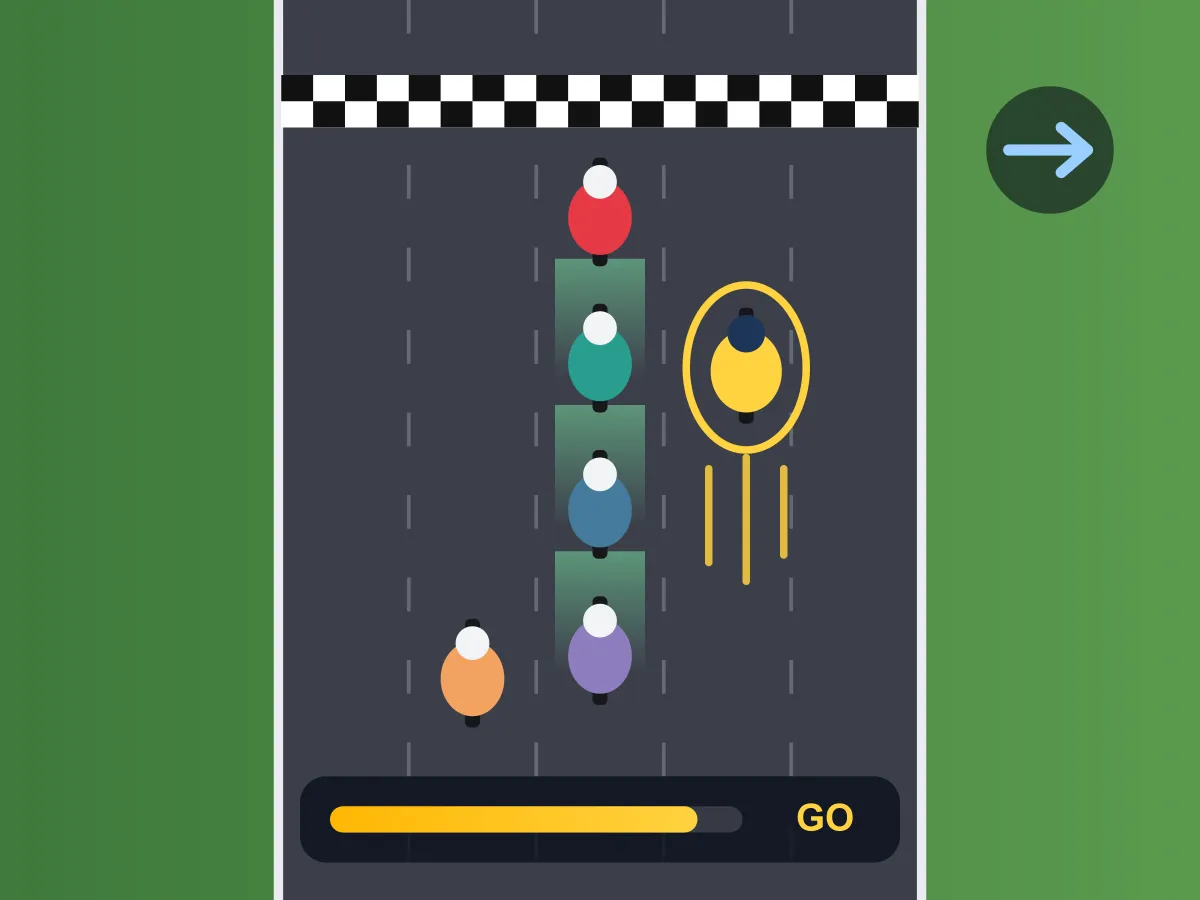
Cycling Sprint is a free online road cycling game about racing tactics rather than pedalling fast. You ride a stage in a bunch of rivals on a seven-lane road seen from above. Tuck in behind another rider and the air he pushes aside is air you do not have to: your reserve refills while you sit on his wheel, and drains when you ride in the wind. In a crosswind the shelter moves one lane downwind, the bunch fans out across the road, and whoever is left over in the gutter gets dropped. Riders attack, some strong enough to stay away, some not; you choose whom to follow. And at the end there is the sprint: a full effort lasts only a few hundred metres, the sprint-reach gauge says how many, and the stage goes to whoever launches at the right moment from the right lane. Eight stages — flat, windy, hilly and a mountain-top finish — no download, no sign-up.
How to play Cycling Sprint
- Press Ride. The stage runs four times faster than real time until the last 1.2 km, which is played in real time; an attack slows it to twice for a few seconds so you can answer it.
- Steer between the seven lanes with ← and →. The green glow behind each rider is the shelter: sit in it, a wheel behind somebody, and the Shelter gauge fills. Out of it you are in the wind.
- Choose your effort with ↑ and ↓. Easy lets you drift back. Ride is the gear you race in: it holds the wheel directly in front of you, but never goes much past your steady limit, so when that wheel accelerates hard a gap opens. Hard closes gaps and makes attacks, and drains your reserve fast.
- Watch the Reserve bar. Any effort above your steady limit drains it; riding below it, especially in shelter, refills it. Empty it and you crack: you can only crawl until a third of it comes back, and the bunch rides away.
- In a crosswind — the blue stretches on the stage strip, and streaks across the road — the shelter is one lane downwind of the rider ahead, not straight behind, and the road runs out of lanes. The hint line warns you 600 m before one starts: move up to the front group before it does.
- When a rider attacks, a banner shows how strong the move is. A strong move can stay away to the line if nobody goes with it; a weak one fades and is caught. To follow, shift to Hard, get onto the attacker’s wheel, then back to Ride.
- The Sprint reach gauge shows how far a full sprint from your reserve would carry you. When the line comes inside it, the gauge says GO: move to a lane with nobody in front of you and hold Space to the line. Win the stage for three stars, make the podium for two, finish in the top third for one; a star unlocks the next stage.
Tips
- Ride is enough most of the time. Get behind a wheel with ← →, stay on Ride, and let the gear hold the gap for you; use Hard only when a gap has opened.
- Sprint from a free lane. Launch straight into the back of the rider in front and you are stuck behind him at his speed — move over first, then hold Space.
- The reach gauge counts the whole sprint, including the last metres on an empty tank. Going at half of it lets the others come past; going at twice it empties you with far too far still to go.
- Answer the strong attacks, not all of them. Chasing every move burns the reserve you need for the finish.
- Before a crosswind, move up. Once it starts, the riders at the front take the shelter across the road, and anyone behind the last of them is riding alone.
- On the climbing stages the shelter is worth much less — the speed is too low for the air to matter much. There, riding the short climbs hard near the front can drop the sprinters before the finish.
- Race again keeps the same field and the same attacks, so you can learn a stage. New field draws different rivals and different moves.
FAQ
Is this cycling game free to play?
Yes. Cycling Sprint runs free in your browser with no download, no install and no account, on a computer, tablet or phone.
How do I win a stage?
Save your strength and spend it at the end. Sit in the wheels so your reserve stays full, follow only the attacks that are strong enough to matter, move up before crosswinds and in the last kilometre, and launch your sprint from a free lane when the line comes inside your sprint reach. The quickest-handed test riders who played that way made the top third on every stage at least half the time and won every stage at least one race in five; slower hands still won every stage at least one race in ten.
What is drafting, and why does it matter here?
A rider pushes the air aside, and a rider a wheel behind him rides in the hole he leaves. In this game a rider tucked in directly behind another needs a little over half the power for the same speed, and a second rider ahead saves a little more. That saving is your reserve: sheltered, it refills; in the wind, the same speed drains it. A test rider who rode in the wind at the front all day never earned a star on the headwind or crosswind stages, and on the calm first stage made the top third in only about one race in five and never won.
When should I start my sprint?
When the line comes inside your sprint reach — the gauge turns to GO. A full sprint lasts only as long as your reserve, so the reach shrinks the more you spent getting there. Test riders who launched on the reach finished well ahead of the same riders launching at half of it or from a fixed 150 m, which let the others come past; launching at twice the reach was no better either.
What happens in a crosswind?
The wind blows across the road, so the shelter is no longer straight behind the rider ahead but one lane downwind of him. A line of riders becomes a diagonal across the road, and once it reaches the edge there is nowhere left to hide: the riders behind it ride in the wind, lose contact and the race splits. Be near the front before the crosswind starts; the game warns you 600 m ahead.
Should I follow every attack?
No. The banner shows how strong each move is. A strong move can stay away to the line if you let it go; a weak one runs out of strength and is caught. Chasing costs reserve, so follow the strong ones and let the rest go. A test rider who never answered an attack and always sprinted from 200 m finished a long way behind one who picked the right moves.
What if I just go flat out from the start?
You pull the whole bunch along in the wind, your reserve runs out long before the finish, and everybody who sat on your wheel rides past you. A test rider who rode Hard from the start and sprinted from 400 m never earned a star on any stage in any of its test races, and a rider who touched nothing at all never earned one either.
Are the climbing stages different?
Yes. Uphill the speed is low, so the air — and the shelter from it — matters much less, and a light rider’s climbing power matters more. There, riding the short climbs hard near the front is a real tactic: it drops the sprinters before the line. On the mountain-top finish, pace yourself on the wheels and keep the reserve for the last few hundred metres.
How many stages are there?
Eight: a calm canal road, a headwind coast road, rolling hills, a crosswind polder, a late climb, an echelon classic with crosswinds and attacks together, a mountain-top finish and a grand finale that has a bit of everything against the strongest field. A star on one stage unlocks the next.
Can I play on my phone?
Yes. Five pads sit under the road — lane left, ease, sprint, push and lane right; hold Sprint with your thumb. On an upright phone the road fills a taller frame with the gauges under it; held sideways, the two lane pads and Ease move to the left of the road and Push and Sprint to the right.
Is it the same race every time?
Race again from the result card and it is the same field, the same attacks at the same places and the same rivals’ launch points, so you can learn a stage. New field draws different riders and different moves. How you ride is always your own.