



Guandan is a free online version of the four-player Chinese partnership card game, played in the browser against three computer players with no download and no account. Two full decks are used — 108 cards, four jokers — and everyone is dealt twenty-seven. You sit opposite your partner and play as a team against the pair to your left and right. What separates Guandan from every other shedding game is that you are not playing for points but for levels. Your partnership starts at 2 and climbs toward the ace, and getting past the ace wins the match. How far you climb depends on where both of you finish: first and second together is three levels, first and third is two, first and last is one. That is why a deal is never dead — your partner coming second is worth as much as a comfortable win of your own. Two more rules make the game its own thing. Whatever your team’s current level is, that rank is promoted above the ace and sits just below the jokers, so at level 7 a seven is the highest ordinary card on the table — and it goes back to being a seven the moment the level moves on. And the two hearts of the current level rank are wild: they stand in for any card except a joker, which means the same five cards in your hand can be three different combinations depending on what you decide the wild ones are. Bombs run in eight tiers here rather than two, with a straight flush sitting between the five-card and six-card bombs. Six tables of opponents run from a home game that hoards its wildcards to a national final that spends them exactly when it should.
How to play Guandan
- Two decks are dealt out between four players, twenty-seven cards each. You are at the bottom; the player opposite you is your partner, and the two at the sides are the opposing pair.
- Lead any legal combination. Everyone else must play the same shape but higher, or pass. When everyone still holding cards has passed, the trick is over and whoever played last leads the next one.
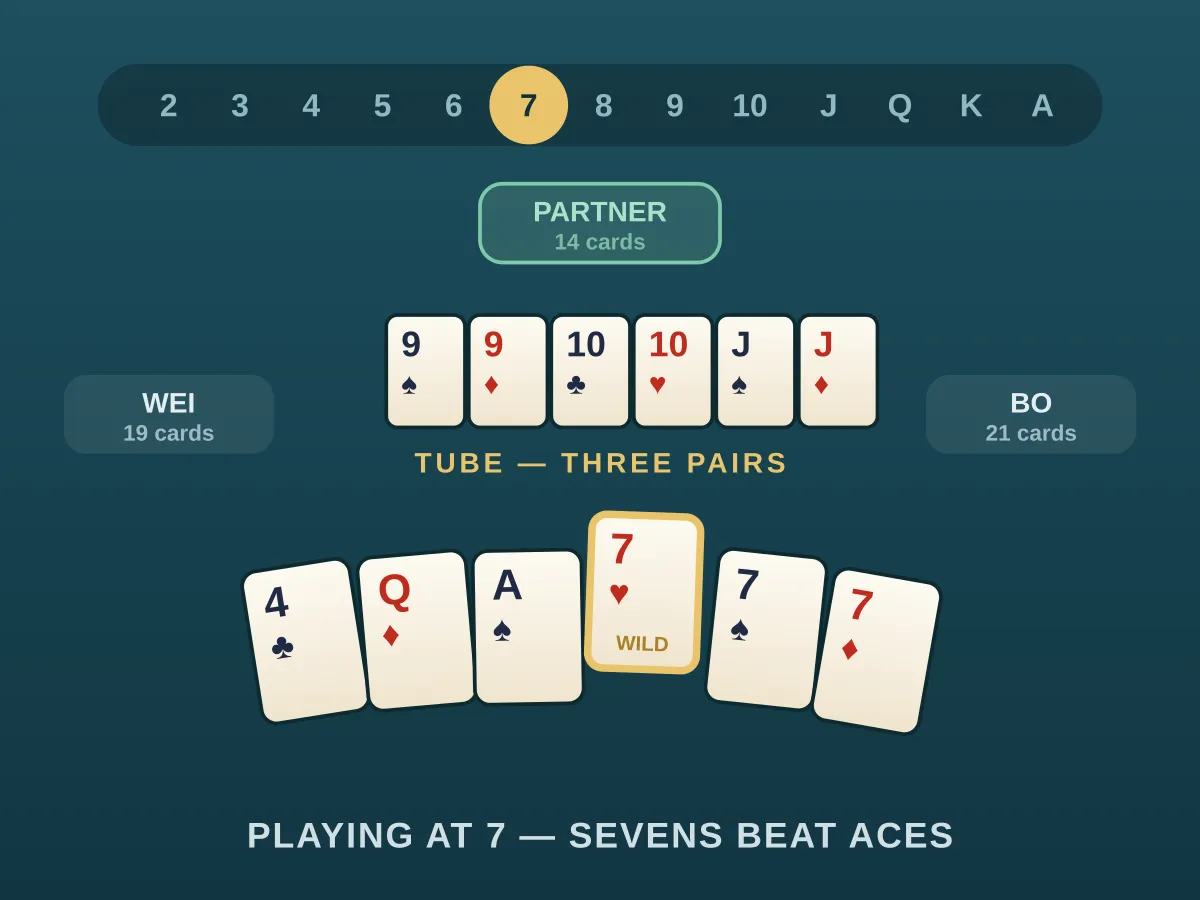
- The shapes are: a single; a pair; three of a kind; a full house (three plus a pair); a straight of exactly five; a tube, which is three consecutive pairs; and a plate, which is two consecutive trios.
- Your team has a level, starting at 2. Whatever that level is, that rank jumps above the ace and sits just below the jokers. At level 7 a single seven beats a single ace — and stops doing so as soon as your level moves on.
- Inside a straight, though, the level rank keeps its ordinary place. At level 7, 5-6-7-8-9 is still a plain run from the five.
- The two hearts of the current level rank are wild. They can stand in for any card except a joker, so they turn a pair into a trio, a trio into a bomb, or fill the gap in a straight. They are outlined in gold in your hand.
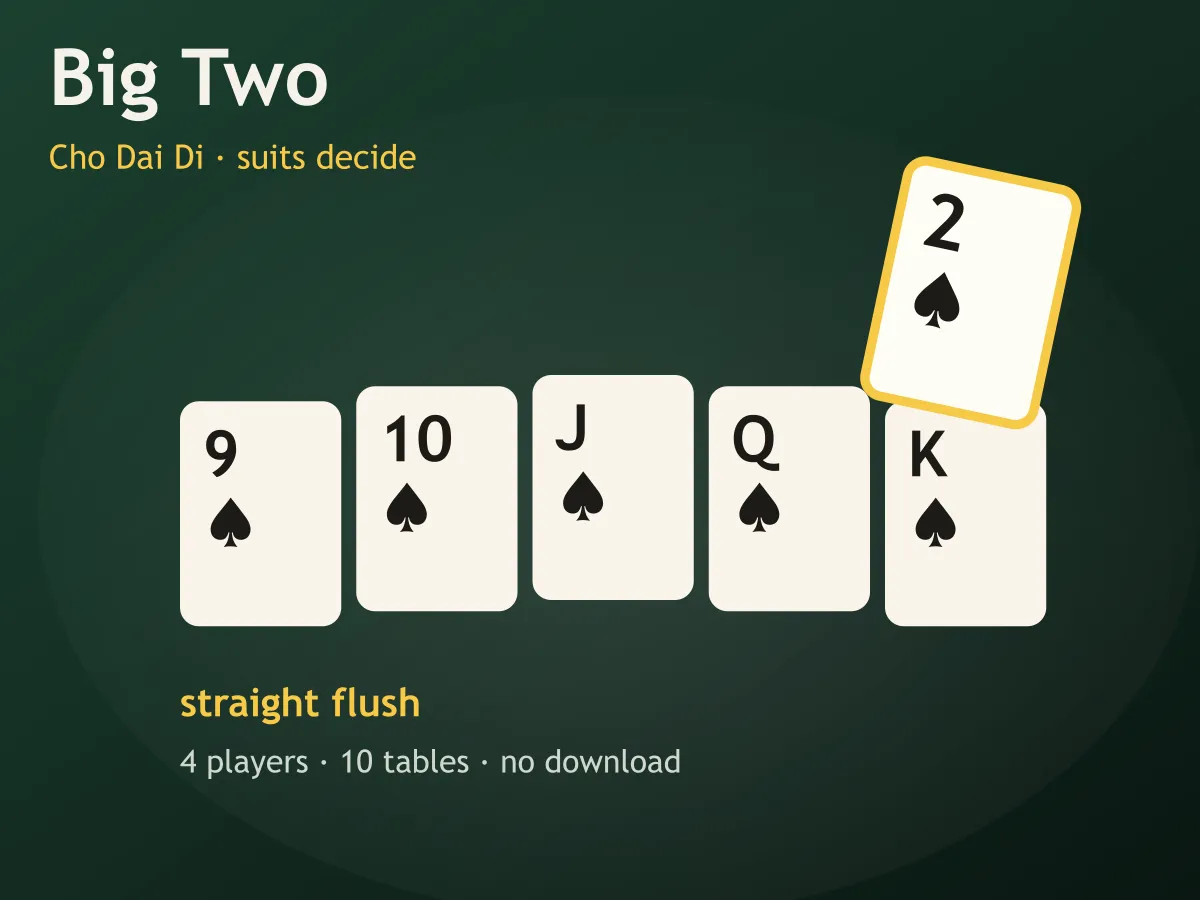
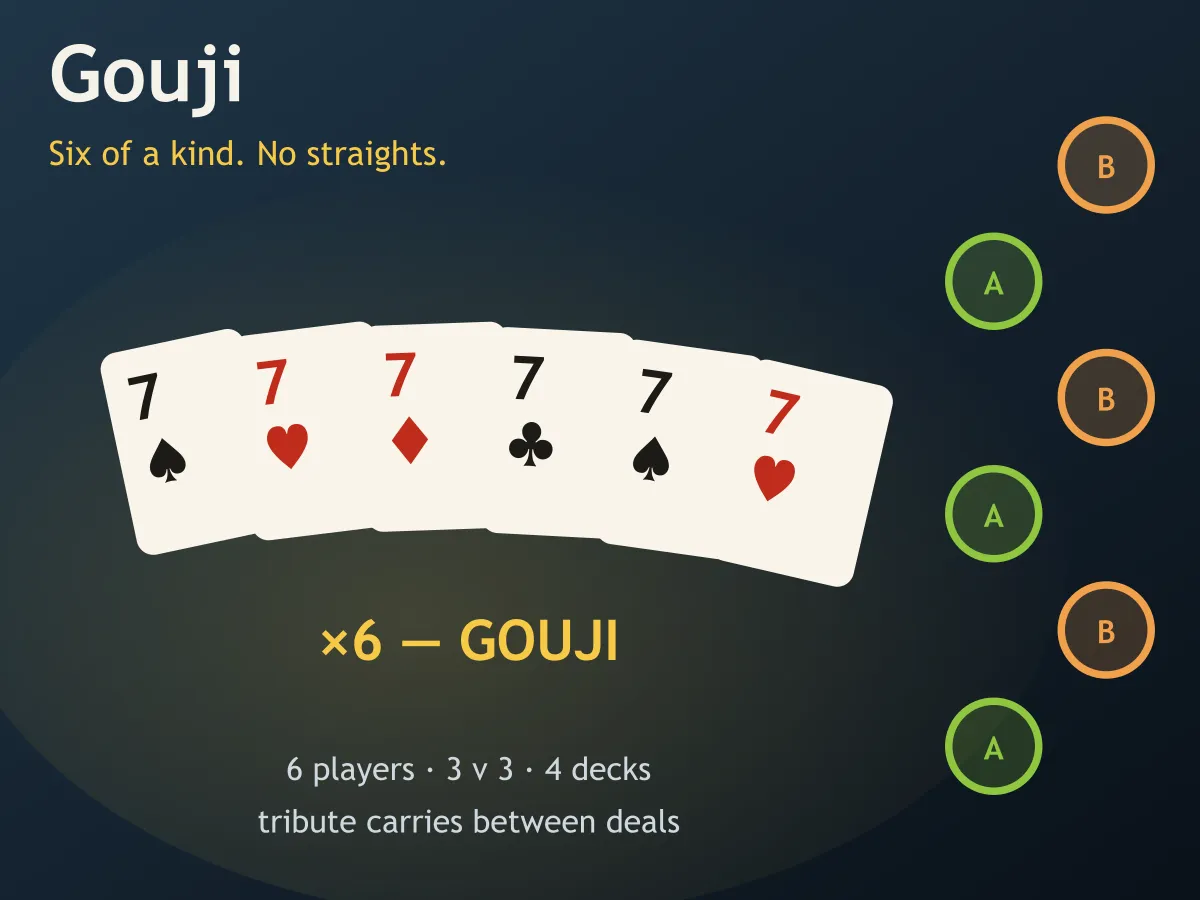
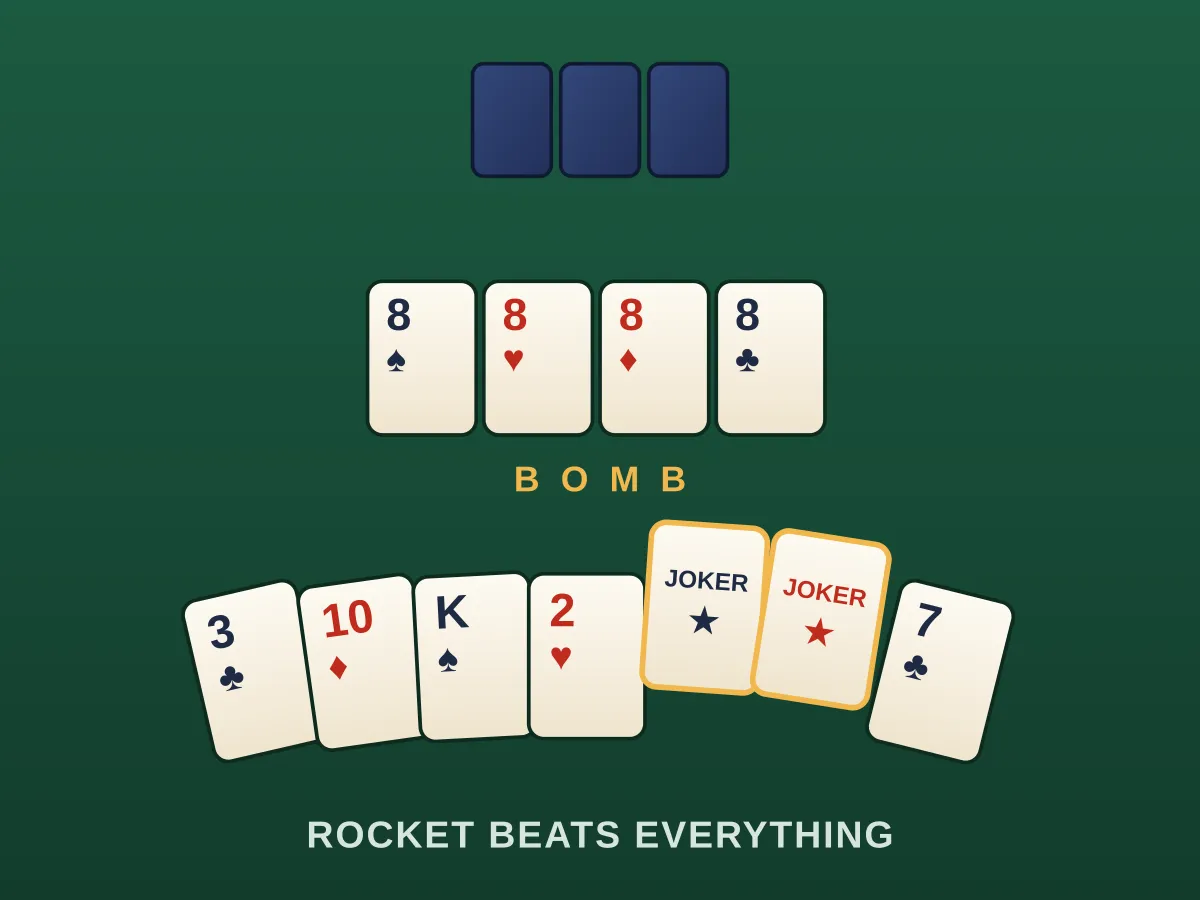
- Bombs beat any ordinary shape. There are eight tiers: four of a kind, then five, then a straight flush, then six, seven and eight of a kind, and finally all four jokers, which nothing beats.
- The straight flush sits between the five-card and six-card bombs. That is not an approximation — it is where the rules put it.
- Whoever empties their hand first ends up deciding the score. If you and your partner finish first and second your team climbs three levels; first and third climbs two; first and last climbs one.
- The next deal is played at the level of whichever team just climbed. Getting past the ace wins the match.
- Tap cards to select them and press Play. Hint picks the cheapest legal answer, and deliberately never suggests spending a wildcard while an ordinary play exists.
Tips
- Do not sit on your wildcards. A wildcard still in your hand when the deal ends bought you nothing, and the two easiest tables lose games precisely because they hoard them — you can watch it happen.
- The best use of a wildcard is almost always a bomb. Turning three of a kind into four is a much bigger swing than turning a pair into a trio, because bombs cut across shape entirely.
- Watch what the level rank is doing to your hand. At level 10 your spare tens are suddenly the best singles on the table; at level 3 they are back to being tens. A hand that looks weak can be strong purely because of what your team is playing at.
- Help your partner go out. Second place is worth a whole extra level, so passing a trick your partner leads costs you a card and gains you a level — that trade is the core of the game.
- Count the opposing pair’s cards, not just the leader’s. When either of them is down to one or two you have to take the lead whatever it costs, because a single seat going out first sets the whole score.
- Long shapes get harder to place as the deal goes on. Lead your tubes and plates early while people still have the cards to answer, and keep singles for the endgame where they are cheap to shed.
- Do not spend a bomb to win a trick you did not need. There are eight bomb tiers here, which means a bomb you play can very often be beaten — losing one and the trick is much worse than passing.
- If you are stuck, Hint will tell you plainly when nothing in your hand can beat what is down. That is a genuine answer in this game, not a failure.
FAQ
Is Guandan free to play?
Yes. It runs in your browser with no download, no sign-up and nothing to buy. All six tables of opponents are here and unlock as you win matches.
What is the level rank and why does a seven beat an ace?
Each partnership has a level, starting at 2 and climbing toward the ace. Whatever your level is, that rank is promoted above the ace and below the jokers for the whole deal — so while you are playing at level 7, a seven is the highest ordinary card in the game. When your level moves on, it goes back to being a seven. It is the rule that makes every deal feel different from the last.
Which cards are wild?
The two hearts of the current level rank. At level 7 that is the two 7 of hearts in the double deck. They can stand in for any card at all except a joker, so they complete pairs, trios, bombs and straights. They are outlined in gold in your hand so you never have to work out which they are.
How is this different from Dou Dizhu?
Almost entirely, despite the family resemblance. Guandan has four players in two fixed partnerships rather than three with one against two, two decks rather than one, wildcards, a promoted level rank, and eight bomb tiers instead of two. Above all it is scored in levels rather than points, so finishing second matters and no deal is ever worthless.
How do I win the match?
By getting your partnership past the ace. You start at level 2 and climb one, two or three levels per deal depending on where you and your partner finish — first and second together is three. Whichever team gets past the ace first wins the whole match.
Does the level rank count as high inside a straight too?
No, and this is the detail most versions get wrong. The promotion applies to the card as a card, not to its place in a sequence. At level 7 a lone seven beats a lone ace, but 5-6-7-8-9 is still an ordinary straight from the five.
What beats a straight flush?
A six-card bomb, a seven-card bomb, an eight-card bomb, or all four jokers. The straight flush is stronger than a five-card bomb and weaker than a six-card one — it sits inside the bomb ladder rather than above or below it.
Does it work on a phone?
Yes. A twenty-seven card hand fans and overlaps to fit the width of the screen, the three opponents sit around the centre in the same positions they would at a real table, and tapping a card selects it exactly like clicking.