
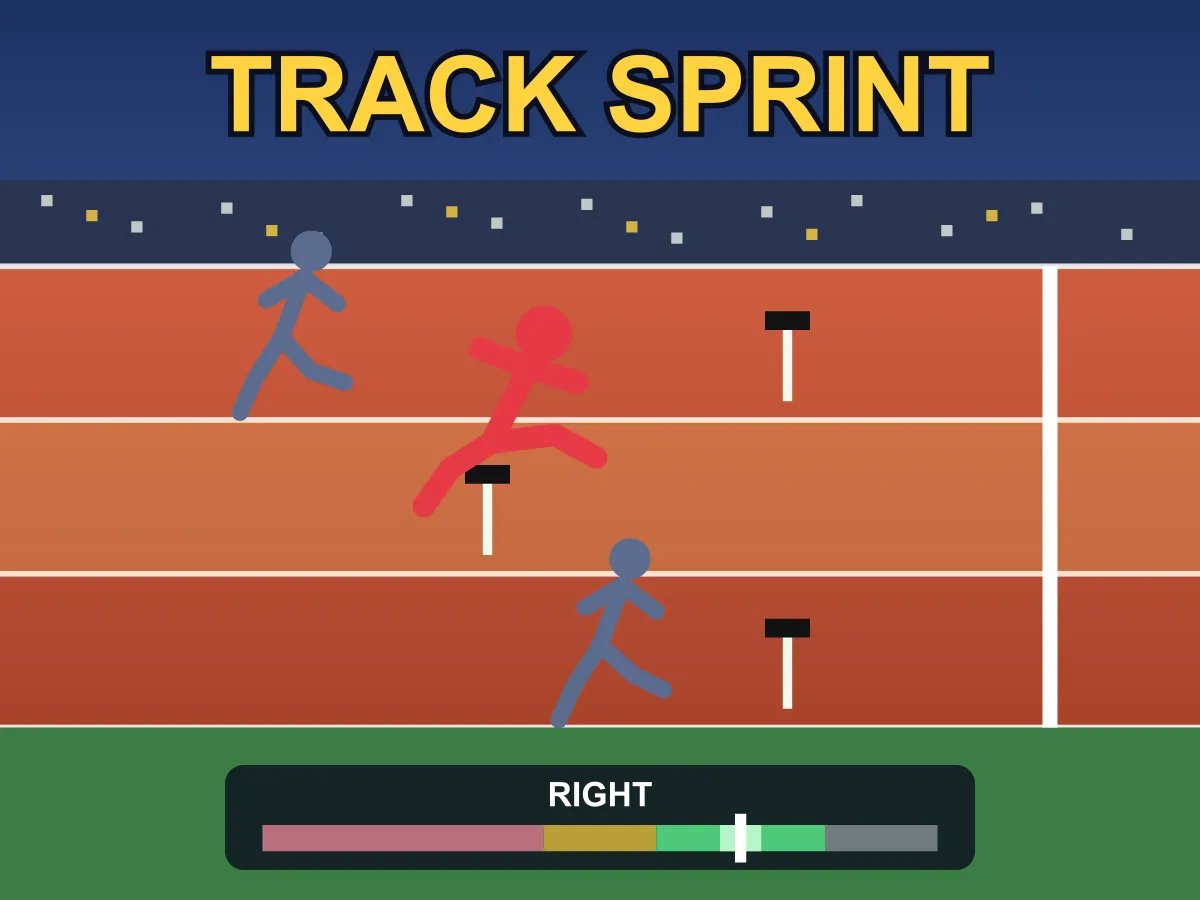
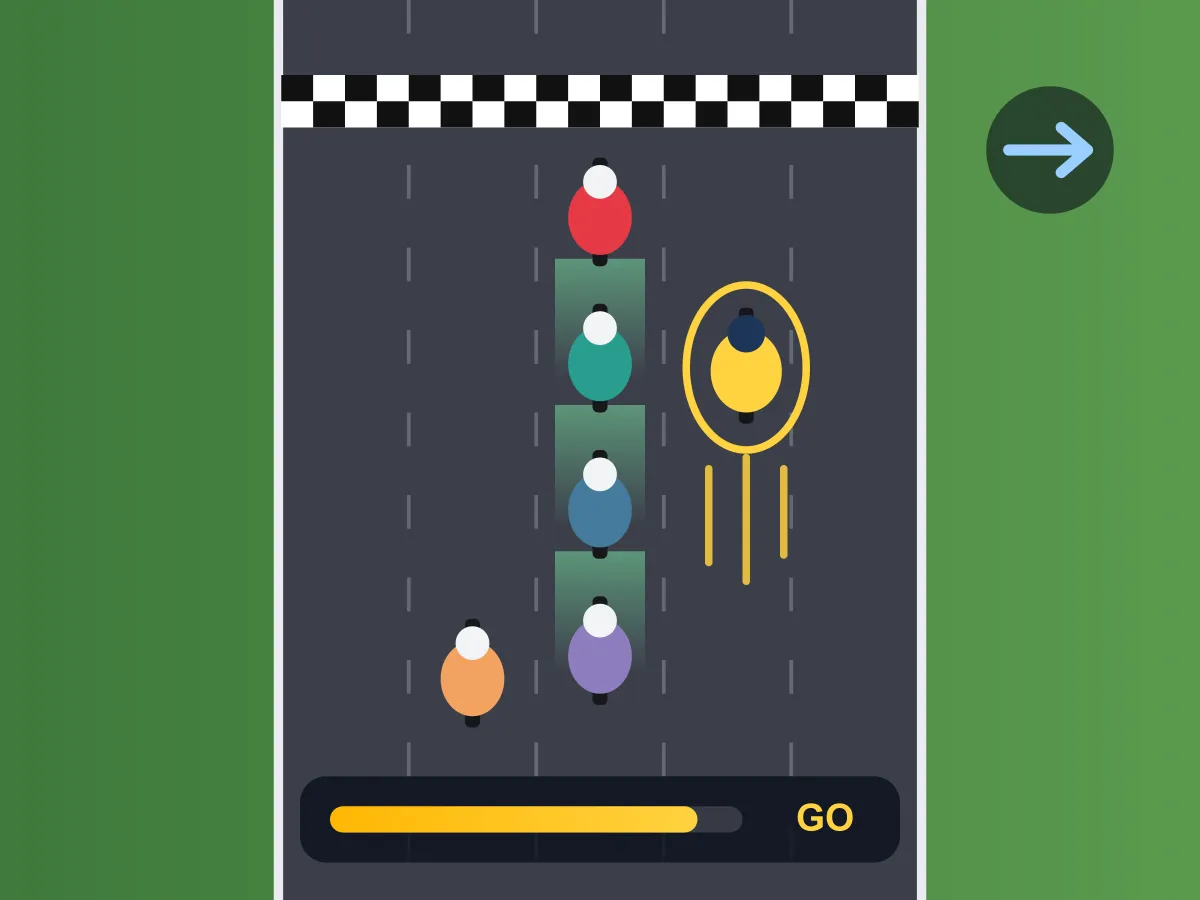






Track Sprint is a free online track and field game where speed comes from rhythm, not from pressing faster. Alternate the left and right foot keys, and put each foot down as the stride meter reaches its green band: a stride on the beat drives you towards top speed, one pressed early is a stutter that scrubs speed off, and the same foot twice is a stumble. The beat quickens as you speed up. Each event adds one skill: go on the gun without a false start in the 100 m, take off about two metres before each of ten hurdles, and hit the long jump board and hold for the angle. Results score on the decathlon points tables, and medals against the rivals earn the stars across eight meets. No download, no sign-up — keyboard, mouse or phone.
How to play Track Sprint
- Press To the blocks, or any control, to start the first event. Every meet is three events in order: the 100 m, the 110 m hurdles, then three long jumps where the best one counts.
- Wait for the gun. The starter calls on your marks, then set, then fires after a pause that changes every time. A foot pressed before the gun, or within a tenth of a second after it, is a false start. At the first four meets the first one is a warning; from the National Championships on it puts you out of that event.
- Run on the beat. Press left (← or A) and right (→ or D) in turn, each as the marker on the stride meter reaches the green band. The light green centre is a perfect stride. Early, in the red, is a stutter that loses speed; late, in the grey, you coast and slow down; the same foot twice is a stumble.
- Hurdles: keep the stride beat and press Space (or ↑, or the Jump pad) about two metres before each of the ten barriers. Too close or too far clips it and slows you; no jump at all runs into it.
- Long jump: run up on the beat and press Space as you reach the white board. The jump is measured from the foul line, so every centimetre behind it is lost, and over it is a foul. Keep Space held to lift the angle and let go near 21 degrees.
- Each time or distance scores on the decathlon points tables. Beat the rivals in the other lanes for gold, silver or bronze: 3 medal points for gold, 2 for silver, 1 for bronze. Three medal points earn one star and unlock the next meet, six earn two stars and eight earn three.
Tips
- Watch the meter, not your fingers. The right moment is not a fixed count: the first strides out of the blocks are long and slow, and the beat quickens as you reach top speed.
- Just early and just late cost the same, but the far ends do not: a foot put down far too early is a stutter that also loses speed at once, while one far too late only coasts. If you are unsure, wait for the green.
- Do not guess the gun. The pause after set is different every race, and a reaction under a tenth of a second counts as a false start even if you pressed after the bang.
- After each hurdle either foot can lead, and the first stride after landing always counts as on the beat — so put a foot down straight away, then keep the rhythm from that stride.
- On the long jump, aim a little behind the board rather than exactly on it. A foul scores nothing, while ten centimetres behind the line only costs ten centimetres.
- Let go of the angle early rather than late: the gauge rises at fifty degrees a second, so the green band around 21 degrees lasts about a sixth of a second.
- Losing a meet on medals? Run it again with the same field to learn it, or draw a new field of rivals from the result card.
FAQ
Is this track and field game free to play?
Yes. Track Sprint runs free in your browser with no download, no install and no account, on a computer, tablet or phone.
Why does pressing the keys faster not make me run faster?
Because a stride only drives you forward when it lands near its right moment, shown by the green band on the stride meter. A foot put down early is a stutter that loses a little speed, so pressing as fast as possible makes almost every stride a stutter: a test runner doing that took more than twice as long over 100 m as one on the beat, and never won a single medal at any meet, even with a perfect start and perfect take-offs.
What counts as a false start?
Any foot or jump pressed before the gun, and any reaction quicker than a tenth of a second after it — the same limit real starting blocks use. At the first four meets the first false start is a warning and the race is restarted; the second puts you out of the event. From the National Championships on, the first false start puts you out.
When should I jump a hurdle?
About two metres before it. A take-off between roughly 1.6 and 2.6 metres in front of the barrier clears it cleanly. Closer or further clips it and costs a quarter of your speed, and not jumping at all runs into it and costs more than half. A jump with no hurdle in reach is a wasted hop.
How is the long jump measured?
From the front edge of the white board, the foul line. Take off behind it and the gap is lost from the jump; take off over it, or run through the pit without jumping, and the jump is a foul with no mark. Hold the jump key to raise the take-off angle and let go near 21 degrees, which flies furthest. You get three jumps and the best one counts.
How are the points and stars worked out?
Every time and distance is scored on the decathlon points tables, so 10.00 seconds in the 100 m is 1,096 points and 7.76 metres in the long jump is 1,000. Medals come from beating the rivals in each event, and stars from medal points: gold 3, silver 2, bronze 1, so three, six and eight of the nine possible earn one, two and three stars.
How do I get three stars at the later meets?
By landing your strides evenly on the beat. The fields were set with test runners that differ only in how evenly they hit it: one within about two hundredths of a second earned three stars at every meet in at least seven tries out of ten, one about three and a half hundredths off stopped earning three stars reliably from the Regional Championships on, and pressing to a steady count instead of watching the meter stopped earning three stars reliably from the Continental Championships on.
How many meets are there?
Eight, from a School Sports Day with four classmates to a World Final. Each one has a stronger field of rivals, and the first false start stops being a warning from the fifth meet on. A star at one meet unlocks the next.
Can I play on my phone?
Yes. Three pads sit under the track — Left, Jump and Right — so tap left and right with two thumbs and press Jump for the hurdles and the long jump, holding it for the angle. It works upright or sideways.
Is it the same race every time?
Run it again from the result card and it is the same field of rivals with the same marks and the same pauses before the gun, so you can learn it. New field draws different rivals and different pauses. Your strides are always your own.