


Home / Board / Resource Island
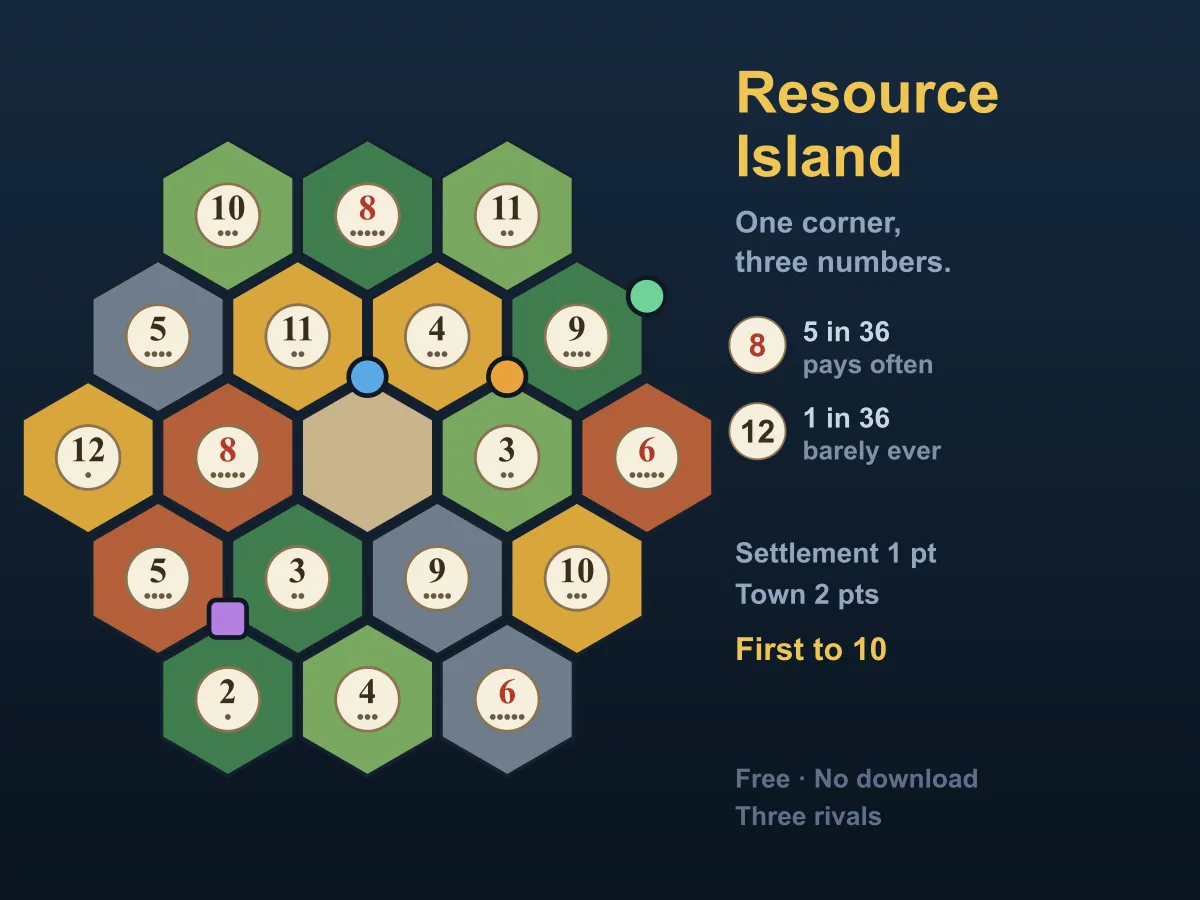
Resource Island is a free online settlement-building board game for one player against three computer settlers, first to ten points. The island is nineteen hexagonal tiles, each producing one of five goods and carrying a number from two to twelve. Two dice are rolled every turn, and every settlement standing on a corner of a matching tile pays out. Because each corner touches up to three tiles, choosing where to build is choosing three numbers at once — and the numbers are not equal. An eight comes up five times in thirty-six and a twelve comes up once, so the board prints the odds under every number as dots rather than leaving you to feel for them. A settlement is one point and costs a spread of four different goods; upgrading it to a town is a second point, pays double for ever after, and costs grain and stone instead. The one structural rule is distance: no two settlements may sit on neighbouring corners, anybody's, so taking a good corner also denies its neighbours. Trading and the robber are deliberately gone — four-way haggling has no good single-player shape, and a robber mostly means being told you lost a turn. In their place a roll of seven costs anyone holding more than seven goods half of them, which still punishes hoarding, and a market converts four of any good into one of any other, so a bad run of dice is survivable without another player to bargain with. The seating is drawn fresh for each island, because a fixed order measurably hands the game to one seat.
How to play Resource Island
- Press Play. Everyone places two opening settlements, going down the seating and back up it, so settling last is not a punishment.
- Tap a corner to settle. The dots under each number show how often two dice make it — five dots is an eight, one dot is a twelve.
- A corner touches up to three tiles, so a settlement collects from all three. That is the whole of the board game: one choice, three numbers.
- No two settlements may sit on neighbouring corners, anybody's. Taking a good corner also takes its neighbours out of the game.
- Your second settlement pays out immediately, so it is usually picked for the goods you are short of rather than for the biggest numbers.
- On your turn, roll the dice. Every settlement on a tile carrying that number pays its owner one of that good; a town pays two.
- A settlement costs one each of timber, clay, grain and wool, and is worth one point.
- A town costs two grain and three stone, replaces one of your settlements, and is worth two points as well as double production.
- Four of any one good buys one of any other at the market, which is how you dig out of a bad run of dice.
- A roll of seven pays nobody, and anyone holding more than seven goods loses half of them — so do not sit on a huge hand waiting for the perfect build.
- First to ten points settles the island.
Tips
- Read the dots, not the numbers. A corner touching 6, 5 and 9 collects on fourteen of the thirty-six rolls; one touching 12, 2 and 3 collects on four.
- Spread your goods on the opening two settlements. A settlement needs four different things, so a corner paying three of one good is worth less than it looks.
- Stone and grain are the town goods, and towns are the fastest points in the game. A board position with no stone at all takes a long time to convert into a win.
- Taking a corner denies its three neighbours to everybody. Against three opponents, a slightly worse corner that blocks a much better one is often the better move.
- Upgrade before you spread. A town doubles a corner you already own, costs no timber or clay, and is two points rather than one.
- Keep your hand under eight. A seven costs half of everything above that line, and over a long game that is more goods than any single bad corner.
- The market is four for one, which is expensive — but four spare wool for the stone that finishes a town is almost always worth it.
- Your seat changes from island to island. Settling first means the best corner; settling last means two picks in a row, and they are worth about the same.
FAQ
Is Resource Island free to play?
Yes. It runs free in your browser with no download, no install and no account.
How do I win?
Reach ten points before the other three settlers. A settlement is one point and a town is two, so ten points is somewhere between five and ten buildings depending on how many you upgrade.
What do the dots under the numbers mean?
How often two dice make that number, out of thirty-six. Six and eight have five dots each; two and twelve have one. It is the single most useful thing on the board and it is printed rather than left to be remembered.
Why can I not build on this corner?
Either something is already there, or one of its neighbouring corners is built on. No two settlements may be neighbours, which is what stops a player taking all three corners of the richest tile.
What does a town do?
It replaces one of your settlements, counts two points instead of one, and collects two goods instead of one every time its numbers come up. It costs two grain and three stone.
What happens on a seven?
Nobody collects, and anyone holding more than seven goods loses half of them, taken from whatever they hold most of. It replaces the robber: it still punishes hoarding, without anybody being told they have lost a turn.
Can I trade with the other settlers?
Not directly — four-way haggling has no good shape with one human at the table. Instead there is a market that gives you one of any good for four of any other, which is deliberately expensive but always available.
Why does my turn order change between games?
Because the seating is drawn from the island's seed. Measured with all four seats played the same way, fixed seating gave the last seat about sixty percent of the wins — two consecutive picks in the middle of the opening draft beat first-and-last badly.